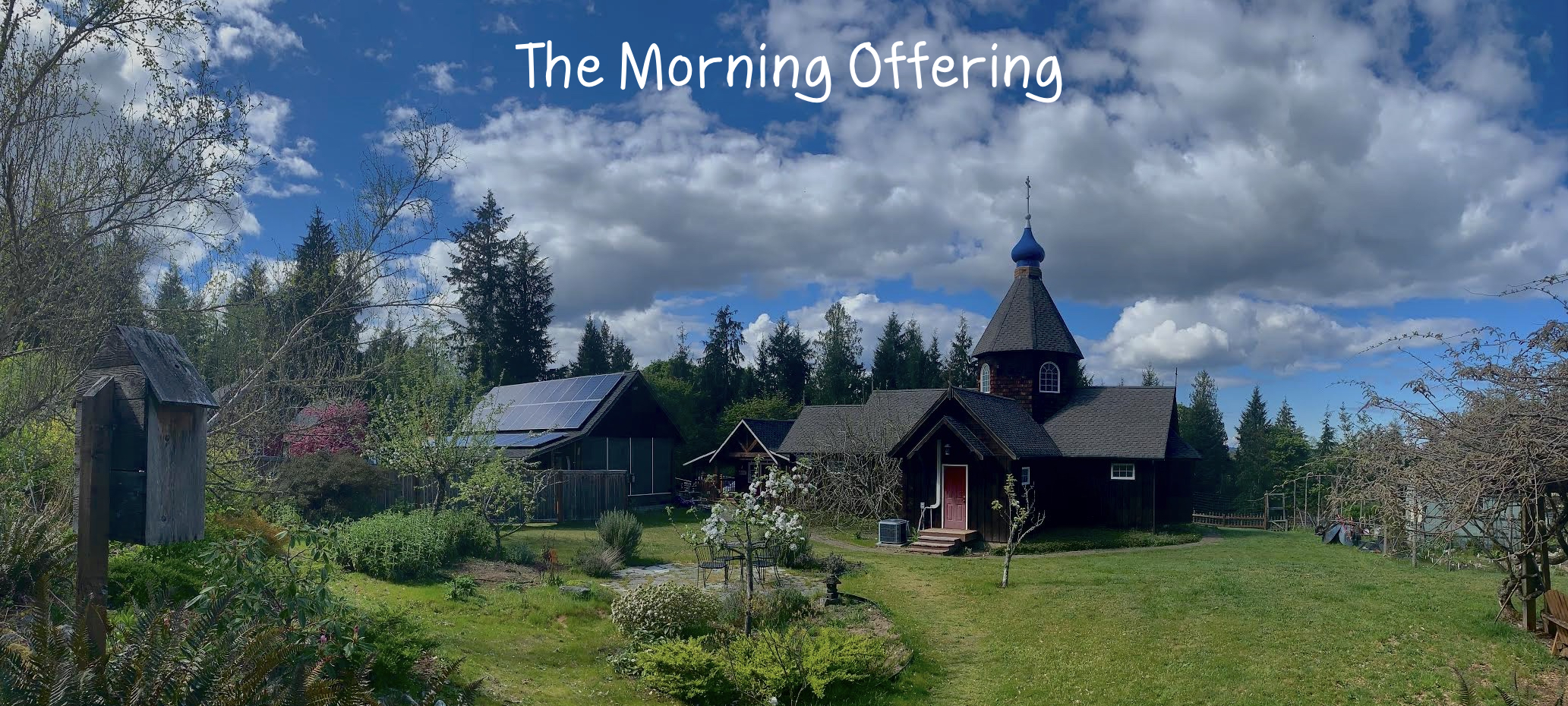
On caring for the environment as good stewards of our world

As Orthodox monks we hold to the importance of respecting the environment, which requires us to be good stewards of what God has given us. An important part of that stewardship is working towards sustainability, based on a simple principle that everything we need for our survival and well-being depends, either directly or indirectly, on our natural environment. When balance is maintained, we can coexist with the environment, rather than fight it.
With our goal of sustainability before us, we maintain bee hives, and grow as much of our own food as we can, always without pesticides. We eat eggs from our happy, free range, Rhode Island Reds. We limit our use of water, keep our thermostats at lower temperatures, and turn off lights when they are not needed. We try as best we can not to waste energy, ever doing our part to giving witness to the importance, as Christians, to take good care of this beautiful world God has given us. Our next goal, with the help of an Orthodox man who works in the solar energy field, will be to install solar panels on many of our southern facing buildings.
As monks we believe it important to leave as little “footprint” as possible, using the natural resources with gratitude before God. We hold to an eucharistic ethos, means that we must use the natural resources with thankfulness, and offer them back to God with gratitude. Such an attitude is, for we Christians, incompatible with wastefulness. As monks, our ascetic practices remind us that even the simplest foods and the simplest comforts, which have been provided for our needs, are gifts from God. They are not ours to be abused or wasted.
With love in Christ,
Abbot Tryphon

Photos: Luke Currier of Duluth, Minnesota, presented a day long Permaculture workshop at the monastery. Nineteen people signed up for the program designed to learn a system of agricultural and social design principles centered around simulating or directly utilizing the patterns and features observed in natural ecosystems, integrating a truly sustainable system that is at its core, Orthodox. Permaculture is a philosophy of working with, rather than against nature; of protracted and thoughtful observation rather than protracted and thoughtless labor; and of looking at plants and animals in all their functions, rather than treating any area as a single product system. In sync with the ecological views of His All Holiness the Ecumenical Patriarch Bartholomew, Luke Currier has become an expert on the subject. Luke is a spiritual son of Abbot Tryphon.

Sunday May 15, 2016 / May 2, 2016
Third Sunday of Pascha: The Myrrh-bearing Women. Tone two.
Sts. Myrrh-Bearing Women, righteous Joseph of Arimathea and Nicodemus (celebration on the 3rd Sunday of Pascha).
Right-believing Tamara, Queen of Georgia (movable holiday on the Sunday of Myrrh-Bearing Women).
Sts. Mary and Martha, sisters of St. Lazarus (1st c.) (movable holiday on the Sunday of Myrrh-Bearing Women).
All Saints of Thessalonica (celebration on the 3rd Sunday of Pascha) (Greek).
New Hieromartyr Seraphim, archbishop of Phanarion and Neochorion (celebration on the 3rd Sunday of Pascha) (Greek).
New Monk-martyr Elias (Ardunis) of Mt. Athos and Kalamata (1688) (celebration on the 3rd Sunday of Pascha) (Greek).
New Martyr Demetrius of Peloponnesus (1803) (celebration on the 3rd Sunday of Pascha) (Greek).
St. Athanasius the Great, archbishop of Alexandria (373).
Translation of the relics (1072 and 1115) of the Holy Passion-bearers Boris and Gleb of Russia, in holy baptism Romanus and David (1015).
St. Athanasius III, patriarch of Constantinople and wonderworker of Lubny (1654).
Martyrs Hesperus, Zoe, and their sons Cyriacus and Theodulus, at Attalia (2nd c.).
St. Boris-Michael, prince of Bulgaria (907).
“Putivl’sk” (1635) and “Vutivansk” Icons of the Mother of God.
St. Athanasius of Syandem and Valaam (1550).
Blessed Basil of Kadom (1848).
St. Jordan the Wonderworker (Greek).
Scripture Readings
Acts 6:1-7
Seven Chosen to Serve
6 Now in those days, when the number of the disciples was multiplying, there arose a complaint against the Hebrews by the Hellenists,[a] because their widows were neglected in the daily distribution. 2 Then the twelve summoned the multitude of the disciples and said, “It is not desirable that we should leave the word of God and serve tables. 3 Therefore, brethren, seek out from among you seven men of good reputation, full of the Holy Spirit and wisdom, whom we may appoint over this business; 4 but we will give ourselves continually to prayer and to the ministry of the word.”
5 And the saying pleased the whole multitude. And they chose Stephen, a man full of faith and the Holy Spirit, and Philip, Prochorus, Nicanor, Timon, Parmenas, and Nicolas, a proselyte from Antioch, 6 whom they set before the apostles; and when they had prayed, they laid hands on them.
7 Then the word of God spread, and the number of the disciples multiplied greatly in Jerusalem, and a great many of the priests were obedient to the faith.
Mark 15:43-16:8
43 Joseph of Arimathea, a prominent council member, who was himself waiting for the kingdom of God, coming and taking courage, went in to Pilate and asked for the body of Jesus. 44 Pilate marveled that He was already dead; and summoning the centurion, he asked him if He had been dead for some time. 45 So when he found out from the centurion, he granted the body to Joseph. 46 Then he bought fine linen, took Him down, and wrapped Him in the linen. And he laid Him in a tomb which had been hewn out of the rock, and rolled a stone against the door of the tomb. 47 And Mary Magdalene and Mary the mother of Joses observed where He was laid.
He Is Risen
16 Now when the Sabbath was past, Mary Magdalene, Mary the mother of James, and Salome bought spices, that they might come and anoint Him. 2 Very early in the morning, on the first day of the week, they came to the tomb when the sun had risen. 3 And they said among themselves, “Who will roll away the stone from the door of the tomb for us?” 4 But when they looked up, they saw that the stone had been rolled away—for it was very large. 5 And entering the tomb, they saw a young man clothed in a long white robe sitting on the right side; and they were alarmed.
6 But he said to them, “Do not be alarmed. You seek Jesus of Nazareth, who was crucified. He is risen! He is not here. See the place where they laid Him. 7 But go, tell His disciples—and Peter—that He is going before you into Galilee; there you will see Him, as He said to you.”
8 So they went out quickly and fled from the tomb, for they trembled and were amazed. And they said nothing to anyone, for they were afraid.