
When clergy become arrogant
There are some clergy who hide their insecurities and flaws by acting in an arrogant and condescending manner toward those who are under their spiritual care. Being domineering, and thinking themselves privileged, they become condescending toward those they consider lesser then themselves. Rather than serving in the role of a loving father to their parishioners, they act as though they are entitled to special honor and privilege. Thinking themselves above others, they use the vulnerability and pain of those in their charge, as building blocks for their own egos. Wanting to avoid their own vulnerability and low self esteem, they hide behind their role as priest or bishop, and “bigging themselves up” in order to hide their fear of being ordinary. This often involves knocking others down, while building up their personal pride, rank, and dignity. Their central goal becomes focused on their arrogant self-image, leading them to display a proud contempt of others. Their emphasis on personal dignity and rank requires them to view others as somehow beneath them.
As they act out in an overbearing manner, their pride consists in exorbitant claims of rank, dignity, estimation, or power, and an exalted sense of worth and importance. This arrogance is centered in egotism, conceit, grandiosity, and a sinful inflation of self-importance. Ancient Greek literature refers to hubris, a form of arrogance in which a person thinks himself to be higher in status than other ordinary mortals, and they think themselves as a sort of god. Their arrogance becomes a way of manipulating others’ perceptions of themselves in order to avoid taking a “hit” to their own self-esteem. Their basic strategy is to get others to see them as special, perfect, flawless, and thus diverting attention from their ordinary imperfections, weaknesses and failings, thereby keeping their self-esteem artificially inflated.
The truth is that to be effective in ministry, clergy need to see themselves as least of the brethren, and a servant to others. In being open about their failings and culpability, their own humanness allows them to be true pastors and fathers to their flock. Their own imperfections become the stepping stones for bringing about the healing of those who come to them. Their gentle guidance, and their willingness to be vulnerable as Christ’s agents of healing, make them true icons of the Co-Suffering Saviour, who came in the flesh as a simple servant.
Abbot Tryphon
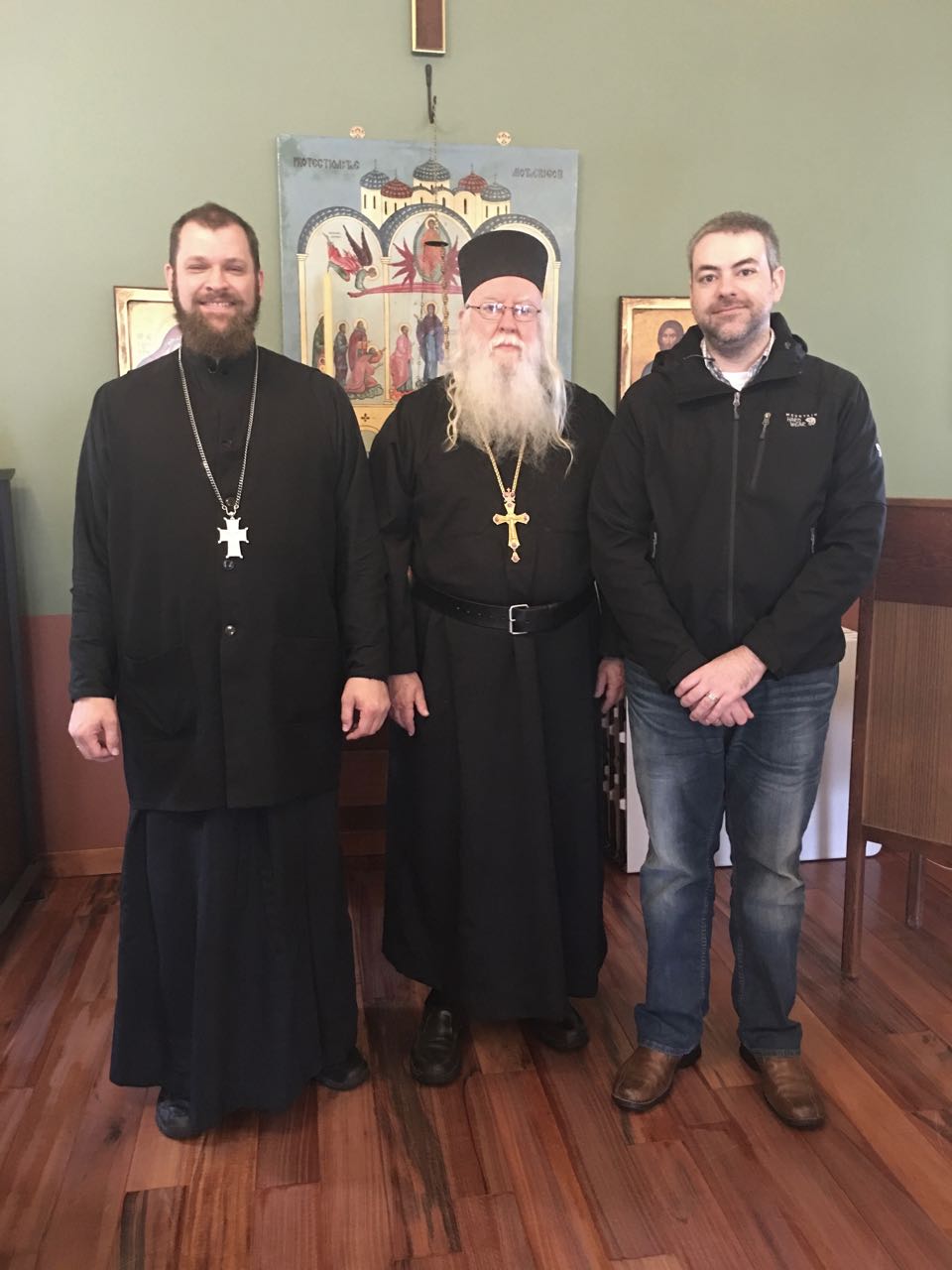
Photo: Archpriest Andrew Stephen Damick, pastor of Saint Paul Antiochian Orthodox Church of Emmaus, Pennsylvania, and author of Orthodoxy and Heterodoxy, together with Gabe Martini of Bellingham, WA, visited the monastery on Friday.
Saturday October 8, 2016 / September 25, 2016
16th Week after Pentecost. Tone six.
Venerable Euphrosyne, nun, of Alexandria (445).
Repose of Venerable Sergius, abbot, of Radonezh (1392).
St. Nicholas confessor, priest (1941).
Venerable Euphrosyne, nun, of Suzdal (1250).
Translation of the relics of St. Herman, archbishop of Kazan (1595).
Venerable Dosithea the Recluse of Kiev (1776).
Martyr Paphnutius and 546 companions in Egypt (3rd c.).
Commemoration of the earthquake in Constantinople in 447, when a boy was lifted to heaven and heard the “Trisagion”.
St. Finbar (Barry), bishop of Cork (Ireland) (Celtic & British).
St. Cadoc of Llancarfan (Wales) (577) (Celtic & British).
Martyrs Paul and Tatta and their children Sabinian, Maximus, Rufus, and Eugene of Damascus (Greek).
St. Arsenius the Great, Catholicos of Georgia (887).
Scripture Readings
Matthew 11:27-30
27 All things have been delivered to Me by My Father, and no one knows the Son except the Father. Nor does anyone know the Father except the Son, and the one to whom the Son wills to reveal Him. 28 Come to Me, all you who labor and are heavy laden, and I will give you rest. 29 Take My yoke upon you and learn from Me, for I am gentle and lowly in heart, and you will find rest for your souls.30 For My yoke is easy and My burden is light.”
Galatians 5:22-6:2
22 But the fruit of the Spirit is love, joy, peace, longsuffering, kindness, goodness, faithfulness, 23 gentleness, self-control. Against such there is no law. 24 And those who are Christ’s have crucified the flesh with its passions and desires. 25 If we live in the Spirit, let us also walk in the Spirit. 26 Let us not become conceited, provoking one another, envying one another.
Bear and Share the Burdens
6 Brethren, if a man is overtaken in any trespass, you who are spiritual restore such a one in a spirit of gentleness, considering yourself lest you also be tempted. 2 Bear one another’s burdens, and so fulfill the law of Christ.
Luke 6:17-23
Jesus Heals a Great Multitude
17 And He came down with them and stood on a level place with a crowd of His disciples and a great multitude of people from all Judea and Jerusalem, and from the seacoast of Tyre and Sidon, who came to hear Him and be healed of their diseases, 18 as well as those who were tormented with unclean spirits. And they were healed. 19 And the whole multitude sought to touch Him, for power went out from Him and healed them all.
The Beatitudes
20 Then He lifted up His eyes toward His disciples, and said:
“Blessed are you poor,
For yours is the kingdom of God.
21 Blessed are you who hunger now,
For you shall be filled.
Blessed are you who weep now,
For you shall laugh.
22 Blessed are you when men hate you,
And when they exclude you,
And revile you, and cast out your name as evil,
For the Son of Man’s sake.
23 Rejoice in that day and leap for joy!
For indeed your reward is great in heaven,
For in like manner their fathers did to the prophets.
Dear in Christ Abbott Tryphon, Bless,
Thank you for your many helpful insights. Low esteem may be one explanation for seeming arrogance, but I think there may be others.
The existence of an aristocracy is seemingly inconsistent with the teachings of Christ. “The rich young ruler” was asked to not only give away his wealth but also his privilege. Early Christians shared all things in common and all was given for the greater Glory of the One True God, Father, Son and Holy Spirit and His Church. They greeted each other with a holy kiss having been sanctified in Christ.
And yet, our hierarchy are Christ’s earthly representative. Are we not all? However, humility is a cure for many things, so gladly I’ll kiss your hand and ask your blessing and your holy prayers ( which i truly believe are holy. I will gladly give you the best seat and the finest cut of fish and the best wine in the house and feel blessed for doing so.
Perhaps “expect nothing and be grateful for everything” would be a helpful reminder for some.
Thank You for your thoughts.
In Christ, Susannah