
Communing from the Body and Blood of the Master during the period of spiritual combat
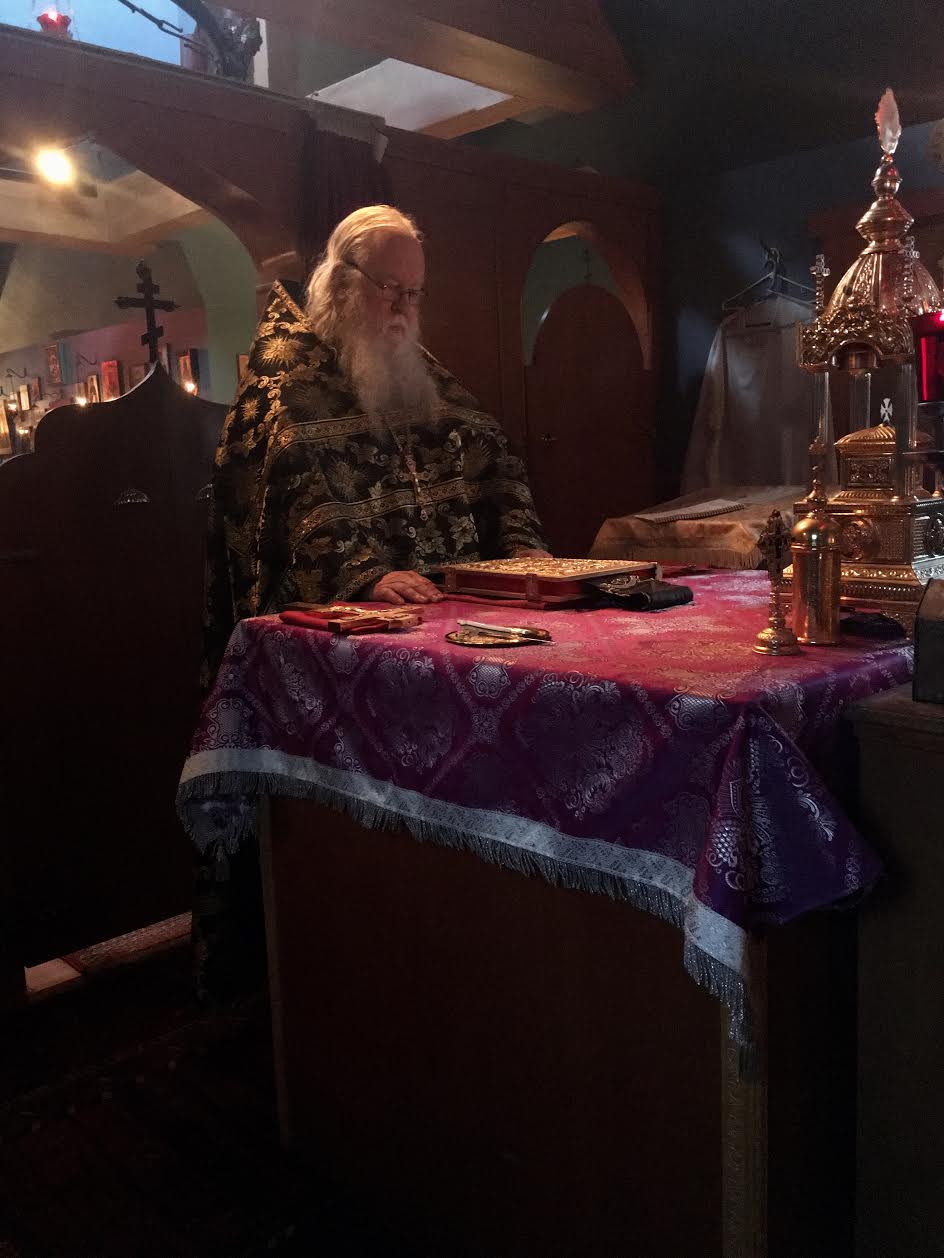
The Liturgy of the Presanctified Gifts is attributed to Saint Gregory the Dialogist († 604), Pope of Rome, but in actuality, it is not the work of one individual, but is a composite work coming down to us from Holy Tradition.
The Liturgy of the Presanctified Gifts, which consists of the Service of Vespers and the Communion of the Faithful with the Holy Gifts. It is commonly celebrated daily in monastic communities, and on Wednesdays and Fridays in parishes, with Holy Bread—that is, the Body of Christ—which has been intincted in the Holy Blood and consecrated at the preceding complete Liturgies on Saturdays or Sundays. The Presanctified or “abridged” Divine Liturgy (since it is affixed to Vespers), is normally celebrated in the late afternoon, when Christians, having fasted until that time, commune, afterwards eating a meal of dry foodstuffs (dried fruits and nuts).
The celebration of the Divine Liturgy, because it is festive and Resurrectional in character, is not allowed during Great Lent and the somber period of the fast, according to ancient tradition and the forty-ninth Canon of the Synod of in Laodiceia [336]. However, from their side, the faithful children of the Church, engaged in the abstemious struggle of the Great Fast and having a clear and particular need for reinforcement by the Holy Mysteries during this period of intensive spiritual combat, desired to commune as often as they could, since Holy Communion was indeed their life and sustenance.
For this reason, so that the faithful not be deprived of the Holy Eucharist on the weekdays of the Great Fast, but that they might be able to commune from the Presanctified Holy Bread [the Body if Christ], the Church, by way of the fifty-first Canon of the Fifth-Sixth [Quinisext] Synod [692], appointed that the Divine Liturgy of the Presanctified Gifts take place on the weekdays of the Great Fast.
Saint Nikodemos the Hagiorite [† 1809], in his Rudder, citing the Byzantine canonologist Matthew Blastaris [fl. 14th cenury], reminds us that the faithful resemble wrestlers, and just as wrestlers cease their matches in the afternoon to take nourishment in order to strengthen themselves for the upcoming bout, so the faithful commune from the Body and Blood of the Master during the period of spiritual combat in the Great Fast, that they might be reinvigorated and reinforced by the Lord, thus to continue their match against the passions and the spiritual enmity of the devil with renewed powers and more valorously.
With love in Christ,
Abbot Tryphon
Sunday March 5, 2017 / February 20, 2017
First Sunday of the Great Lent: Triumph of Orthodoxy. Tone four.
Great Lent. Food with Oil
“Cyprus” Icon of the Most Holy Theotokos from the village Staromniy, Moscow region (movable holiday on the 1st Sunday of the Great Lent).
Venerable Leo, bishop of Catania in Sicily (ca. 780).
Abbot Macarius and 34 monks and novices of Valaam Monastery martyred by the Lutherans: hieromonk Titus, schemamonk Tikhon, monks Gelasius, Sergius, Varlaam, Sabbas, Conon, Silvester, Cyprian, Pimen, John, Simonas, Jonah, David, Cornelius, Niphon, Athanasius, and Serapion, and novices Varlaam, Athanasius, Anthony, Luke, Leontius, Thomas, Dionysius, Philip, Ignatius, Basil, Pachomius, Basil, Theophilus, John, Theodore, and John (1578).
New Hieromartyr Nicholas priest (1938).
St. Yaroslav the Wise (1054).
Venerable Agatho, wonderworker of the Kiev Caves (13th-l4th c.).
Beheading of Venerable Cornelius, abbot of the Pskov Caves (1570), and his disciple St. Bassian of Murom.
Hieromartyr Sadoc (Sadoth), bishop of Persia, and 128 Martyrs with him (342).
Venerable Agatho, pope of Rome (682).
Venerable Bessarion the Great, wonderworker of Egypt (466) (Greek).
St. Cindeus, bishop of Pisidia (Greek).
Hieromartyr Eleutherius, bishop in Byzantium (2nd c.).
St. Eleutherius, bishop of Tournai (531).
St. Eucherius, bishop of Orleans (740).
The Scripture Readings
Luke 24:1-12
He Is Risen
24 Now on the first day of the week, very early in the morning, they, and certain other women with them, came to the tomb bringing the spices which they had prepared. 2 But they found the stone rolled away from the tomb. 3 Then they went in and did not find the body of the Lord Jesus. 4 And it happened, as they were greatly perplexed about this, that behold, two men stood by them in shining garments. 5 Then, as they were afraid and bowed their faces to the earth, they said to them, “Why do you seek the living among the dead? 6 He is not here, but is risen! Remember how He spoke to you when He was still in Galilee, 7 saying, ‘The Son of Man must be delivered into the hands of sinful men, and be crucified, and the third day rise again.’”
8 And they remembered His words. 9 Then they returned from the tomb and told all these things to the eleven and to all the rest. 10 It was Mary Magdalene, Joanna, Mary the mother of James, and the other women with them, who told these things to the apostles. 11 And their words seemed to them like idle tales, and they did not believe them. 12 But Peter arose and ran to the tomb; and stooping down, he saw the linen cloths lying by themselves; and he departed, marveling to himself at what had happened.
Hebrews 11:24-26
24 By faith Moses, when he became of age, refused to be called the son of Pharaoh’s daughter, 25 choosing rather to suffer affliction with the people of God than to enjoy the passing pleasures of sin, 26 esteeming the reproach of Christ greater riches than the treasures in Egypt; for he looked to the reward.
Hebrews 11:32-12:2
32 And what more shall I say? For the time would fail me to tell of Gideon and Barak and Samson and Jephthah, also of David and Samuel and the prophets: 33 who through faith subdued kingdoms, worked righteousness, obtained promises, stopped the mouths of lions, 34 quenched the violence of fire, escaped the edge of the sword, out of weakness were made strong, became valiant in battle, turned to flight the armies of the aliens. 35 Women received their dead raised to life again.
Others were tortured, not accepting deliverance, that they might obtain a better resurrection. 36 Still others had trial of mockings and scourgings, yes, and of chains and imprisonment. 37 They were stoned, they were sawn in two, were tempted, were slain with the sword. They wandered about in sheepskins and goatskins, being destitute, afflicted, tormented— 38 of whom the world was not worthy. They wandered in deserts and mountains, in dens and caves of the earth.
39 And all these, having obtained a good testimony through faith, did not receive the promise, 40 God having provided something better for us, that they should not be made perfect apart from us.
The Race of Faith
12 Therefore we also, since we are surrounded by so great a cloud of witnesses, let us lay aside every weight, and the sin which so easily ensnares us, and let us run with endurance the race that is set before us, 2 looking unto Jesus, the author and finisher of ourfaith, who for the joy that was set before Him endured the cross, despising the shame, and has sat down at the right hand of the throne of God.
John 1:43-51
Philip and Nathanael
43 The following day Jesus wanted to go to Galilee, and He found Philip and said to him, “Follow Me.” 44 Now Philip was from Bethsaida, the city of Andrew and Peter. 45 Philip found Nathanael and said to him, “We have found Him of whom Moses in the law, and also the prophets, wrote—Jesus of Nazareth, the son of Joseph.”
46 And Nathanael said to him, “Can anything good come out of Nazareth?”
Philip said to him, “Come and see.”
47 Jesus saw Nathanael coming toward Him, and said of him, “Behold, an Israelite indeed, in whom is no deceit!”
48 Nathanael said to Him, “How do You know me?”
Jesus answered and said to him, “Before Philip called you, when you were under the fig tree, I saw you.”
49 Nathanael answered and said to Him, “Rabbi, You are the Son of God! You are the King of Israel!”
50 Jesus answered and said to him, “Because I said to you, ‘I saw you under the fig tree,’ do you believe? You will see greater things than these.” 51 And He said to him, “Most assuredly, I say to you, hereafter you shall see heaven open, and the angels of God ascending and descending upon the Son of Man.”