The afterlife, and the oneness of creation

There is no formal doctrine in the Orthodox Church concerning the afterlife for animals, including our pets. Those Fathers of the Church who have expressed themselves on this matter were simply expressing theological opinions that have not become universally accepted, and remain known as “theologoumena” (personal opinion).
The Church has wisely refrained from pronouncing conclusively regarding the afterlife, for much remains unknown. We will not truly understand what awaits us after this life until we have entered into the afterlife. As Orthodox Christians, we simply accept the Nicaeo-Constantinopolitan Creed, reciting the words, “I look for….the life of the world to come.”
By God’s grace and our cooperation with this grace, we expect to inherit eternal life. We believe that all beings who have been a part of our lives will also be there. Some of us would even hope, along with C.S. Lewis, that it might be possible Paradise will also include our beloved pets, and even the animals that have contributed in a myriad of ways to our own well being. Would it be possible that the cow that provided milk for our children, and cheese for our table, might one day join us in a Paradise where there is no death and no pain?
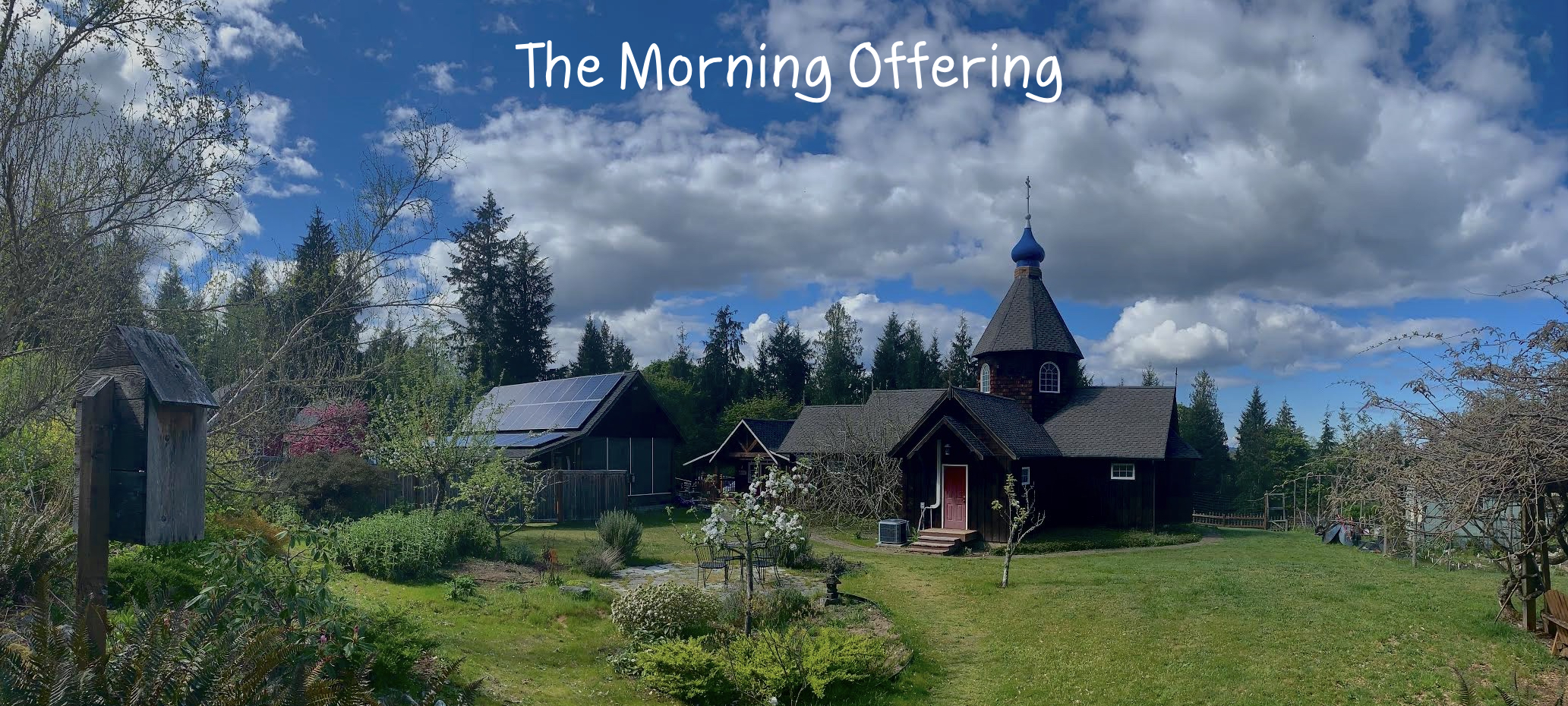
C.S. Lewis describes something like this in his book “The Great Divorce” in which a sanctified lady in paradise is accompanied by a myriad of animals as she walks in glory through the fields of Paradise. As I have enjoyed the affection and loyalty of our monastery’s wonderful Norwegian Forest Cat, Hammi, it would seem to me a Paradise without this loving little creature, would be wanting. Even the eternal loss of our hens, who’ve provided us with so many wonderful, fresh eggs, and given me so much delight as I’ve watched them enjoying their free range lives, would seem sad to me.
This is simply my opinion, and I look forward to the possibility of meeting with the many beloved dogs and cats whose lives I have shared, over my seventy-two years. The saints saw animals as creatures of God, created as gifts of God’s love, and therefore resisted negligence or indifference when these animals were under their charge.
Saint Paul of Obnora was known to converse with birds, and Saint Seraphim of Sarov made friends with a bear. Saint Anthony the Great had a friendship with a lion. Saint Modestos viewed animals as sublime and mysterious gifts from God, and would often bless the livestock of the faithful – praying for their health and survival and glorifying in the vastness and beauty of all that God made. I myself, for some eighteen years, have blessed our cat Hammi, as I’ve let him out of the library after his night of sleep.
The traditional lands of Britain, Scotland, Wales and Ireland, all lands of the Celtic peoples, which, until the 11th century were part of the unified Orthodox Catholic Church and whose saints and spiritual life have much to offer the contemporary world, saw all of reality as a single unity. These saints knew, as all of the holy saints of the Church have known, that the wholeness of creation had been torn apart by the sin of Adam, and was restored by the saving act of Christ. In their lives they embodied the restoration of wholeness in creation, whether by communication with angels and spirits, or by kinship with all of the natural world.
Saint Athanasius said, “(God) provided the work of creation also as a means by which the Maker might be known … Three ways thus lay open to them, by which they might obtain the knowledge of God. (First), they could look up to the immensity of heaven, and by pondering the harmony of creation come to know its Ruler, the Word of the Father.” Thus, the natural world, seen in the light of Christ, remains a way to know God, that is, a way of salvation.
The oneness of our relationship with Creation is brought to life with the story of Saint Kevin of Glendalough. While standing at prayer in a traditional Celtic monastic position with his arms outstretched in the form of a cross, a blackbird built a nest on his arm and laid her eggs. Saint Kevin, not wanting to disturb her nest, stayed in the position until the eggs were hatched. The saint is said to have stated, “It is no great thing for me to bear this pain of holding my hand under the blackbird for the sake of heaven’s king.”
In the beginning of the restoration of the unity in the entire fallen cosmos, Christ went out into the desert and “He was with the wild beasts, and the angels served Him” (Mark 1:13). These heavenly and earthly creatures who were destined to become the new creation in the God-Man Jesus Christ were assembled around Him. There is a pointed reference to this restoration in the life of St Isaac of Syria, when he wrote:
The humble man approaches wild animals, and the moment they catch sight of him their ferocity is tamed. They come up and cling to him as their Master, wagging their tails and licking his hands and feet. They scent as coming from him the same fragrance that came from Adam before the transgression, the time when they were gathered together before him and he gave them names in Paradise. This scent was taken away from us, but Christ has renewed it and given it back to us at his coming. It is this which has sweetened the fragrance of humanity.
In other words, the state of likeness to God in Christ to which he had risen enabled him to be with the wild beasts just as Adam was in his naming of them. And, I suspect the reason pets are so important to we humans is that they aid in our journey into the restoration of kinship between two different parts of creation. Our pets become like all the animals were in the beginning, when Adam was charged with naming them.
When the human can lie down with the cat, or the dog, or the chicken, (to paraphrase Isiah) we aid the advancement of the Kingdom just a little, work to recreate Paradise just a little, and so give new meaning to such menial tasks as cleaning out the chicken coop, or the litter box.
With love in Christ,
Abbot Tryphon
Tuesday November 21, 2017 / November 8, 2017
25th Week after Pentecost. Tone seven.
Synaxis of the Archangel Michael and the other Bodiless Powers: the Archangels Gabriel, Raphael, Uriel, Salaphiel, Jegudiel, Barachiel, and Jeremiel.
New Martyr Michael the Blessed of Chernigov (1922).
New Hieromartyr Paul priest (1937).
Righteous Martha, princess of Pskov (1300). Venerable Tyssilio, abbot of Meifod (Powys) (7th c.) (Celtic & British).
St. Willihad, bishop of Bremen (Germany).
New Martyr Michael the Blessed of Chernigov (1922).
The Scripture Readings
Matthew 13:24-30
The Parable of the Wheat and the Tares
24 Another parable He put forth to them, saying: “The kingdom of heaven is like a man who sowed good seed in his field; 25 but while men slept, his enemy came and sowed tares among the wheat and went his way. 26 But when the grain had sprouted and produced a crop, then the tares also appeared. 27 So the servants of the owner came and said to him, ‘Sir, did you not sow good seed in your field? How then does it have tares?’ 28 He said to them, ‘An enemy has done this.’ The servants said to him, ‘Do you want us then to go and gather them up?’ 29 But he said, ‘No, lest while you gather up the tares you also uproot the wheat with them. 30 Let both grow together until the harvest, and at the time of harvest I will say to the reapers, “First gather together the tares and bind them in bundles to burn them, but gather the wheat into my barn.”’”
Matthew 13:36-43
The Parable of the Tares Explained
36 Then Jesus sent the multitude away and went into the house. And His disciples came to Him, saying, “Explain to us the parable of the tares of the field.”
37 He answered and said to them: “He who sows the good seed is the Son of Man. 38 The field is the world, the good seeds are the sons of the kingdom, but the tares are the sons of the wicked one. 39 The enemy who sowed them is the devil, the harvest is the end of the age, and the reapers are the angels. 40 Therefore as the tares are gathered and burned in the fire, so it will be at the end of this age. 41 The Son of Man will send out His angels, and they will gather out of His kingdom all things that offend, and those who practice lawlessness, 42 and will cast them into the furnace of fire. There will be wailing and gnashing of teeth. 43 Then the righteous will shine forth as the sun in the kingdom of their Father. He who has ears to hear, let him hear!
Hebrews 2:2-10
2 For if the word spoken through angels proved steadfast, and every transgression and disobedience received a just reward, 3 how shall we escape if we neglect so great a salvation, which at the first began to be spoken by the Lord, and was confirmed to us by those who heard Him, 4 God also bearing witness both with signs and wonders, with various miracles, and gifts of the Holy Spirit, according to His own will?
The Son Made Lower than Angels
5 For He has not put the world to come, of which we speak, in subjection to angels. 6 But one testified in a certain place, saying:
“What is man that You are mindful of him,
Or the son of man that You take care of him?
7 You have made him a little lower than the angels;
You have crowned him with glory and honor,
And set him over the works of Your hands.
8 You have put all things in subjection under his feet.”
For in that He put all in subjection under him, He left nothing that is not put under him. But now we do not yet see all things put under him. 9 But we see Jesus, who was made a little lower than the angels, for the suffering of death crowned with glory and honor, that He, by the grace of God, might taste death for everyone.
Bringing Many Sons to Glory
10 For it was fitting for Him, for whom are all things and by whom are all things, in bringing many sons to glory, to make the captain of their salvation perfect through sufferings.
Luke 10:16-21
16 He who hears you hears Me, he who rejects you rejects Me, and he who rejects Me rejects Him who sent Me.”
The Seventy Return with Joy
17 Then the seventy returned with joy, saying, “Lord, even the demons are subject to us in Your name.”
18 And He said to them, “I saw Satan fall like lightning from heaven. 19 Behold, I give you the authority to trample on serpents and scorpions, and over all the power of the enemy, and nothing shall by any means hurt you. 20 Nevertheless do not rejoice in this, that the spirits are subject to you, but rather rejoice because your names are written in heaven.”
Jesus Rejoices in the Spirit
21 In that hour Jesus rejoiced in the Spirit and said, “I thank You, Father, Lord of heaven and earth, that You have hidden these things from the wise and prudent and revealed them to babes. Even so, Father, for so it seemed good in Your sight.