
Our good works help us gain God’s “likeness” in this life

Salvation can not be explained in legalistic terms of acquittal and justification, for salvation is much more than simply being forgiven and getting into heaven. The close tie between faith and works, when it comes to the Orthodox view of salvation, is not about being “saved” by our works, for this is impossible. Works do not save us, but when placed in the context of a relationship, works do indeed have an eternal component.
Our “works” do not supplant the place of grace and faith with God, but are part of the whole experience in our relationship with God. Saint John Chrysostom (349-407), one of the greatest of the Church Fathers, and perhaps the greatest preacher in the history of the Church, wrote, “For Scripture says that faith has saved us. Put better: Since God willed it, faith has saved us. Now in what case, tell me, does faith save without itself doing anything at all? Faith’s workings themselves are a gift of God, lest anyone should boast. What then is Paul saying? Not that God has forbidden works but that he has forbidden us to be justified by works. No one, Paul says, is justified by works, precisely in order that the grace and benevolence of God may become apparent.”
The purging fire of God’s presence is only a warmth for the one already purified with the good works done in this life. Yet the one who wastes this life, and does nothing to enhance his relationship with others through his good works, will have sacrificed a loving relationship with the God Who has called us into communion with Him. This person will experience the fire on judgement day as painful, for he who has not done good works in this life, will have done nothing to promote a sound relationship with the God Who has called us into a life of transformation. It is God’s intent that this life bring us into holiness, preparing us for an eternity in the presence of God’s holiness. If we have not been made holy, eternity in the presence of God, will be as a burning fire.
Our works do not earn us salvation, but neither are works unimportant. According to the Fathers, works make our communion with God fuller, and more complete. Our good works help us gain God’s “likeness” in this life, and bring us into a joyful communion with Christ. The more we become like Christ, the more joy we will experience. Pain and suffering are the end result of our being less of God’s likeness.
With love in Christ,
Abbot Tryphon
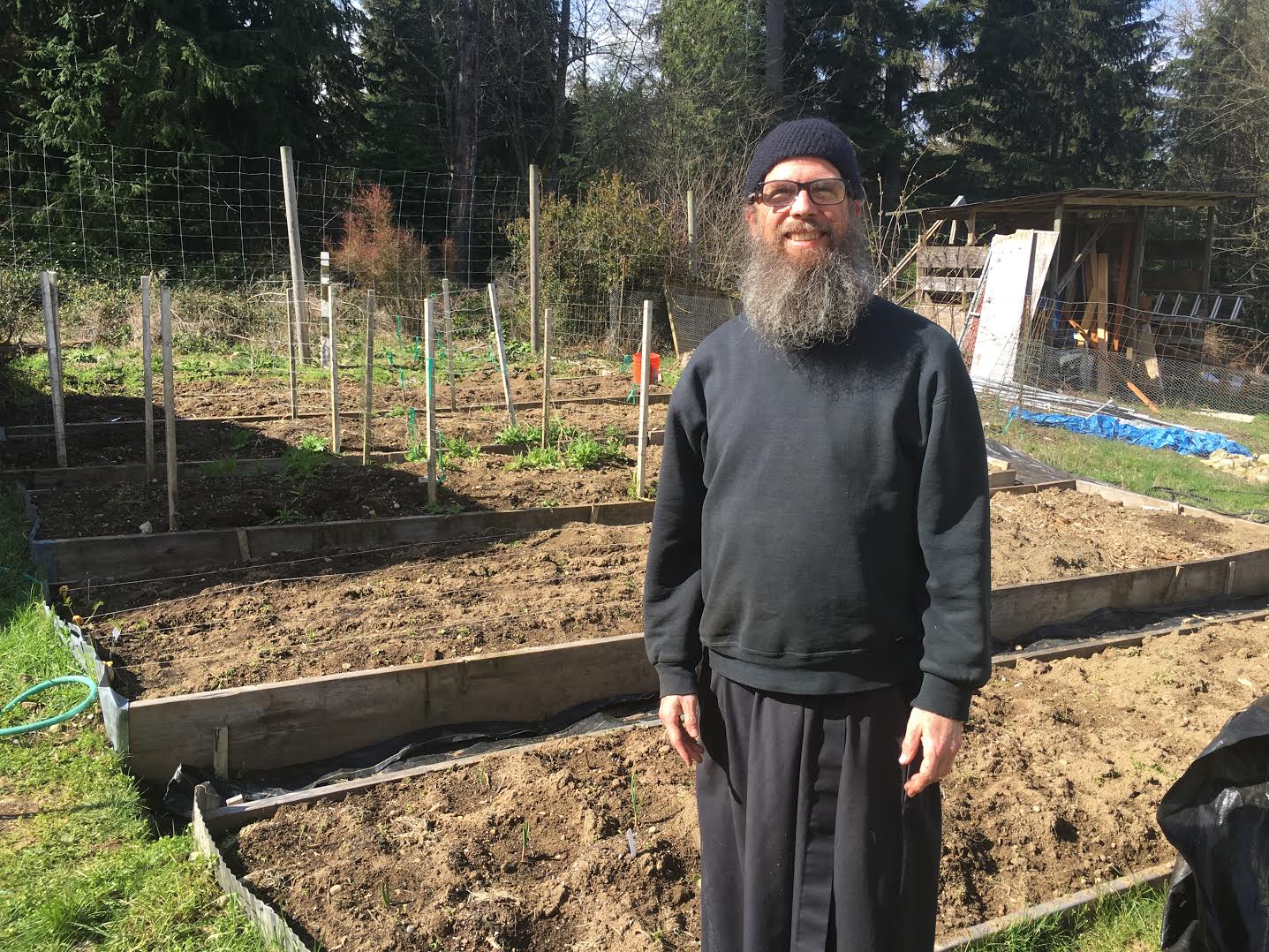
Photos: The first signs of Spring around the Monastery!

Friday March 24, 2017 / March 11, 2017
Fourth Week of the Great Lent: Adoration of Cross. Tone six.
Great Lent. By Monastic Charter: Strict Fast (Bread, Vegetables, Fruits)
St. Sophronius, patriarch of Jerusalem (638).
St. Euthymius, Bishop of Novgorod, wonderwoker (1458).
Venerable Alexis of Goloseyevsky Skete, Kiev Caves (1917).
Venarable Patrikius confessor (1933).
New Hieromartyr Basil, priest (1937).
Venerable Sophronius, recluse of the Kiev Caves (13th c.).
Hieromartyr Pionius of Smyrna and those with him: Asclepiades, Macedonia, Linus and Sabina (250).
Translation of the relics of Martyr Epimachus of Pelusium to Constantinople (250).
St. Sophronius of Vratsa (1815) (Bulgaria).
Venerable George, abbot of Sinai, brother of St. John Climacus (7th c.).
Venerable John Moskhos (622).
Venerable Oengus the Culdee, compiler of first Irish martyrology (824) (Celtic & British).
Venerable George the New, wonderworker of Constantinople (970) (Greek).
St. Theodora, queen of Arta, wife of Despot Michael II of Epirus (1275) (Greek).
Hieromartyr Eulogius, metropolitan of Cordova (859).
Martyrs Trophimus and Thalus of Laodicea (300) (Greek).
Hieromartyr Constantine, in Kintyre.


The Scripture Readings
Isaiah 29:13-23
13 The Lord says:
“These people come near to me with their mouth
and honor me with their lips,
but their hearts are far from me.
Their worship of me
is based on merely human rules they have been taught.
14 Therefore once more I will astound these people
with wonder upon wonder;
the wisdom of the wise will perish,
the intelligence of the intelligent will vanish.”
15 Woe to those who go to great depths
to hide their plans from the Lord,
who do their work in darkness and think,
“Who sees us? Who will know?”
16 You turn things upside down,
as if the potter were thought to be like the clay!
Shall what is formed say to the one who formed it,
“You did not make me”?
Can the pot say to the potter,
“You know nothing”?
17 In a very short time, will not Lebanon be turned into a fertile field
and the fertile field seem like a forest?
18 In that day the deaf will hear the words of the scroll,
and out of gloom and darkness
the eyes of the blind will see.
19 Once more the humble will rejoice in the Lord;
the needy will rejoice in the Holy One of Israel.
20 The ruthless will vanish,
the mockers will disappear,
and all who have an eye for evil will be cut down—
21 those who with a word make someone out to be guilty,
who ensnare the defender in court
and with false testimony deprive the innocent of justice.
22 Therefore this is what the Lord, who redeemed Abraham, says to the descendants of Jacob:
“No longer will Jacob be ashamed;
no longer will their faces grow pale.
23 When they see among them their children,
the work of my hands,
they will keep my name holy;
they will acknowledge the holiness of the Holy One of Jacob,
and will stand in awe of the God of Israel.
Genesis 12:1-7
The Call of Abram
12 The Lord had said to Abram, “Go from your country, your people and your father’s household to the land I will show you.
2 “I will make you into a great nation,
and I will bless you;
I will make your name great,
and you will be a blessing.
3 I will bless those who bless you,
and whoever curses you I will curse;
and all peoples on earth
will be blessed through you.”
4 So Abram went, as the Lord had told him; and Lot went with him. Abram was seventy-five years old when he set out from Harran.5 He took his wife Sarai, his nephew Lot, all the possessions they had accumulated and the people they had acquired in Harran, and they set out for the land of Canaan, and they arrived there.
6 Abram traveled through the land as far as the site of the great tree of Moreh at Shechem. At that time the Canaanites were in the land. 7 The Lord appeared to Abram and said, “To your offspring I will give this land.” So he built an altar there to the Lord, who had appeared to him.
Proverbs 14:15-26
15 The simple believe anything,
but the prudent give thought to their steps.
16 The wise fear the Lord and shun evil,
but a fool is hotheaded and yet feels secure.
17 A quick-tempered person does foolish things,
and the one who devises evil schemes is hated.
18 The simple inherit folly,
but the prudent are crowned with knowledge.
19 Evildoers will bow down in the presence of the good,
and the wicked at the gates of the righteous.
20 The poor are shunned even by their neighbors,
but the rich have many friends.
21 It is a sin to despise one’s neighbor,
but blessed is the one who is kind to the needy.
22 Do not those who plot evil go astray?
But those who plan what is good find love and faithfulness.
23 All hard work brings a profit,
but mere talk leads only to poverty.
24 The wealth of the wise is their crown,
but the folly of fools yields folly.
25 A truthful witness saves lives,
but a false witness is deceitful.
26 Whoever fears the Lord has a secure fortress,
and for their children it will be a refuge.
Fr,,
Thank you so much for everything you do! May God Richly Bless You, Your Brothers and the Monastery !