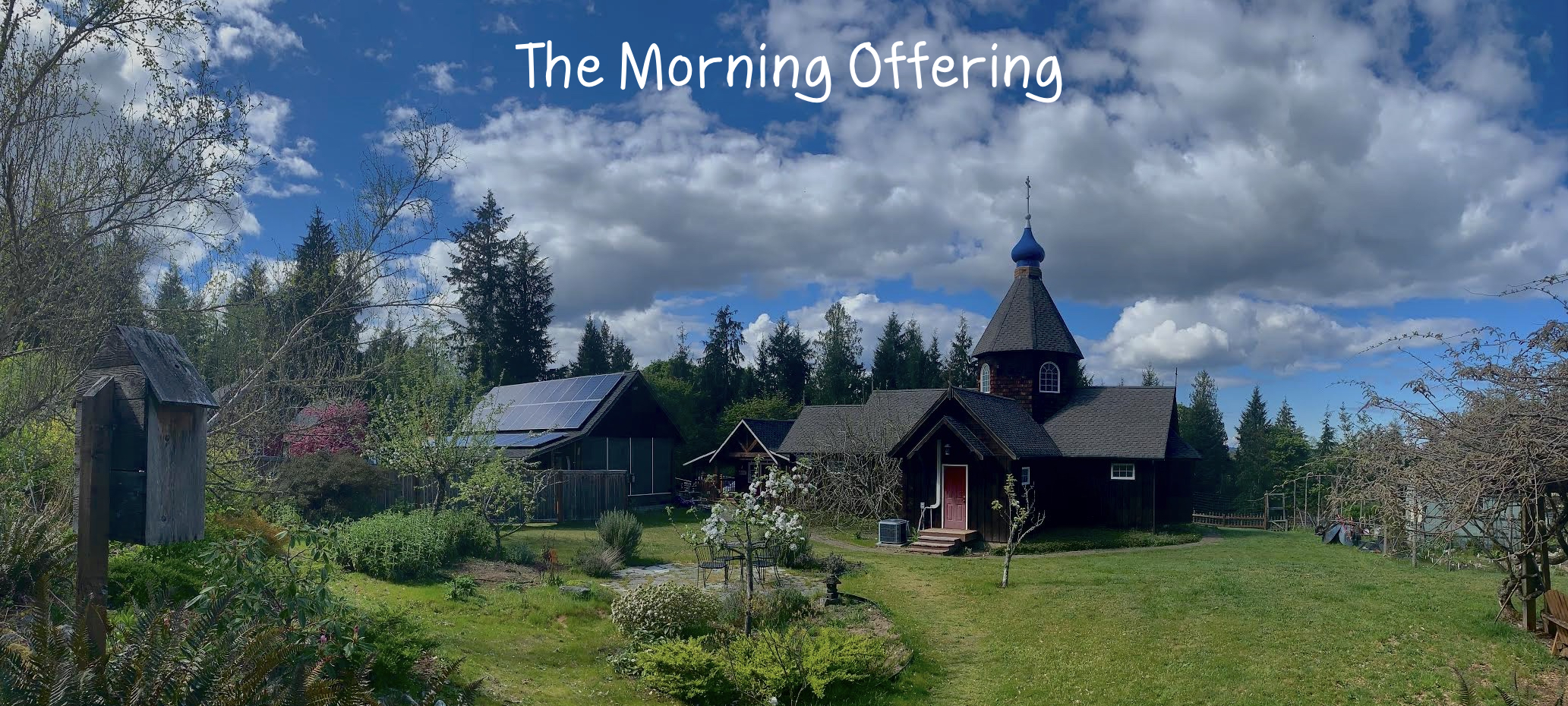
The inseparability of Orthodoxy and beauty

Orthodox Christianity attracted me from my very first encounter with the magnificence of its churches and the grandeur of her divine services. Having grown up amid the natural beauty of Northern Idaho, with mountains and lakes that could take our breath away, I’d previously found inspiration primarily in the world of nature.
Orthodoxy and beauty are inseparable because God and beauty are inseparable. The beauty of a sunset is a reflection of our Creator, just as is the interior of a temple reflects our experience with this Creator God. We humans were formed as physical beings, placed in a material world and invited to commune with our Creator. The majesty and beauty of the created world inspires us to an awareness of God’s presence.
A bouquet of flowers placed in our icon corner has an internal affect on us. Created in God’s image, we in turn become creators. The beauty that comes from the artist’s brush or the poet’s voice, is an act of a creator. Taking our creative instincts into the realm of the spiritual unites us with God and connects us to the eternal. This is why an artist or a poet can experience the eternal when creating something of beauty.
God is the Creator of heaven and earth and is present through His creative energies. The material world, being good, is an important means through which God expresses Himself. It is through God’s created beauty that we are drawn into a relationship that is meant to be eternal and through which Divine Revelation can transform our nature. Then creation is completed and the created is united to the Creator.
Love in Christ,
Abbot Tryphon
Photo: His Holiness Patriarch Kyrill of Moscow and All Russia.
Wednesday October 17, 2018 / October 4, 2018
21st Week after Pentecost. Tone three.
Fast. Food with Oil
Hieromartyr Hierotheus, bishop of Athens (1st c.).
Uncovering of the relics (1595) of St. Gurias, first archbishop of Kazan (1563) and St. Barsanuphius, bishop of Tver (1576).
Synaxis of All Saints of Kazan.
New Hieromartyr Demetrius priest (1918).
New Hieromartyrs Demetrius priest Nicholas, Micael, Jacob and Tikhon priests, Martyr Basil (1937).
St. Khionia confessor (1945).
St. Vladimir Yaroslavich, prince of Novgorod (1052), and his mother, St. Anna of Novgorod (1050).
Venerables Helladius and Onesimus of the Near Caves in Kiev (12th-13th c.).
Venerable Ammon of the Far Caves in Kiev (13th c.).
Martyrs Gaius, Faustus, Eusebius, and Chaeremon of Alexandria (3rd c.).
Venerable Peter of Capitolia, bishop of Bostra (715).
Martyrs Domnina and her daughters Berenice (Bernice) and Prosdoce, of Syria (4th c.).
Venerable Paul the Simple (340) and Venerable Ammon (350), of Egypt, disciples of St. Anthony the Great.
Martyr Adauctus and his daughter St. Callisthene, of Ephesus(4th c.).
Martyr Stephen (Stiljanovich) of Serbia (1515) and his wife, St. Elena (Serbia).
Blessed Elizabeth of Serbia (Greek).
St. Theodore the Wonderworker, bishop of Tamassos in Cyprus (2nd. c.).
St. John (Lampadistes) of Cyprus (10th c.).
Sts. Jonah and Nectarius of Kazan, monks (16th c.).
Martyr Evdemoz the Catholicos of Georgia (1642).
Venerable Peor recluse of the Kiev Caves (13 c.).
St. Peter (Michurin) of Siberia (1820).
The Scripture Readings
Colossians 1:18-23
18 And He is the head of the body, the church, who is the beginning, the firstborn from the dead, that in all things He may have the preeminence.
Reconciled in Christ
19 For it pleased the Father that in Him all the fullness should dwell, 20 and by Him to reconcile all things to Himself, by Him, whether things on earth or things in heaven, having made peace through the blood of His cross.
21 And you, who once were alienated and enemies in your mind by wicked works, yet now He has reconciled 22 in the body of His flesh through death, to present you holy, and blameless, and above reproach in His sight— 23 if indeed you continue in the faith, grounded and steadfast, and are not moved away from the hope of the gospel which you heard, which was preached to every creature under heaven, of which I, Paul, became a minister.
Luke 6:46-7:1
Build on the Rock
46 “But why do you call Me ‘Lord, Lord,’ and not do the things which I say? 47 Whoever comes to Me, and hears My sayings and does them, I will show you whom he is like: 48 He is like a man building a house, who dug deep and laid the foundation on the rock. And when the flood arose, the stream beat vehemently against that house, and could not shake it, for it was founded on the rock. 49 But he who heard and did nothing is like a man who built a house on the earth without a foundation, against which the stream beat vehemently; and immediately it fell. And the ruin of that house was great.”
Jesus Heals a Centurion’s Servant
7 Now when He concluded all His sayings in the hearing of the people, He entered Capernaum.
Beautiful words to describe our glorious and beautiful faith. Thank you!