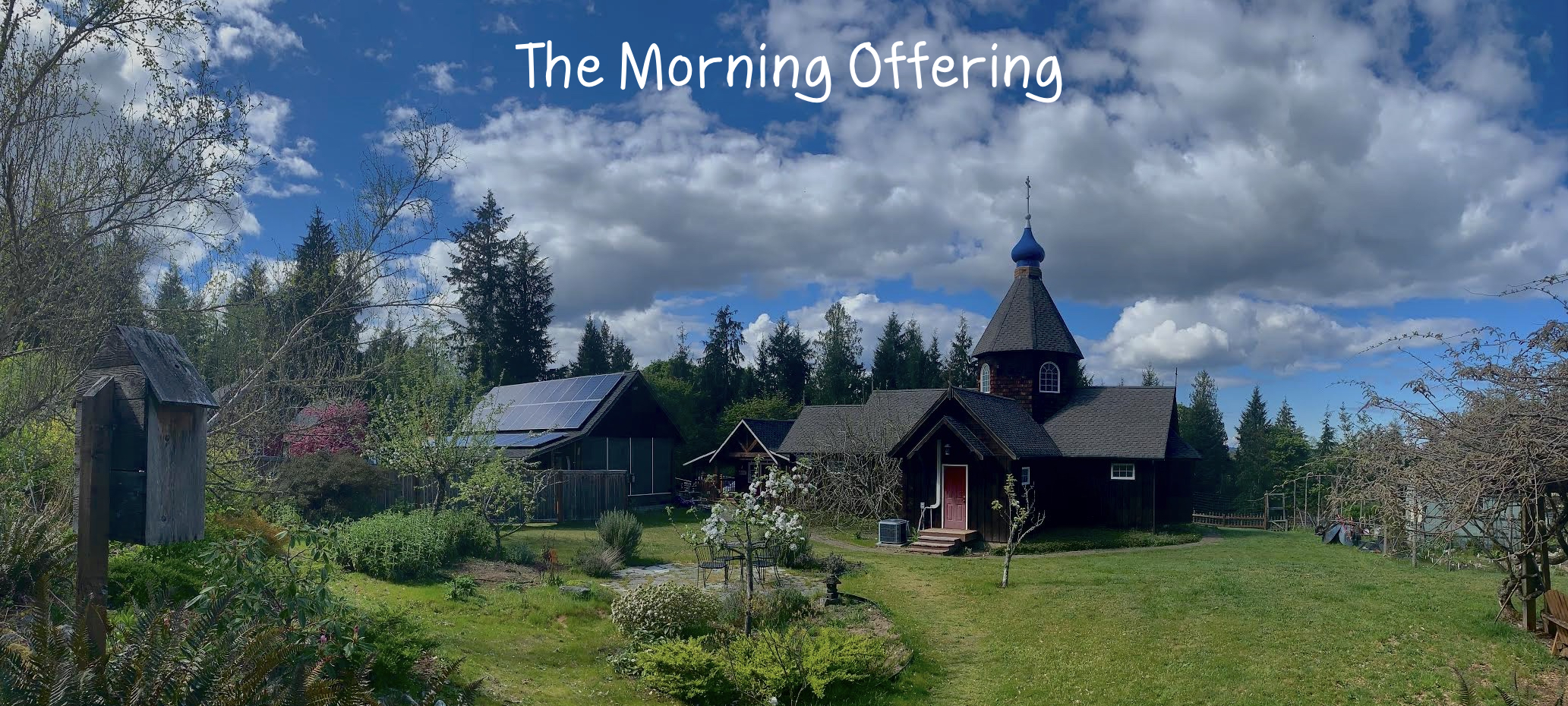
The link between the Old and New Testament Temples

Orthodox temples have kept to the same form and function since ancient times. Using the Old Testament Temple model, Orthodox churches are divided into several courts or spaces peculiar to their function. The Holy Table, upon which is celebrated the Eucharist, is situated at the east end of the building behind the Iconostasis (icon screen). This is a continuation of and corresponds to the Holy of Holies in the ancient Israelite temple in Jerusalem.
The whole area behind the iconostasis is called the altar, and is considered the most sacred part of the temple. While great respect must be shown throughout the Church, the altar is very special. It is here that the Holy Spirit descends making the offering of bread and wine in to the Body and Blood of Christ.
Only those who receive the specific blessing of the bishop or the priest may enter, since no one has the right to go behind the iconostasis. The Church allows only those who have a particular reason to be there, a specific task or function, to enter. A blessing must be received each and every time, even if a person serves regularly behind the iconostasis. No one should ever simply wander into the altar without a blessing.
The Holy Table, the proskomedia table (table of preparation), and the discos and chalice, should never be touched by anyone other than a bishop, priest or deacon. The sacredness of these items, set apart for divine worship, is such because they have all been blessed by the Church for the worship of God.
We approach our God with fear and awe, bowing down in worship before His Throne in wonder. We worship the Holy Trinity with the same reverence as did the ancients. The very God Who created us, and Who condescended to join His Divinity with our humanity, is worshiped in temples just as beautiful as that which He commanded to be built in the Holy City, because He has invited us into communion with Him. The worship we offer on this earth is an image of that which is taking place before the Throne in Heaven.
With love in Christ,
Abbot Tryphon
Tuesday December 12, 2017 / November 29, 2017
28th Week after Pentecost. Tone two.
Nativity (St. Philip’s Fast). Food with Oil
Martyr Paramon and 370 Martyrs in Bithynia (250).
Martyr Philumenus of Ancyra, and with him Martyrs Valerian and Phaedrus (274).
Venerable Acacius of Mt. Latros, who is mentioned in The Ladder (6th c.).
New Hieromartyr Sergius priest (1941).
Venerable Nectarius the Obedient of the Kiev Caves (12th c.).
Hieromartyr Abibus, bishop of Nekressi in Georgia (6th c.) (Georgia).
Venerable Pitirim of Egypt (4th c.), disciple of Venerable Anthony the Great.
Hieromartyr Dionysius, bishop of Corinth (182).
St. Tiridates, king of Armenia (4th c.).
St. Saturninus, martyr and bishop of Toulouse ( 257) (Gaul).
St. Nicholas, archbishop of Thessalonica (Greek).
Hieromartyr John of Persia (Greek).
St. Urban of Macedonia, bishop (Greek).
St. Pancosmius, monk (Greek).
St. Radboud, bishop of Utrecht (917) (Neth.).
St. Brendan of Birr (571) (Celtic and British).
The Scripture Readings
2 Timothy 3:16-4:4
16 All Scripture is given by inspiration of God, and is profitable for doctrine, for reproof, for correction, for instruction in righteousness, 17 that the man of God may be complete, thoroughly equipped for every good work.
Preach the Word
4 I charge you therefore before God and the Lord Jesus Christ, who will judge the living and the dead at His appearing and His kingdom: 2 Preach the word! Be ready in season and out of season. Convince, rebuke, exhort, with all longsuffering and teaching. 3 For the time will come when they will not endure sound doctrine, but according to their own desires, because they have itching ears, they will heap up for themselves teachers; 4 and they will turn their ears away from the truth, and be turned aside to fables.
Luke 19:45-48
Jesus Cleanses the Temple
45 Then He went into the temple and began to drive out those who bought and sold in it, 46 saying to them, “It is written, ‘My house is a house of prayer,’ but you have made it a ‘den of thieves.’”
47 And He was teaching daily in the temple. But the chief priests, the scribes, and the leaders of the people sought to destroy Him, 48 and were unable to do anything; for all the people were very attentive to hear Him.
With all this in mind Father. What are your views on the Western Rite? Like those practiced by ROCOR or the Antiochians?
Having grown up in a very liturgically oriented Lutheran church, I can appreciate good Western Rite liturgics. That said, I do not believe it necessary to introduce the Western Rite to the West, as a way to reach out with Orthodoxy. The Orthodox Church, to me, is not some “mysterious eastern religion” that can not be relevant to me as a westerner, for the liturgical practices of the “Eastern” Orthodox Church are relevant to me in every way. That Orthodoxy has been in the West for so long, makes the need for “Western Rite” unnecessary, in my opinion. But that is just me. That Western Rite parishes exist with the blessings of bishops, is not really my business. This is the realm of the bishops.
The only barrier I could see would be language. The Orthodox Church has a history of liturgies in the language of the people. For English speaking Americans, Greek or Arabic or Russian Orthodox Liturgies, translated into the language of those people, and said in those languages makes it difficult to feel a part of the service. It just seems that originally the effort was made to translate it for the people. Be they Arabic or Russian. But for English speakers it is left to them to learn another language.
In its beauty and divine mystery, the Liturgy of Saint John Chrysostom has been a staple of grace-conveying mercy to Orthodox faithful throughout the centuries, and in its magnificence, the other ancient forms of Liturgy are often eclipsed. Orthodoxy in its catholicity ought to consider other rites, whether they are eastern, western, northern or southern, just as there are variations of language and chant peculiar to every Orthodox culture.
In the West, even pre-schism, there was a movement to suppress all rites (e.g. Ambrosian, Mozarabic, Celtic/Sarum) instituting only the Roman ritual, and over the following centuries this was eventually realized. Similarly, in the East, the Chrysostom Liturgy became the preference and emphasis, though tradition acknowledges the Saint James Liturgy, but reserves it for only one day a year in monasteries. Recall that holy Archbishop John of Shanghai supported the Gallican rite for the Orthodox of France. The Orthodox Assyrians of the east use a ritual modified slightly from the Chrysostom Liturgy. And then there are the Liturgies of northeastern Africa. Interestingly, some scholars have noted that Old Roman Gregorian chant has similitude and some roots in the Coptic Church and the Middle East.
Before they were forced into schism, the inhabitants of Croatia, Dalmatia & Istria prayed the Glagolitic Liturgy, and on the Adriatic Islands, one can still hear their haunting melodies. This was the only region that was allowed to keep its language and liturgical rites during the time when the Vatican began imposing the Latin language and Roman ritual upon all churches under its omophorion, and for which the Apostles to the Balkan Slavs were persecuted.
Abbot Tryphon is correct in stating that the standard eastern Liturgy and rite is relevant to us all here in the West. Yet, doubtless, as David has expressed, the European languages can present a barrier in those parishes more accustomed to ethnocentricity to the person wishing to either convert or participate on another level. The unsuccessful and failed experiments of the western rites have understandably given rise to hostility toward the concept; but the solution to this, accomplished by recent scholars, is to apply serious study to the correction of medievalism and the impurities that give cause for mistrust by reason of dogmatic suspicion. Regardless, however, of ritual, the inner life and theosis is what we need to lovingly cultivate in our souls, no matter how it is expressed externally, under the Mercy [of God].