
Troublesome passages of the Old Testament
It is important when reading the Old Testament, to remember that it was written as an account of a peoples journey to God. As the Israelites journey continued, they came to know God, little by little, through God’s self-revelation to their prophets, and their understanding of God expanded. Christ, as the Logos (the Word of God), was from the very beginning, and identified Himself as the Alpha and the Omega. Thus, the Old Testament can only be properly understood in reference to Christ’s resurrection.
The God of the Old Testament can only be understood in light of the New Testament, so we should not take too seriously the troublesome accounts of God telling His people to kill their neighbors, and bash their enemies children against the rocks. Alleged historical accounts of the wrath of the Old Testament God should not be an issue with us, for it is only in light of Christ’s revelation that we can truly comprehend Truth.
Various Church Fathers saw the dashing of infants in these Old Testament accounts as representing the passions, and the rock representing Christ. As believers we dash our thoughts on the Rock, as the way of making sure our passions do not return to overwhelm us. Many of the psalms have similar allegories as an invitation to guard the walled city of our hearts and preserve the spiritual treasures we have received from Our King and Our God.
Historical literalism is not important when confronting the revealed true nature of God, and our turning from a literalism in our interpretation of Scripture, is not a capitulation to modernism. The Church has always known how we should read the Scriptures, for the Truth of the biblical account can only be known in light of Christ, as revealed by His Church.
The Fathers of the Church recognized the human component in the Scriptures, since the Holy Spirit enlightened the human authors without them ever losing themselves, as a sort of trans-medium. These writers of the Scriptures were not some sort of conduit of the Holy Spirit, for they wrote within the context of their human experience of God, within the context of their cultural and tribal experience.
There was a certain synergy happening, as they attempted to cooperate with God. The Old Testament writers were speaking to the people of their times, and their tribal culture, all within their own identity as people of their age. Accounts of a brutal and angry God, as perceived by these writers, must be taken into account as reflective only of the age in which they lived.
“God did not invent death, and when living creatures die, it gives Him no pleasure. He created everything so that it might continue to exist, and everything He created is wholesome and good. There is no deadly poison in them. No, death does not rule this world (Wisdom I:12-14).” This God of the Old Testament did not command governments and armies to kill, otherwise He would be contradicting the Ten Commandments, wherein He told His people they should not kill.
References to capital punishment say nothing of His people killing anyone, but only that consequences of sin was death. The accounts of stoning sinners, bashing the heads of children against rocks, and slaughtering their neighbors, originated in the sin and darkness of a people who were only beginning to receive the revelation of God’s love. This love had it’s crescendo in the Resurrection of Christ from the dead, and the banishing of the power of death, once and for all.
With love in Christ,
Abbot Tryphon
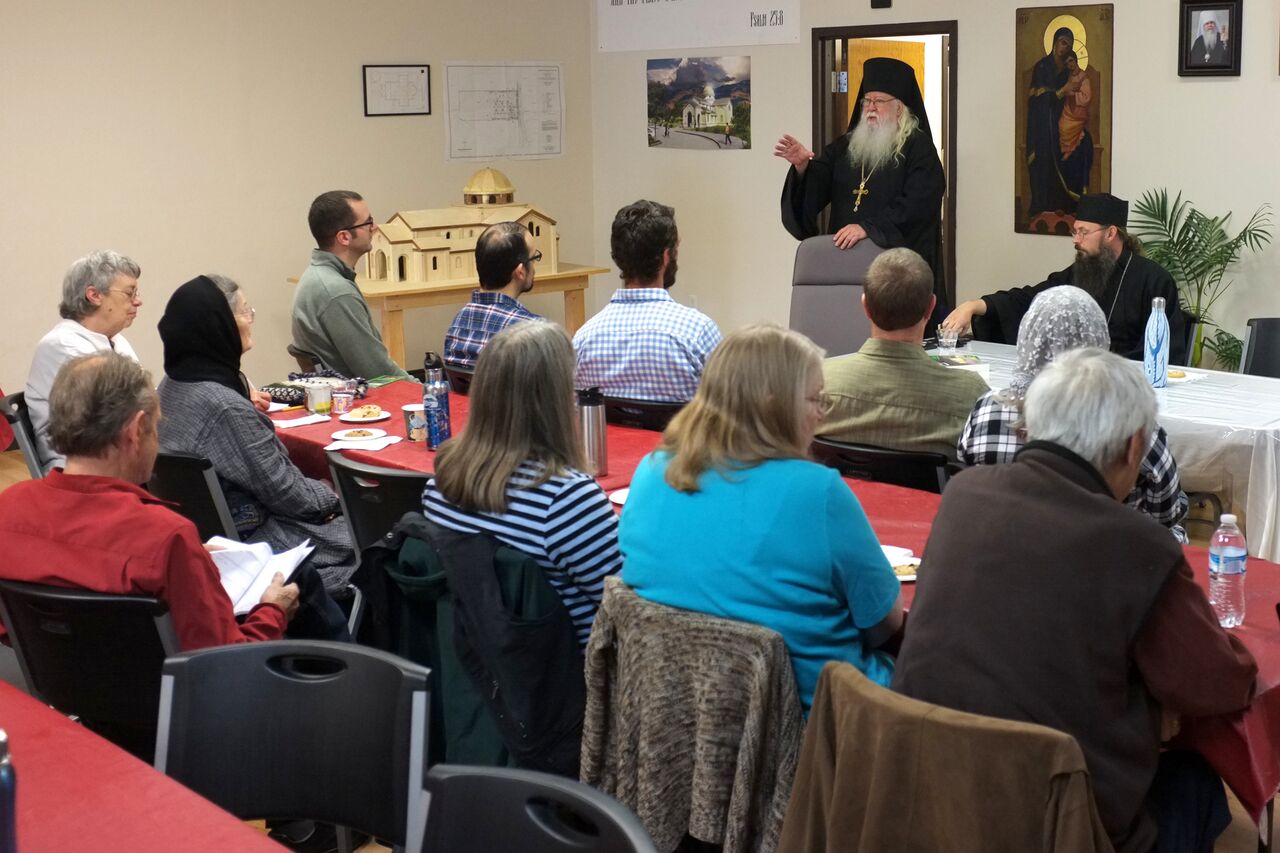
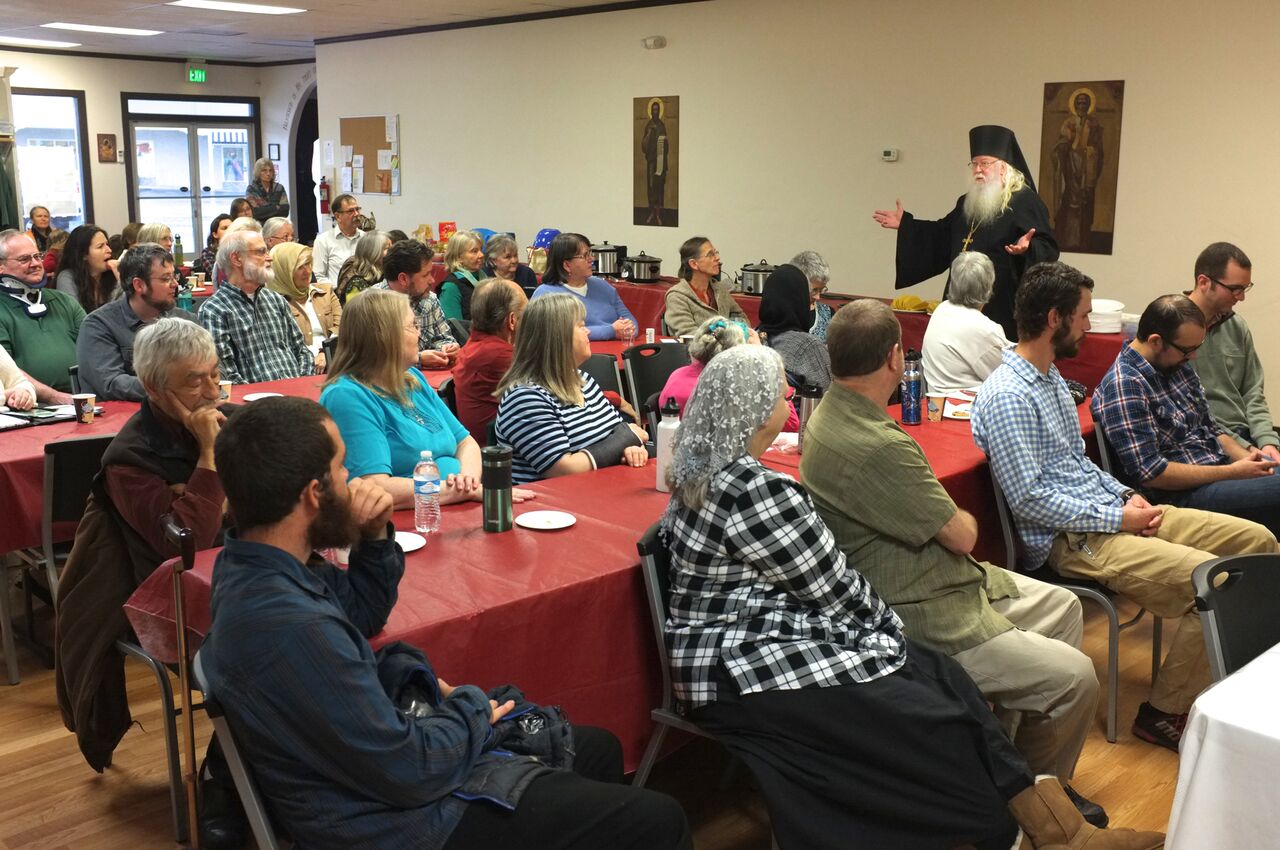
Photos: I spoke from 10 to 4 on Saturday, with the blessings of my Archbishop Kyrill, and OCA Archbishop Benjamin, before a Pan-Orthodox gathering held at Archangel Gabriel Orthodox Mission near Ashland, Oregon. The parish priest, my friend Father Andreas Blom, is from Sweden. People came Greek, OCA, and ROCOR parishes from as far away as Davis, California, and Corvallis and Bend, Oregon. It is good that we Orthodox act as one, and that we not treat our jurisdictional differences as though they make us a different family. Orthodox unity is critical to our missionary efforts, as we spread the truth of Christ’s Church.

Sunday October 30, 2016 / October 17, 2016
19th Sunday after Pentecost. Tone two.
Prophet Hosea (Osee) (820 B.C.).
Monk-martyr Andrew of Crete (767).
New Hieromartyr Neophit priest, Martyrs Hyacinth and Callistus (1918).
New Hieromartyr Archbishop Alexander (Shchukin) of Semipalatinsk (1937).
Venerable Anthony, abbot, of Leokhonov (Novgorod) (1611).
Holy Martyrs and Unmercenaries Cosmas and Damian in Cilicia (4th c.), and their brothers Leontius, Anthimus, and Eutropius.
Translation of the relics (898) of St. Lazarus “Of the Four Days” (in the tomb), bishop of Kition on Cyprus.
“Before Birth and After Birth the Virgin” (1827) and “Deliverer”(1889) Icons of the Mother of God.
Martyr Queen Shushaniki (Susanna) of Georgia (475) (Georgia).
St. Joseph the Wonderworker, Catholicos of Georgia (1770) (Georgia).
Holy Martyr Kozman (Georgia).
Martyrs Ethelred and Ethelbert, princes of Kent (England) (ca. 640) (Celtic & British).
Translation of the relics of St. Ethelreda, abbes of Ely. (Celtic & British).
Scripture Readings
John 20:11-18
Mary Magdalene Sees the Risen Lord
11 But Mary stood outside by the tomb weeping, and as she wept she stooped down and looked into the tomb. 12 And she saw two angels in white sitting, one at the head and the other at the feet, where the body of Jesus had lain. 13 Then they said to her, “Woman, why are you weeping?”
She said to them, “Because they have taken away my Lord, and I do not know where they have laid Him.”
14 Now when she had said this, she turned around and saw Jesus standing there, and did not know that it was Jesus. 15 Jesus said to her, “Woman, why are you weeping? Whom are you seeking?”
She, supposing Him to be the gardener, said to Him, “Sir, if You have carried Him away, tell me where You have laid Him, and I will take Him away.”
16 Jesus said to her, “Mary!”
She turned and said to Him, “Rabboni!” (which is to say, Teacher).
17 Jesus said to her, “Do not cling to Me, for I have not yet ascended to My Father; but go to My brethren and say to them, ‘I am ascending to My Father and your Father, and to My God and your God.’”
18 Mary Magdalene came and told the disciples that she had seen the Lord, and that He had spoken these things to her.
2 Corinthians 11:31-12:9
31 The God and Father of our Lord Jesus Christ, who is blessed forever, knows that I am not lying. 32 In Damascus the governor, under Aretas the king, was guarding the city of the Damascenes with a garrison, desiring to arrest me; 33 but I was let down in a basket through a window in the wall, and escaped from his hands.
The Vision of Paradise
12 It is doubtless not profitable for me to boast. I will come to visions and revelations of the Lord: 2 I know a man in Christ who fourteen years ago—whether in the body I do not know, or whether out of the body I do not know, God knows—such a one was caught up to the third heaven. 3 And I know such a man—whether in the body or out of the body I do not know, God knows— 4 how he was caught up into Paradise and heard inexpressible words, which it is not lawful for a man to utter. 5 Of such a one I will boast; yet of myself I will not boast, except in my infirmities. 6 For though I might desire to boast, I will not be a fool; for I will speak the truth. But I refrain, lest anyone should think of me above what he sees me to be or hears from me.
The Thorn in the Flesh
7 And lest I should be exalted above measure by the abundance of the revelations, a thorn in the flesh was given to me, a messenger of Satan to buffet me, lest I be exalted above measure. 8 Concerning this thing I pleaded with the Lord three times that it might depart from me. 9 And He said to me, “My grace is sufficient for you, for My strength is made perfect in weakness.” Therefore most gladly I will rather boast in my infirmities, that the power of Christ may rest upon me.
Luke 8:5-15
5 “A sower went out to sow his seed. And as he sowed, some fell by the wayside; and it was trampled down, and the birds of the air devoured it. 6 Some fell on rock; and as soon as it sprang up, it withered away because it lacked moisture. 7 And some fell among thorns, and the thorns sprang up with it and choked it. 8 But others fell on good ground, sprang up, and yielded a crop a hundredfold.” When He had said these things He cried, “He who has ears to hear, let him hear!”
The Purpose of Parables
9 Then His disciples asked Him, saying, “What does this parable mean?”
10 And He said, “To you it has been given to know the mysteries of the kingdom of God, but to the rest it is given in parables, that
‘Seeing they may not see,
And hearing they may not understand.’
The Parable of the Sower Explained
11 “Now the parable is this: The seed is the word of God. 12 Those by the wayside are the ones who hear; then the devil comes and takes away the word out of their hearts, lest they should believe and be saved. 13 But the ones on the rock are those who, when they hear, receive the word with joy; and these have no root, who believe for a while and in time of temptation fall away. 14 Now the ones that fell among thorns are those who, when they have heard, go out and are choked with cares, riches, and pleasures of life, and bring no fruit to maturity. 15 But the ones that fell on the good ground are those who, having heard the word with a noble and good heart, keep it and bear fruit with patience.
Thank you so much for some clarification by referring to “literalism” vs the teaching of Fathers in the light of Christ’s Resurrection.