Christ’s resurrection paves the way
The fact that we Orthodox do not accept the doctrine of original sin as espoused in the West, does in no way suggest that we do not need to be born again (born anew). We believe, as did the Early Church Fathers, that we inherit only the results of Adams sin, not his guilt. This is known as ancestral sin because the sin of our first parents, Adam and Eve, resulted in our inheritance of death, sickness and an inclination toward evil. Christ’s death on the cross has its power, not in an atonement sacrifice, but in the conquering of the power of death. Death is trampled down by death. It is by Christ’s resurrection that a way was made for us to be transformed by contact with the Living God, thus becoming his children by adoption.
Although we do not refer to ourselves as “saved”, as do Evangelical Christians, we nevertheless believe that we are in need of salvation. (We believe salvation is a process.) Our understanding of sin in an ancestral way, which is distinct from the concept of original sin and the hereditary guilt that required, consequently, a substitutionary atonement-type of sacrifice, separates us doctrinally from Western Christianity.
From the Orthodox perspective, no sin can be imputed to the Church, which, in it’s essential nature, as the theanthropic Body of Christ, the spotless bride, the ark of salvation, partakes of the sinless perfection of its head; any sin is the personal sin of fallible, broken, wounded and mislead individual Christians, whose sinfulness does not taint the perfection of the Church.
We Christians all need to repent of our personal sin. There is where the accountability lies, not in any ethnic group, class, race or other category of persons. That is part of the meaning of the concept of ancestral sin. As we do not inherit the guilt of our first ancestors (only the consequences, which fall upon us as heavy burdens), likewise, no one person is guilty for the sin of any other person. We are not judged by God on the basis of being a member of a group; we are judged by our own personal choices in thought, word and deed.
Had there not been a fall, the Second Person of the Holy Trinity, the Logos (Word) would still have incarnated into the flesh and taken on our nature. For it is by this condescension by our Creator God to take on the nature of that which He created that we are given the opportunity of being deified (Saint Paul said we shall become as gods).
Our journey into the heart culminates in theosis, whereby we are joined in everlasting communion with the very God Who created us. Saint Athanasius of Alexandria said, “The Son of God became man, that we might become god.” In II Peter 1:4, we read that we have become “…partakers of divine nature.” Saint Athanasius further says that theosis is “becoming by grace what God is by nature.”
With love in Christ,
Abbot Tryphon
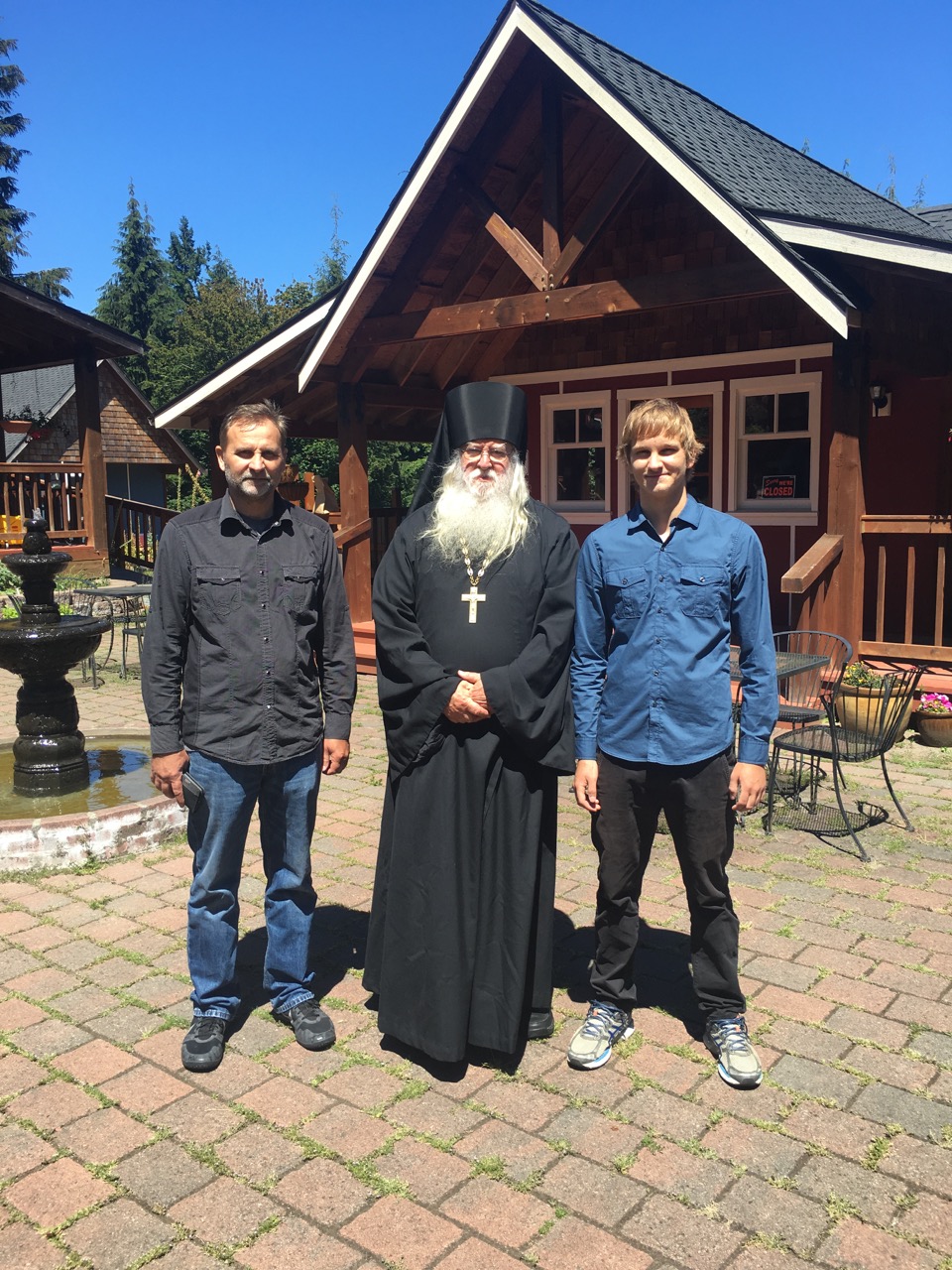
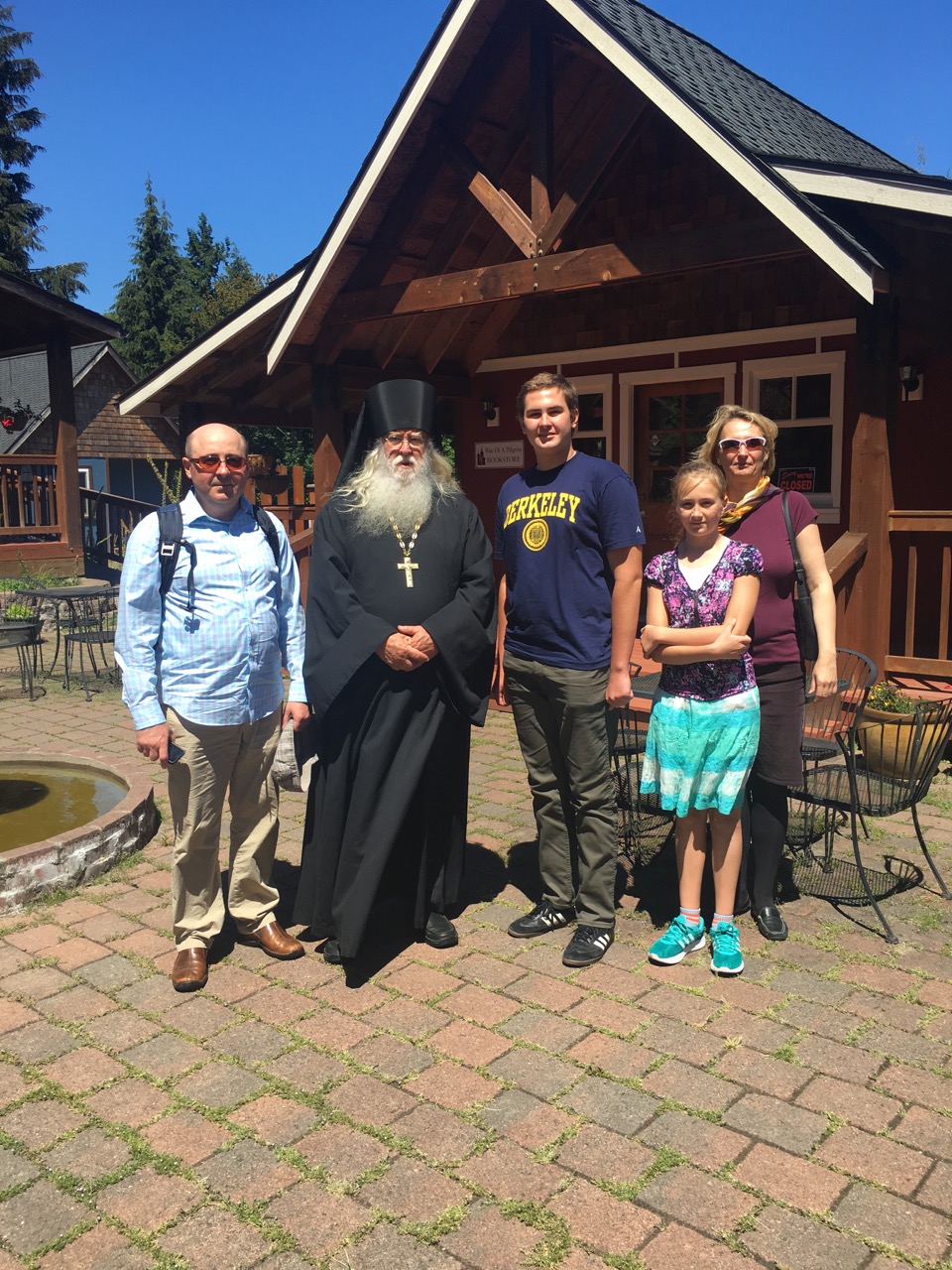
Photos: Victor Goussarav, of Los Angeles, together with his son Michael, spent a few days with us this weekend. On Sunday afternoon we received Roman Kassianik, together with his wife Tatiana, and their children Paul and Seraphim, members of Holy Virgin Cathedral in San Francisco.
Monday June 27, 2016 / June 14, 2016
2nd Week after Pentecost. Tone eight.
Apostles’ (Peter & Paul) Fast. By Monastic Charter: Strict Fast (Bread, Vegetables, Fruits)
Beginning of Apostles’ (Peter & Paul) Fast
Prophet Elisha (10th c. B.C.).
St. Methodius, patriarch of Constantinople (847).
Finding of the relics (1992) of New Hieromartyr Vladimir, Metropolitan of Kiev.
New Hieromartyr Joseph priest (1918).
New Hieromartyrs Nicholas, Alexander, Paul priests and Nicholas deacon (1938).
St. Mstislav-George, prince of Novgorod (1180).
Venerable Methodius, abbot of Peshnosha (1392).
Venerable Elisha, monk, of Suma (Solovki) (15th- 16th c.).
Synaxis of All Saints of Diveevo.
Venerable Niphon, monk of Kapsokalyvia, Mt. Athos (1330).
Venerable Julitta (Julia) of Tabenna in Egypt.
St. John (Mavropos), metropolitan of Euchaita (1100).
St. Joseph, bishop of Thessalonica, brother of St. Theodore of the Studion (830).
St. Sabbas the Fool-for-Christ of Vatopedi, Mt. Athos (1349).
St. Dogmael, monk of Pembrokeshire..
St. Cyril of Gorton.
Scripture Readings
Romans 2:28-3:18
28 For he is not a Jew who is one outwardly, nor is circumcision that which isoutward in the flesh; 29 but he is a Jew who is one inwardly; and circumcision is that of the heart, in the Spirit, not in the letter; whose praise is not from men but from God.
God’s Judgment Defended
3 What advantage then has the Jew, or what is the profit of circumcision? 2 Much in every way! Chiefly because to them were committed the oracles of God. 3 For what if some did not believe? Will their unbelief make the faithfulness of God without effect? 4 Certainly not! Indeed, let God be true but every man a liar. As it is written:
“That You may be justified in Your words,
And may overcome when You are judged.”
5 But if our unrighteousness demonstrates the righteousness of God, what shall we say? Is God unjust who inflicts wrath? (I speak as a man.) 6 Certainly not! For then how will God judge the world?
7 For if the truth of God has increased through my lie to His glory, why am I also still judged as a sinner? 8 And why not say, “Let us do evil that good may come”?—as we are slanderously reported and as some affirm that we say. Their condemnation is just.
All Have Sinned
9 What then? Are we better than they? Not at all. For we have previously charged both Jews and Greeks that they are all under sin.
10 As it is written:
“There is none righteous, no, not one;
11 There is none who understands;
There is none who seeks after God.
12 They have all turned aside;
They have together become unprofitable;
There is none who does good, no, not one.”
13 “Their throat is an open tomb;
With their tongues they have practiced deceit”;
“The poison of asps is under their lips”;
14 “Whose mouth is full of cursing and bitterness.”
15 “Their feet are swift to shed blood;
16 Destruction and misery are in their ways;
17 And the way of peace they have not known.”
18 “There is no fear of God before their eyes.”
Matthew 6:31-34
31 “Therefore do not worry, saying, ‘What shall we eat?’ or ‘What shall we drink?’ or ‘What shall we wear?’ 32 For after all these things the Gentiles seek. For your heavenly Father knows that you need all these things. 33 But seek first the kingdom of God and His righteousness, and all these things shall be added to you.34 Therefore do not worry about tomorrow, for tomorrow will worry about its own things. Sufficient for the day is its own trouble.
Matthew 7:9-11
9 Or what man is there among you who, if his son asks for bread, will give him a stone? 10 Or if he asks for a fish, will he give him a serpent? 11 If you then, being evil, know how to give good gifts to your children, how much more will your Father who is in heaven give good things to those who ask Him!