Imparting the faith as a missionary people

Two Byzantine brothers, Saints Cyril and Methodius, brought Orthodox Christianity to the Slavs in the ninth century. The brilliance of Eastern Orthodox missionary outreach, as opposed to that of the Latin Church, was in the very use of the vernacular. These great saints who became known as the Apostles to the Slavs, left the Slavs with a liturgical language that was understandable to them. The services were not imparted in the Greek language, as though it alone was sacred enough to be used in Divine Worship, but helped them understand their new faith by worshiping in their own language.
The first missionary monks to the North American came to a land where Orthodoxy had never been. Their encounter with the native peoples was one of mutual respect. They did not greet their new neighbors as pagans, but as a people who’s experience with God was limited, but who nevertheless held to certain truths that were, by their very nature, Orthodox truths. Sharing with these peoples, the Orthodox monks came to know that the native Alaskans did not worship totem poles, but used them as tools for passing on family and tribal history. The monks honored the indigenous peoples, befriending them, and, most important of all, treating them as God’s children.
As Orthodox Christians, we are duty bound to share our faith with others. Christ is for everyone, but with all the bad press Christianity has been getting during the past decade, it is especially important that we approach evangelism in light of the historic Church. The missionary mind of the Orthodox Church must be rekindled in our time. Parishes must not remain enclaves of Greeks, Russians, Bulgarians, Romanians, Palestinians, or Serbs. The doors of the churches must be opened wide, welcoming all.
Having unlocked doors is worthless if a visitor is greeted with a frown upon entering the temple. I’ve lost count at how many people have shared their experience at having been ignored by other worshipers, upon entering an Orthodox parish for the first time. Numerous people have told me about being confronted with the question, “are you Greek”, followed by, “then why are you here”. Others have shared their sadness at having been ignored in the parish hall, because they did not speak Russian, or Arabic.
A Roman Catholic friar once told me he’d gone to an Orthodox church to attend his first Divine Liturgy. The first service had concluded, and as the clergy walked down the steps, they looked right through him, as though he were invisible, even though he was wearing his Franciscan habit. He’d felt so unwelcome, he turned and left, and was deprived of his first experience of Orthodox worship. What kind of witness was this? Have we reduced Orthodoxy to the status of a private club? Do we see the Church only in ethnic terms? What if Saints Cyril and Methodius had treated the Slavs in such a manner? What if the Jewish Christians of the first century had treated the gentiles in such a manner?
Orthodox clergy must remember that we are the first line of witness for the Faith, and if we hold ourselves aloof while wearing our cassocks and crosses in public, we are in essence slamming the door in the faces of potential converts to our faith. And, as priests belonging to different jurisdictions, we must cooperate in the foundation of new missions, so we don’t undermine the ability of any one mission to support a full time priest, and raise the necessary funds to construct a permanent church. Having numerous little mission parishes without proper facilities, and a full time priest, is counterproductive to the overall goal of a mission, because the witness it gives to the community at large is one of disunity among the Orthodox, and the promotion of the commonly held view that we are multiple denominations.
With love in Christ,
Abbot Tryphon
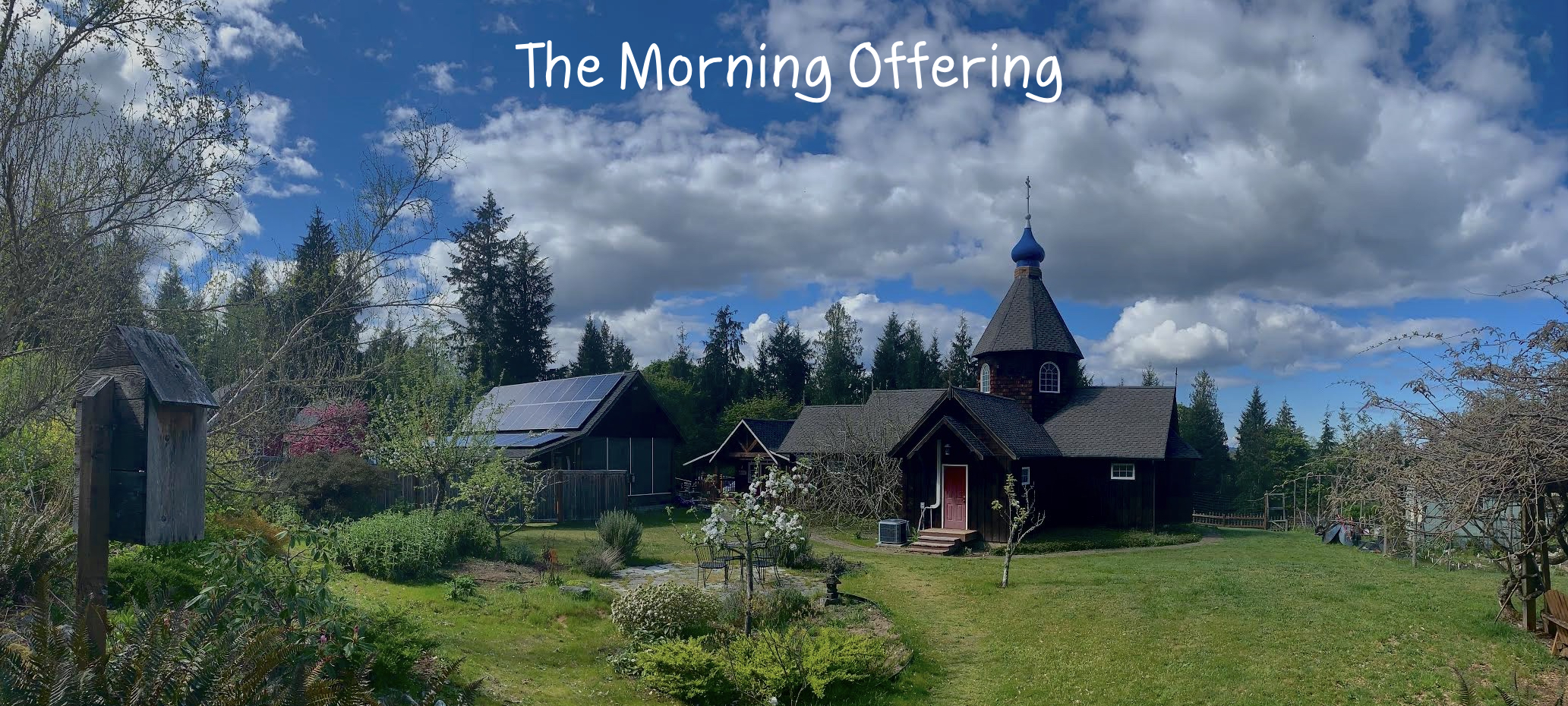
Photo: A group of twenty-four senior citizens traveled from Vancouver, WA. to visit the monastery on Thursday of this past week.
Sunday June 4, 2017 / May 22, 2017
Pentecost – Trinity Sunday.
Synaxis of Hieromartyrs of Kholmsk and Podliash (movable holiday on the Sunday after May 19th).
“Lesna” Icon of the Most Holy Theotokos (1696) (movable holiday on the Trinity Sunday).
Holy Fathers and Mothers of Atchara (18th c.) (movable holiday on the Trinity Sunday) (Georgia).
Hieromartyr Basiliscus, bishop of Comana (308).
St. John-Vladimir, martyr and ruler of Serbia (1015).
Blessed James, youth of Borovichi (Novgorod) (1540).
New Hieromartyr Michael priest (1942).
Commemoration of the Second Ecumenical Council (381).
New Hieromartyr Zachariah of Prusa (1802) (Greek).
Righteous Melchisedec, king of Salem.
Martyrs Markella and Codratus (Greek).
Martyr Sophia the Healer (Greek).
New Monk-martyrs Paul and Demetrius of Tripoli near Kalavryta (1818) (Greek).
The Scripture Readings
John 20:19-23
The Apostles Commissioned
19 Then, the same day at evening, being the first day of the week, when the doors were shut where the disciples were assembled, for fear of the Jews, Jesus came and stood in the midst, and said to them, “Peace be with you.” 20 When He had said this, He showed them His hands and His side. Then the disciples were glad when they saw the Lord.
21 So Jesus said to them again, “Peace to you! As the Father has sent Me, I also send you.” 22 And when He had said this, He breathed on them, and said to them, “Receive the Holy Spirit. 23 If you forgive the sins of any, they are forgiven them; if you retain the sins of any, they are retained.”
Acts 2:1-11
Coming of the Holy Spirit
2 When the Day of Pentecost had fully come, they were all with one accord in one place. 2 And suddenly there came a sound from heaven, as of a rushing mighty wind, and it filled the whole house where they were sitting. 3 Then there appeared to them divided tongues, as of fire, and one sat upon each of them. 4 And they were all filled with the Holy Spirit and began to speak with other tongues, as the Spirit gave them utterance.
The Crowd’s Response
5 And there were dwelling in Jerusalem Jews, devout men, from every nation under heaven. 6 And when this sound occurred, the multitude came together, and were confused, because everyone heard them speak in his own language. 7 Then they were all amazed and marveled, saying to one another, “Look, are not all these who speak Galileans? 8 And how is it that we hear, each in our own language in which we were born? 9 Parthians and Medes and Elamites, those dwelling in Mesopotamia, Judea and Cappadocia, Pontus and Asia, 10 Phrygia and Pamphylia, Egypt and the parts of Libya adjoining Cyrene, visitors from Rome, both Jews and proselytes, 11 Cretans and Arabs—we hear them speaking in our own tongues the wonderful works of God.”
John 7:37-52
The Promise of the Holy Spirit
37 On the last day, that great day of the feast, Jesus stood and cried out, saying, “If anyone thirsts, let him come to Me and drink.38 He who believes in Me, as the Scripture has said, out of his heart will flow rivers of living water.” 39 But this He spoke concerning the Spirit, whom those believing in Him would receive; for the Holy Spirit was not yet given, because Jesus was not yet glorified.
Who Is He?
40 Therefore many from the crowd, when they heard this saying, said, “Truly this is the Prophet.” 41 Others said, “This is the Christ.”
But some said, “Will the Christ come out of Galilee? 42 Has not the Scripture said that the Christ comes from the seed of David and from the town of Bethlehem, where David was?” 43 So there was a division among the people because of Him. 44 Now some of them wanted to take Him, but no one laid hands on Him.
Rejected by the Authorities
45 Then the officers came to the chief priests and Pharisees, who said to them, “Why have you not brought Him?”
46 The officers answered, “No man ever spoke like this Man!”
47 Then the Pharisees answered them, “Are you also deceived? 48 Have any of the rulers or the Pharisees believed in Him? 49 But this crowd that does not know the law is accursed.”
50 Nicodemus (he who came to Jesus by night, being one of them) said to them, 51 “Does our law judge a man before it hears him and knows what he is doing?”
52 They answered and said to him, “Are you also from Galilee? Search and look, for no prophet has arisen out of Galilee.”
We are relatively recent converts from a Protestant background. When we moved to Washington, we experienced some of what you speak about. We attended a Greek church, and a Serbian church and the people were disinterested and quite nice, respectively, but the almost exclusive use of their native languages left us out in the cold. We eventually found an OCA church where we could feel included because we could actually understand what was going on in the liturgy. In my opinion, this is America and we should speak English in our churches if we want our churches to grow .
Thank you, Abbot Tryphon for all you do to make all welcome. God bless you.
I could not agree more. English is the language of this country, and if we really desire to reach out with our Orthodox Faith, we need to do so in the language of our neighbors, and our country. Immigrants who have chosen to live in America, should embrace not only the country, but the language. Keeping our parishes as ethnic enclaves will ultimately leave our churches empty, deprived of new converts, and even our children and grandchildren.
Amen!!!!Thank you!!!
Eugenia
The issues of language are difficult. My church, Holy Cross in Ormond Beach Florida does all services in English although it is an ethnic melting pot. I happen to be a Spanish teacher and helped start a Spanish mission here in the small town where I live. The Divine Liturgy is in Spanish as are our sister churches in Miami. The great commission must be our purpose and the proclamation of the gospel. When the language is to be changed to the dominate language should be the decision of the bishop, priest and members. The Spanish mission is now going bilingual because more members have English. We have to be sensitive to all language needs and the gospel purpose.
Amen! I am always thrilled when I hear of Spanish language missions! Glory to God!
Many Orthodox immigrated to this country because there was no practical alternative, not because they loved all aspects of the established Anglo-American culture. I mean no offense, but there are some elements of the dominant Anglo-American culture which are un-Orthodox, such as a love for war. Accordingly, many Orthodox parents don’t want their children to assimilate totally into American culture. It will probably take at least another generation for an authentically American Orthodox culture to emerge (outside of Alaska, which has Orthodox communities which are 200 years old.) In the meantime, while it’s important that everyone living in the U.S. honorably fulfill the legal duties of citizenship, it’s understandable that many cradle Orthodox will have misgivings regarding America’s traditional culture and will want to retain some cultural elements from traditionally Orthodox countries.
Many American converts don’t have the time or energy to adopt a new culture. That’s also understandable. However, they shouldn’t force their culture on others. What will probably happen is that in the U.S., there will be both immigrant-oriented parishes and convert-oriented parishes existing side-by-side. Both will learn from each other and become more like each other over time. In my opinion, this is healthy and natural. This is already happening with Coptic parishes in the U.S.
This is what I worry about when going to the only three Orthodox church near me which are both hour away are: Greek, Coptic & Antiochain. Out of the three websites Ive seen only the Coptic list as Multi-ethnic and the others do not list such a thing and from the story I have heard from You Father Tryphon, I fear of going and only being disappointed or discourage of the Orthodox Faith. I’ve only recently started learning about Orthodoxy and wish to know so much more, but like I said, fear that my only places to visit I will be rejected
The bottom line is that we must not allow ourselves to be turned away from Orthodox because of a few people who refuse to welcome us. The Church’s medicine for that which ails us is too important for us to let a cold welcome turn us away.
Justin, I recommend emailing the priests at the different parishes so they’ll be expecting you. The relative warmth of the responses will tell you a lot.
Beyond that, all I can say is that my Coptic parish has welcomed converts who are Irish, Indian, African-American, etc. Pray, and God will guide you. Trust Him, be patient, and don’t be afraid. 🙂
I do agree that one sometimes one can feel isolated in a Church only speeking Serbian, but the Liturgy is so wonderful – as Heaven – and I have been told that their language is without evil words – at least the language for the Church – I have later understood . And I have no alternative in our town,It is the only Church if you have difficulty in moving around. I know Heaven is there even if I cannot speek with the people. So I am going to stay, though I now believe it will be very hard for me to learn that language. We have a translated Liturgy for the Church. So I can follow. I believe they try to preserve/ protect Heaven – ( I have been to other Swedish Churches and there IS a difference)
I have concelebrated many Lituries without understanding the language, but, as you say, when you enter into that place where heaven and earth are united, language doesn’t really matter. Better to be there, than not.
Thank you Father ! 🙂