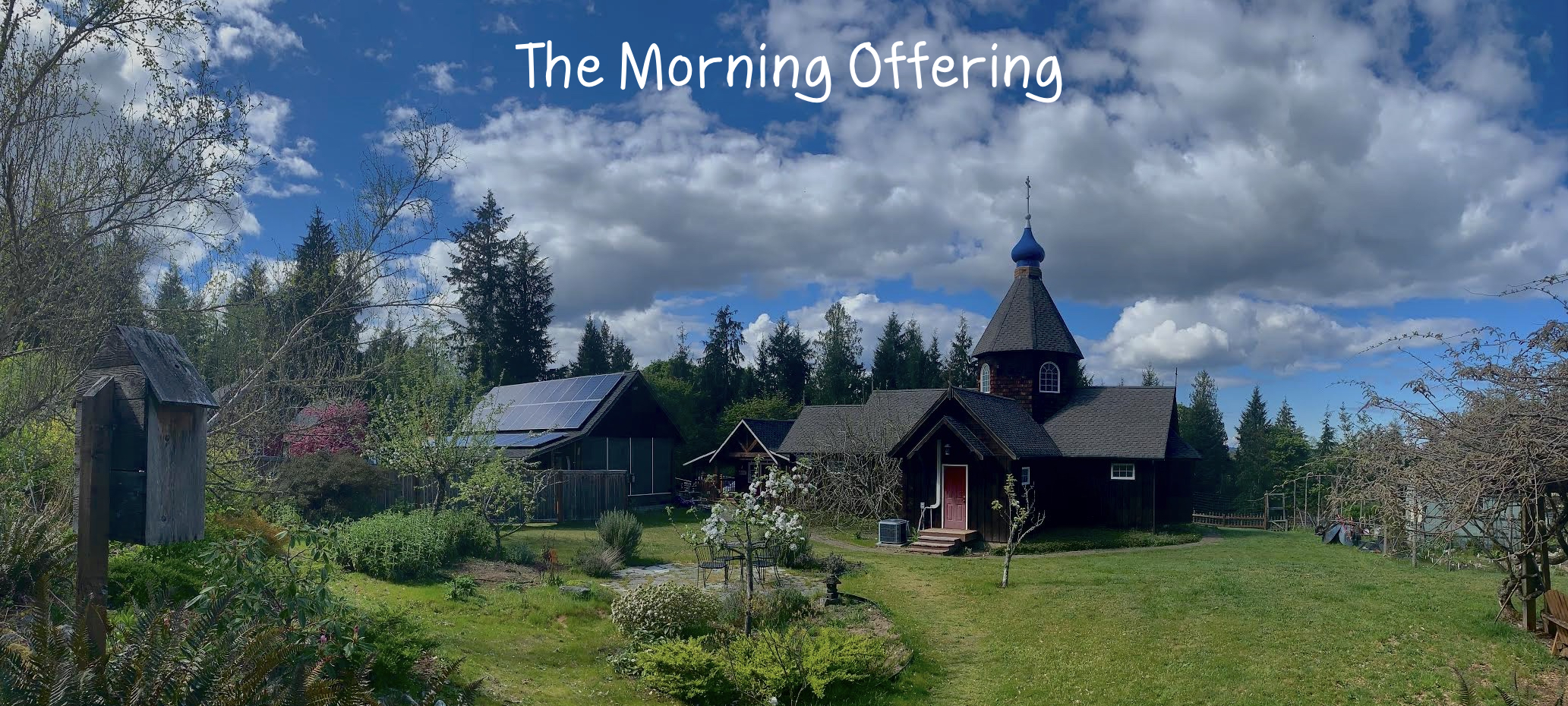
Orthodoxy and beauty are inseparable

Orthodox Christianity attracted me from my very first encounter with the magnificence of its churches and the grandeur of her divine services. Having grown up amid the natural beauty of Northern Idaho, with mountains and lakes that could take our breath away, I’d previously found inspiration primarily in the world of nature.
Orthodoxy and beauty are inseparable because God and beauty are inseparable. The beauty of a sunset is a reflection of our Creator, just as is the interior of a temple reflects our experience with this Creator God. We humans were formed as physical beings, placed in a material world and invited to commune with our Creator. The majesty and beauty of the created world inspires us to an awareness of God’s presence.
A bouquet of flowers placed in our icon corner has an internal affect on us. Created in God’s image, we in turn become creators. The beauty that comes from the artist’s brush or the poet’s voice, is an act of a creator. Taking our creative instincts into the realm of the spiritual unites us with God and connects us to the eternal. This is why an artist or a poet can experience the eternal when creating something of beauty.
God is the Creator of heaven and earth and is present through His creative energies. The material world, being good, is an important means through which God expresses Himself. It is through God’s created beauty that we are drawn into a relationship that is meant to be eternal and through which Divine Revelation can transform our nature. Then creation is completed and the created is united to the Creator.
Love in Christ,
Abbot Tryphon
Tuesday April 25, 2017 / April 12, 2017
Radonitsa, or Day of Rejoicing. Commemoration of the Dead. Tone one.
Venerable Basil the Confessor, bishop of Parium (760).
New Hieromartyr Sergius (1938).
Hieromartyr Zeno, bishop of Verona (ca. 260).
Venerable Isaac the Syrian, abbot of Spoleto, Italy (ca. 550).
Martyrs Menas, David, and John of Palestine (630).
Virgin Anthusa of Constantinople (801).
Venerable Athanasia, abbess of Aegina (860).
“Murom” (12th c.) and “Belynich” (13th c.) Icons of the Mother of God.
St. Acacius of Kapsokalyvia Skete, Mt. Athos (1730).
St. Basil, bishop of Ryazan (1295).
Deposition of the Belt of the Most Holy Mother of God in Constantinople (942).
Martyr Sabbas the Goth, who suffered at Buzau in Wallachia (372) (Romania).
St. Sergius, patriarch of Constantinople (1019).
Martyrs Demas, Protion, and those with them (Greek).
The Scripture Readings
Acts 4:1-10
Peter and John Arrested
4 Now as they spoke to the people, the priests, the captain of the temple, and the Sadducees came upon them, 2 being greatly disturbed that they taught the people and preached in Jesus the resurrection from the dead. 3 And they laid hands on them, and put them in custody until the next day, for it was already evening. 4 However, many of those who heard the word believed; and the number of the men came to be about five thousand.
Addressing the Sanhedrin
5 And it came to pass, on the next day, that their rulers, elders, and scribes, 6 as well as Annas the high priest, Caiaphas, John, and Alexander, and as many as were of the family of the high priest, were gathered together at Jerusalem. 7 And when they had set them in the midst, they asked, “By what power or by what name have you done this?”
8 Then Peter, filled with the Holy Spirit, said to them, “Rulers of the people and elders of Israel: 9 If we this day are judged for a good deed done to a helpless man, by what means he has been made well, 10 let it be known to you all, and to all the people of Israel, that by the name of Jesus Christ of Nazareth, whom you crucified, whom God raised from the dead, by Him this man stands here before you whole.
John 3:16-21
16 For God so loved the world that He gave His only begotten Son, that whoever believes in Him should not perish but have everlasting life. 17 For God did not send His Son into the world to condemn the world, but that the world through Him might be saved.
18 “He who believes in Him is not condemned; but he who does not believe is condemned already, because he has not believed in the name of the only begotten Son of God. 19 And this is the condemnation, that the light has come into the world, and men loved darkness rather than light, because their deeds were evil. 20 For everyone practicing evil hates the light and does not come to the light, lest his deeds should be exposed. 21 But he who does the truth comes to the light, that his deeds may be clearly seen, that they have been done in God.”
Rt. Rev. Father Tryphon,
As an artistic person, thank you for the lovely thoughts on the beauty of the Creator’s creation.
A couple months after I began attending services for the first time, and generally approaching Orthodoxy, I found myself taking a renewed interest in clouds. In a moment, they began to seem more alive, beautiful, and interesting than they had ever really appeared to me in my–by now–long life. Won’t make too much of it here. I’m just sayin’…