The problem of evil in God’s creation

We’ve all read news reports of horrid cases of people being imprisoned for long periods of time by perverted individuals who have been later diagnosed as classic psychopaths. By definition, psychopaths are individuals who are hateful towards others, and incapable of empathy. Sometimes known as Dissocial Personality Disorder, or Narcissistic Personality Disorder (alternate terms for sociopathic behaviour), these people are callous individuals, who are unconcerned for the feelings of others.
There is a lot of clinical evidence that points to a biological grounding for the uncaring nature of the psychopath. Since caring is a largely emotion-driven enterprise, it has been found that the brains of psychopaths have weak connections among the components of the brain’s emotional systems. Such disconnects make it impossible for the psychopath to feel emotions deeply. Disgust, as an emotion, plays an important role on our sense of ethics, and normal people find certain types of unethical actions disgusting, something that keeps them from engaging in cruel treatment of other people. But psychopaths, when shown disgusting photos of mutilated faces and when exposed to foul odors, have extremely high thresholds for disgust. In rarer cases, the psychopathic personality can be the result of having suffered an extremely abusive childhood.
Psychopaths, because they have an inability to empathize with others, are unable to feel the emotion of love. Simply put, psychopaths are not able to participate in normal, loving relationships that bound people together, as family, friends, and fellow human beings. Thus the question arises for the Christian, how can a person who does not have the ability to love, love God? And, if such a person is incapable of loving God, how can they escape eternal hell fire, since it is in this life that we are expected to prepare ourselves for an eternity in the presence of an All Holy God. If a psychopath is incapable of loving God, can we even say such a person was created in the image and likeness of God, Who is love? How can God have even allowed such a person be born, for does not this birth give life to someone who is totally incapable of gaining salvation? Wouldn’t such a birth be a violation of free will?
This question can equally be posed regarding the child born without a brain, or someone born without any cognitive abilities. Such abnormalities in God’s creation are ultimately the result, not of God’s will, but the result of the fall. The Scriptures identify sociopathic and psychopathic behavior as among the severest moral and spiritual effects of man’s fall into sin. Jesus described such sins as arising from evil hearts (Mark 7:20-23), and the holy apostle Paul identified godlessness as the root of such a deadly heart (Romans 1:28-32). In the psychopath we see the worst characteristics of sinful man’s nature, the worst effects of both genetic and environmental moral degradation.
The New Testament does not offer specifics on how a Christian society should deal with such serious problems. The Church’s teachings about morality and immorality of every kind, and her hopeful appeals and invitations to repentance, conversion, and transformed life in Christ, certainly apply to a psychopath as to any sinner. Saint Paul, describing conduct that included psychopathic characteristics, wrote to one congregation of believers in Jesus Christ, “Such were some of you” (1 Corinthians 6:9-11). As Orthodox Christians, we know that God is able to rescue and restore to righteousness the most corrupt heart. Because of this, it is possible for even a psychopath to be healed, and to come into a transformational relationship with the Living God. Yet, ultimately, much of this will remain a mystery to us, until that great day when we stand in the presence of God, and all is revealed to us. I believe culpability is the primary factor. God will not damn someone for things outside of their control.
With love in Christ,
Abbot Tryphon
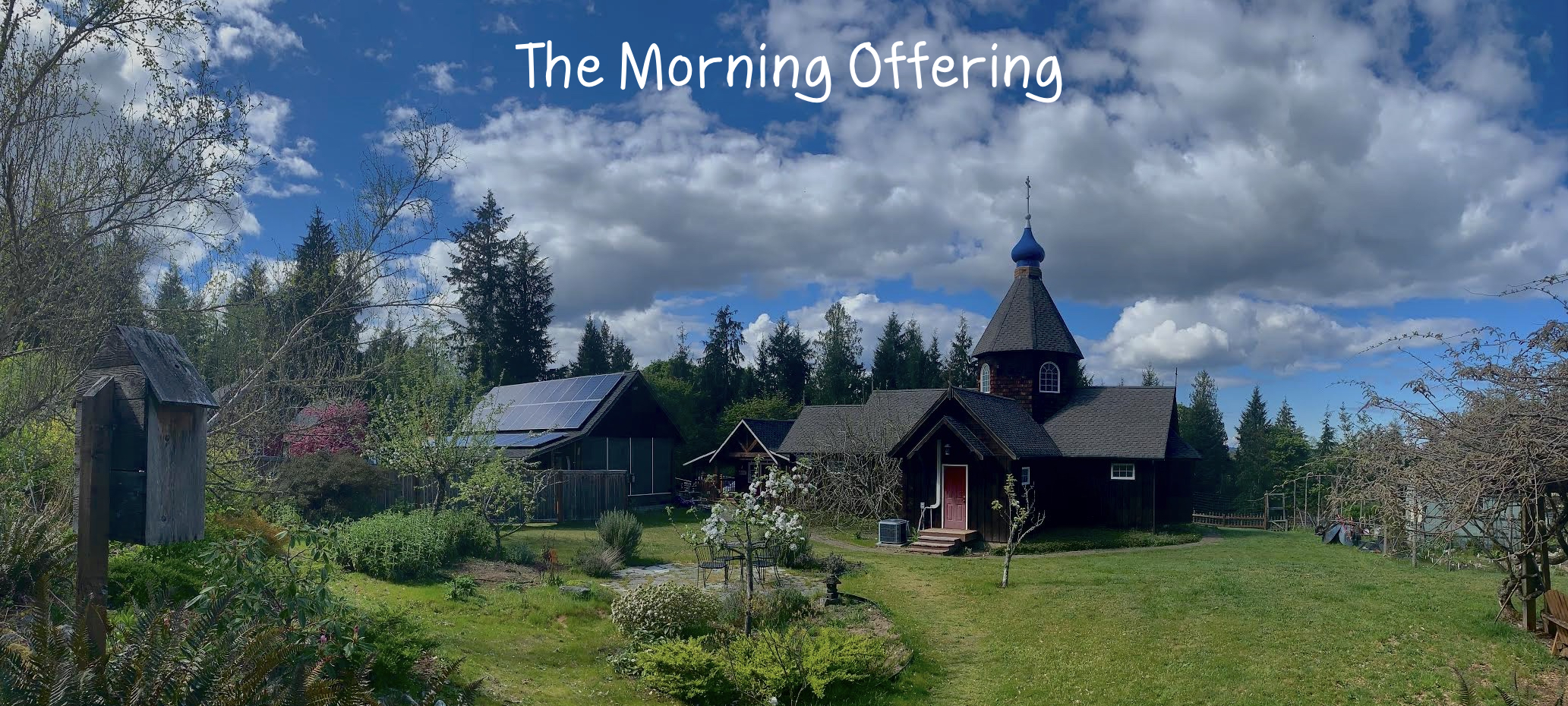
Photos: Father Martin selecting Fall and Winter flowers for the hanging baskets on the library porch. Don’t take the photo above as meaning that our beloved Monk Martin is somehow the “poster boy” for an article on evil. 🙂

Thursday September 8, 2016 / August 26, 2016
12th Week after Pentecost. Tone two.
Commemoration of the Meeting of the “Vladimir” Icon of the Most Holy Theotokos and the deliverance of Moscow from the Invasion of Tamerlane in 1395.
Martyrs Adrian and Natalia and 23 companions of Nicomedia (4th c.).
New Hieromartyr Peter priest and St. Gregory confessor, priest (1938).
Blessed Mary Diveyevo (1931).
New Hieromartyr Victor priets, Martyr Demetrius, Peter and New Hiero-confessor Archpriest Roman Medved of Moscow (1937).
New Hieromartyr Nectarius (Trezvinsky), bishop of Yaransk (1937).
Venerable Adrian, abbot of Ondrusov (Valaam) (1549).
The Pskov Caves Icon of the Most Holy Mother of God, named the “Tenderness” (1542).
Blessed Cyprian of Storozhev, former outlaw (16th c.).
Venerable Adrian, abbot of Poshekhonye (1550).
Vladimir-Eletsk Icon of the Most Holy Mother of God (1395).
Venerable Tithoes of the Thebaid (4th c.), disciple of St. Pachomius the Great (4th c.).
Venerable Ibestion the Confessor, Egyptian ascetic.
St. Zer-Jacob, missionary of Ethiopia.
Venerable Adrian of Uglich (1504), disciple of St. Paisius of Uglich.
Finding of the relics of Venerable Bassian of Alatyr Monastery (17th c.).
Monk Ioasaph, prince of India (Greek).
Martyrs Atticus and Sisinnius (Greek).
The miraculous renewal of the Vladimir Icon of the Theotokos in Harbin (Manchuria) (1925).
Scripture Readings
2 Corinthians 7:1-10
7 Therefore, having these promises, beloved, let us cleanse ourselves from all filthiness of the flesh and spirit, perfecting holiness in the fear of God.
The Corinthians’ Repentance
2 Open your hearts to us. We have wronged no one, we have corrupted no one, we have cheated no one. 3 I do not say this to condemn; for I have said before that you are in our hearts, to die together and to live together. 4 Great is my boldness of speech toward you, great is my boasting on your behalf. I am filled with comfort. I am exceedingly joyful in all our tribulation.
5 For indeed, when we came to Macedonia, our bodies had no rest, but we were troubled on every side. Outside were conflicts, inside were fears. 6 Nevertheless God, who comforts the downcast, comforted us by the coming of Titus, 7 and not only by his coming, but also by the consolation with which he was comforted in you, when he told us of your earnest desire, your mourning, your zeal for me, so that I rejoiced even more.
8 For even if I made you sorry with my letter, I do not regret it; though I did regret it. For I perceive that the same epistle made you sorry, though only for a while. 9 Now I rejoice, not that you were made sorry, but that your sorrow led to repentance. For you were made sorry in a godly manner, that you might suffer loss from us in nothing. 10 For godly sorrow produces repentance leading to salvation, not to be regretted; but the sorrow of the world produces death.
Mark 1:29-35
Peter’s Mother-in-Law Healed
29 Now as soon as they had come out of the synagogue, they entered the house of Simon and Andrew, with James and John. 30 But Simon’s wife’s mother lay sick with a fever, and they told Him about her at once. 31 So He came and took her by the hand and lifted her up, and immediately the fever left her. And she served them.
Many Healed After Sabbath Sunset
32 At evening, when the sun had set, they brought to Him all who were sick and those who were demon-possessed. 33 And the whole city was gathered together at the door. 34 Then He healed many who were sick with various diseases, and cast out many demons; and He did not allow the demons to speak, because they knew Him.
Preaching in Galilee
35 Now in the morning, having risen a long while before daylight, He went out and departed to a solitary place; and there He prayed.
Thank you ! the problem of my life, in my family, when I was married, in my life and relations.
May God help us all !
Father Bless,
I wanted to offer encouragement, I enjoy your articles so much! I converted almost two years ago from a protestant background, although l had not been living a Christian life for a while. I think that contemporary America in many ways must be one of the most challenging cultures that the Orthodox Christianity has ever encountered.
For me Orthodoxy is hard, much more difficult as one tries to progress. The demons certainty attack when they see you are on the path to Truth and as I learn more about the Orthodox understanding of the nature of this battle, I see and feel it’s effects in my life. I would love to say I live in victory but the reality is that I struggle with many of the same old temptations, but at least now I struggle instead of being oblivious.
I live about as far away as one could get from Washington (Florida) but I would love to visit someday. Please keep up the blog, it is having an impact.
When I was young I was raised as a non-nurtured child from my birth…In my 20s I was diagnosed as a psychopath…then in my 30th year God came into my life and changed my heart…I can love when before I could not…I have empathy where before I did not…I was evil …now I am not…Now I understand what I used to be …God has changed me and will continue to change me further…The darkness can always be dispelled by the Light of God…
Good article. For me it’s reinforcement that there are multiple ways to explain the same phenomenon. The fact that the physical brain of a psychopath has weaker neural circuitry in regions associated with emotion is a form of physical evidence of the effects of the fall of mankind to the Orthodox Christian.
I also appreciate the reminder of the culpability concept. God will judge the psychopath according to his situation, and each of us according to the context of our life, good to remember.