Offering the world a different perspective
Monastics are an integral part of the Church and should not be seen as independent of the Church Universal. Monks are bound by the same Gospel as other Christians and need to avail themselves to the missionary and pastoral needs of the Church, as needed. Although a primary role of monasticism is to be found in worship and contemplative prayer, monks also have a long history as missionaries.
Many of the great monasteries of Russia, as an example, were founded in remote places but became centers of pilgrimage, attracting countless people. Whole cities often formed around monasteries, precisely because the monks had reached out with the Gospel and worked among the people. Where there was a need, monks responded with charity and evangelical witness.
In these difficult times of national and global polarization, monks can bring a different perspective to those who’ve lost all hope. Monasteries become centers of spiritual healing and empowerment. People who have been struggling to find meaning in their lives can walk away with a new vision, gained through the interior work of the monks.
The strength of Orthodox monasticism is not to be found in the sameness of every monastery, for each monastic community has its own expression, often quite different from other monasteries. In Greece and Russia, there are monastic communities that run printing presses, care for the elderly and infirm, run Orthodox bookstores in cities, live as hermits, run large retreat facilities, teach in schools, and even, on occasion, serve parishes.
Monasticism is not something that is mastered through academic pursuits, but is rather acquired over many years of struggle, through obedience, long nights of prayer, ascetical practice, and communal life. A monastic, who is true to his vocation, sees himself as a beginner, even though he may have been a monk for forty years, for he realizes how far he is from the perfection that comes only from union with Christ, whom he serves.
Many would wish to see monasticism in a romantic way, with monks silently living out hidden lives, yet there are monks who work with people as spiritual fathers, preachers, teachers, ever participating actively in service to the world. Each monk, and each monastery, is called apart for the service of God and His Church, as God wishes. Thus, it is dangerous ground when we judge a monastery or a monk from our own fanciful image of what we think they should be like, for even on the Holy Mountain of Athos, there are many varieties of monastic expression, none being better than the other, and all based on the prompting of the Holy Spirit, as the monks attempt to live out the evangelical life of the Gospels.
Although the Orthodox Church does not have religious orders as the Latin Church does, there are in Orthodoxy different styles of monastic life, both individually and in community. Generally speaking some monasteries may be more liturgically oriented, while others may be more ascetic, while still others may have a certain mystical tradition, and others be more inclined to spiritual guidance and openness to the world for the purpose of spiritual care and counseling. These various styles of monasticism, which take both a personal as well as a corporate form, are not formally predetermined or officially legislated. They are the result of organic development under the living grace of God.
Yet all monastics share the common vows of poverty, chastity, stability, and obedience, ever following the words of Jesus which are the cornerstone for this life, “be ye perfect as your heavenly Father is perfect.”
With love in Christ,
Abbot Tryphon

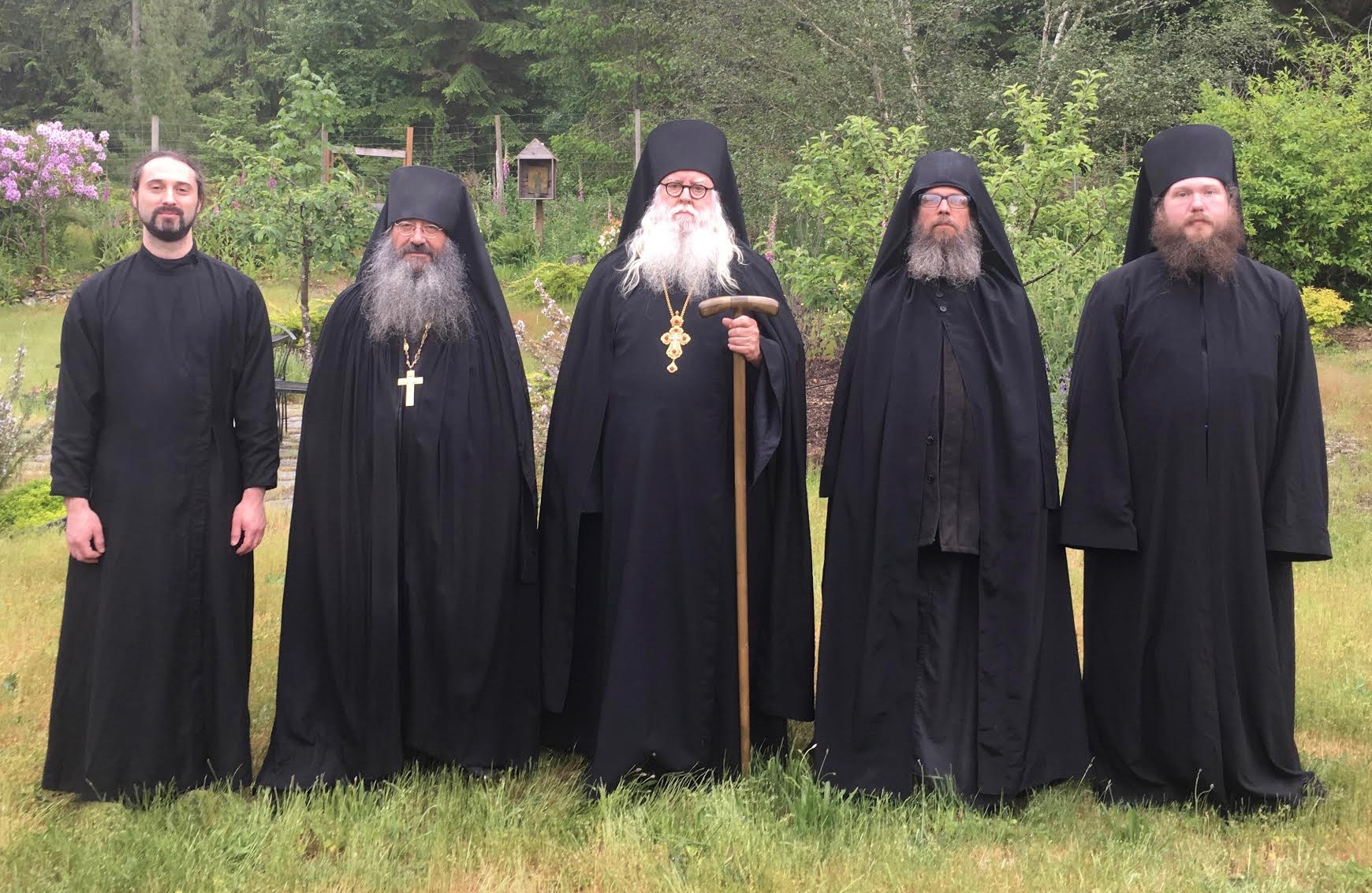
Photos: On Wednesday our Novice Peter was tonsured as a rassaphore monk. He will now be known as Monk Peter, after Saint Peter of Athos. We have grown to love Father Peter, and are filled with joy that he has chosen to be a part of this monastic brotherhood. Many years, Father Peter.

“Blogs and social networks give us new opportunities for the Christian mission…Not to be present there means to display our helplessness and lack of care for the salvation of our brothers.” His Holiness Kirill, Patriarch of Moscow and All Russia
Thursday June 1, 2017 / May 19, 2017
Afterfeast of the Ascension. Tone six.
Venerable David of the Gareji Monastery and Lukiane, Georgia (6th-7th c.) (movable holiday on the Thursday of Holy Ascension).
Hieromartyr Patrick, bishop of Prusa, and his companions: Presbyters Acacius, Menander, and Polyenus (362).
Venerable Cornelius, abbot of Komel (Vologda) (1537).
Right-believing Prince Demetrius Donskoy (1389).
New Hieromartyr Victor (1937).
New Hieromartyrs Onuphrius, archbishop of Kursk; Anthony, bishop of Belgorod, and with him priests Metrophan, Alexander, Michael, Matthew, Hippolytus, Nicholas, Basil, Nicholas, Maxim, Alexander, Paul, and Paul, and Martyrs Michael and George (1938).
New Hieromartyr Onuphrius, archbishop of Kursk (1938).
New Hieromartyr Valentine (1940).
Venerable Cornelius, abbot of Paleostrov and Valaam (1420).
St. John, prince of Uglich, tonsured as Ignatius (Vologda) (1522).
Venerable Sergius, monk, of Shukhtom (1609).
Martyr Acoluthusofthe Thebaid (284-305).
Venerable John, bishop of the Goths in Crimea (787).
Sts. Parthenius and his brother Calogerius (250).
St. Dunstan, archbishop of Canterbury (988) (Celtic & British).
Entrance of St. Nina (Nino), Equal-to-the-Apostles, into Georgia (323) (Georgia).
Monk-martyrs and confessors John, Conon, Jeremias, Cyril, Theoctistus, Barnabas, Maximus, Theognostus, Joseph, Gennadius, Gerasimus, Mark, and Herman of Cyprus, who suffered under the Latins (1231).
Synaxis of Hieromartyrs of Kharkov.
Martyrs Cyriaca and Theotima (311) (Greek).
The Scripture Readings
Matthew 11:27-30
27 All things have been delivered to Me by My Father, and no one knows the Son except the Father. Nor does anyone know the Father except the Son, and the one to whom the Son wills to reveal Him. 28 Come to Me, all you who labor and are heavy laden, and I will give you rest. 29 Take My yoke upon you and learn from Me, for I am gentle and lowly in heart, and you will find rest for your souls.30 For My yoke is easy and My burden is light.”
Acts 25:13-19
Paul Before Agrippa
13 And after some days King Agrippa and Bernice came to Caesarea to greet Festus. 14 When they had been there many days, Festus laid Paul’s case before the king, saying: “There is a certain man left a prisoner by Felix, 15 about whom the chief priests and the elders of the Jews informed me, when I was in Jerusalem, asking for a judgment against him. 16 To them I answered, ‘It is not the custom of the Romans to deliver any man to destruction before the accused meets the accusers face to face, and has opportunity to answer for himself concerning the charge against him.’ 17 Therefore when they had come together, without any delay, the next day I sat on the judgment seat and commanded the man to be brought in. 18 When the accusers stood up, they brought no accusation against him of such things as I supposed, 19 but had some questions against him about their own religion and about a certain Jesus, who had died, whom Paul affirmed to be alive.
John 16:23-33
23 “And in that day you will ask Me nothing. Most assuredly, I say to you, whatever you ask the Father in My name He will give you.24 Until now you have asked nothing in My name. Ask, and you will receive, that your joy may be full.
Jesus Christ Has Overcome the World
25 “These things I have spoken to you in figurative language; but the time is coming when I will no longer speak to you in figurative language, but I will tell you plainly about the Father. 26 In that day you will ask in My name, and I do not say to you that I shall pray the Father for you; 27 for the Father Himself loves you, because you have loved Me, and have believed that I came forth from God. 28 I came forth from the Father and have come into the world. Again, I leave the world and go to the Father.”
29 His disciples said to Him, “See, now You are speaking plainly, and using no figure of speech! 30 Now we are sure that You know all things, and have no need that anyone should question You. By this we believe that You came forth from God.”
31 Jesus answered them, “Do you now believe? 32 Indeed the hour is coming, yes, has now come, that you will be scattered, each to his own, and will leave Me alone. And yet I am not alone, because the Father is with Me. 33 These things I have spoken to you, that in Me you may have peace. In the world you will have tribulation; but be of good cheer, I have overcome the world.”
Congratulations to Father Peter and to the Community! What a great day! Peace and joy to all. And thanks to you to Abbot Tryphon for the ministry of this blog. It has been a blessing to me over the years.
Greetings from the Old Country (Pennsylvania)!! I, for one, am grateful for your digital apostolate. Even the photos that adorn your posts are uplifting. Keep up the good work and never be discouraged. You have a far greater impact in this world than you know. I’m sure of it. Slava Isusu Christu!
Your being too modest! A scriptural argument could be made that the monk/monastery is more integral, but that it IS Christianity!
Congratulations to Father Peter and the Brotherhood!
Congratulations to Fr. Peter and all of you at the holy monastery!
Axios Father Peter
Congratulations…
Fr. Peter! What a step! May love abound!