The energy of the mind inside the heart

In the patristic tradition the heart is the center of our self-awareness. This self-awareness is the energy of the mind inside the heart, something the holy fathers referred to as our “noetic faculty”. There is an important distinction that must be noted concerning the difference between the Western and Eastern understands of how we come to know God. The scholastic approach that places emphasis on the use of logic and reason in the acquisition of the knowledge of God, as seen in the teachings of Augustine of Hippo and Thomas Aquinas, is unknown in the East.
The Ancient Church taught that knowledge of God comes only through the noetic science of the heart. From the standpoint of Orthodox theology, the mind and logic are not the same thing, since logic functions within the brain, while the mind functions within the heart. Thus, the noetic faculty of the heart is the energy of the mind inside the heart. This important distinction results in the Eastern Church seeing herself not as a religious institution, but rather a hospital of the soul, wherein one comes for therapeutic procedures that restore the health of the soul, and allow for the ultimate goal of union with God (theosis). For those who wish further understanding of these ancient Christian teaching, the writings of my favorite modern theologian, Metropolitan Hierotheos of Nafpaktos, are a worthy read.
It is within the life of the Church that we enter into ascetic struggle, “working out”, just as an athlete, through fasting and prayer, and the reception of the Holy Mysteries (Holy Communion), in order to be made well. We are restored to health within the walls of this hospital of the soul, the Church, and trained to this athletic/ascetic dimension of living.
Our mishandling of the memory of God that led to the fall, is now corrected and reactivated through the healing of the “nous” (the eye of the soul), and that memory is restored. This memory is not the reclamation of something of an historical nature, but rather the opening up of a knowledge that has always been there. This healing is not of a juridical nature whereby an angry God has decided to overlook the evil and fallen nature of our souls by the bloodletting of His Son, but by the cleansing of the nous that has been darkened, restoring us to health and wholeness. The memory of God is thus restored, and we are again in full communion with the Most High, freed from the permanency of death by the trampling down of the power of death through Christ’s Holy Resurrection.
The purpose of the Church’s presence in the world is for the cure of humankind, and the restoration of the hearts of men and women. The Church thus functions as a therapy centered hospital, and the priests function as therapists. This Divine-human Organism is the living Body of Christ, the Church, and is life itself. The healing of the nous that comes within the life of the Church returns us to our true nature. In this state of wholeness our faculties are able to use logic and reason as it was meant to be used. Our reason and logic becomes the rightful vehicle by which we can explore the universe, and behold all that God has created, and science, nature, and even the cosmos, can be seen in the light of a heart is the center of our self-awareness.
Love in Christ,
Abbot Tryphon

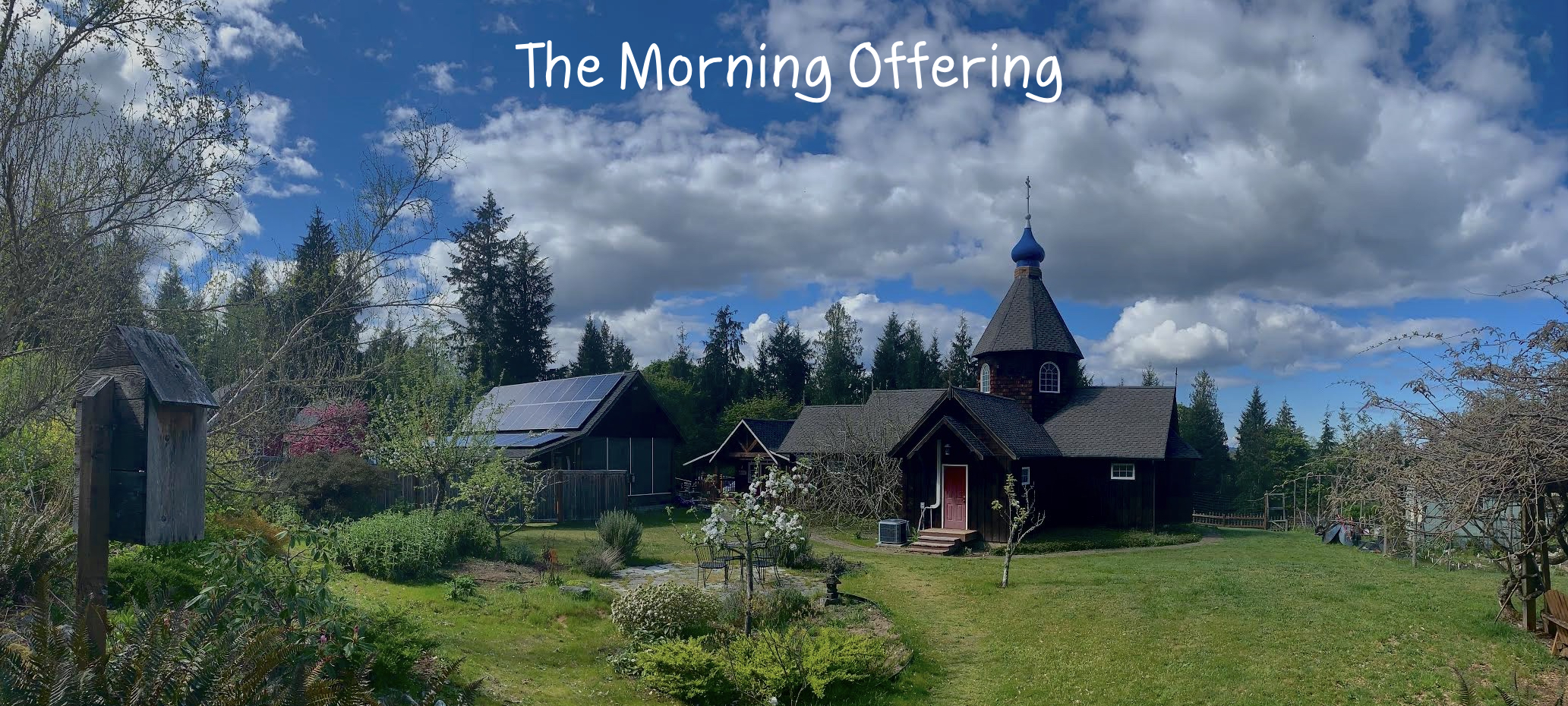
Photos: The Abbot’s study.


Wednesday August 21, 2019 / August 8, 2019
10th Week after Pentecost. Tone eight.
Dormition (Theotokos) Fast. By Monastic Charter: Strict Fast (Bread, Vegetables, Fruits)
St. Emilian the Confessor, bishop of Cyzicus (820).
St. Philaret of Ichalka, Ivanovo (1913).
New Hieromartyr Joseph (1918).
New Hieromartyr Nicholas priest (1937).
New Hieromartyr Nicodemus (Krotov) archbishop of Kostroma and Galich (1938).
Venerable Gregory, iconographer of the Kiev Caves (12th c.).
Translation of the relics (1566) of Venerables Zosimas (1478) and Sabbatius (1435) of Solovki.
Second translation of the relics (1992) of Venerables Zosimas, Sabbatius, and Herman of Solovki.
St. Myron, bishop of Crete (350).
Martyrs Eleutherius and Leonides of Constantinople, and many infants with them.
Venerable Gregory of Sinai (Mt. Athos) (1346).
“Tolga” Icon of the Most Holy Theotokos (1314).
Martyr Gormizdas of Persia (418).
New Martyr Triandaphyllus of Zagora in Thessaly (1680) (Greek).
Twelve Ascetics of Egypt (Greek).
Two Martyrs of Tyre (Greek).
Martyr Styracius (Greek).
New Martyr Anastasius (Spaso) of Radovishte in Strumica who suffered at Thessalonica (1794) (Greek).
St. Gregory, wonderworker of the Kiev Caves (14th c.).
St. Zosimas the Sinaite of Tumana Monastery, Serbia (14th c.).
Monk-martyr Euthymius, abbot of the Monastery of St. John the Baptist at Garesja, Georgia (1804).
The Scripture Readings
1 Corinthians 16:4-12
4 But if it is fitting that I go also, they will go with me.
Personal Plans
5 Now I will come to you when I pass through Macedonia (for I am passing through Macedonia). 6 And it may be that I will remain, or even spend the winter with you, that you may send me on my journey, wherever I go. 7 For I do not wish to see you now on the way; but I hope to stay a while with you, if the Lord permits.
8 But I will tarry in Ephesus until Pentecost. 9 For a great and effective door has opened to me, and there are many adversaries.
10 And if Timothy comes, see that he may be with you without fear; for he does the work of the Lord, as I also do. 11 Therefore let no one despise him. But send him on his journey in peace, that he may come to me; for I am waiting for him with the brethren.
12 Now concerning our brother Apollos, I strongly urged him to come to you with the brethren, but he was quite unwilling to come at this time; however, he will come when he has a convenient time.
Matthew 21:28-32
The Parable of the Two Sons
28 “But what do you think? A man had two sons, and he came to the first and said, ‘Son, go, work today in my vineyard.’ 29 He answered and said, ‘I will not,’ but afterward he regretted it and went. 30 Then he came to the second and said likewise. And he answered and said, ‘I go, sir,’ but he did not go. 31 Which of the two did the will of his father?”
They said to Him, “The first.”
Jesus said to them, “Assuredly, I say to you that tax collectors and harlots enter the kingdom of God before you. 32 For John came to you in the way of righteousness, and you did not believe him; but tax collectors and harlots believed him; and when you saw it, you did not afterward [a]relent and believe him.
Your article today gives us a true sense of purpose and meaning not only for our own being, but with the Orthodox Church. A “hospital” we all need and only by humility can accept the wrongs within our soul/heart.
Lovely photos; very peaceful settings…..
God bless!
“This self-awareness is the energy of the mind inside the heart, something the holy fathers referred to as our “noetic faculty”. ”
Is this concept of “heart” connected to the material reality of our body (soma)? Does healing of the “nous” required a material component?