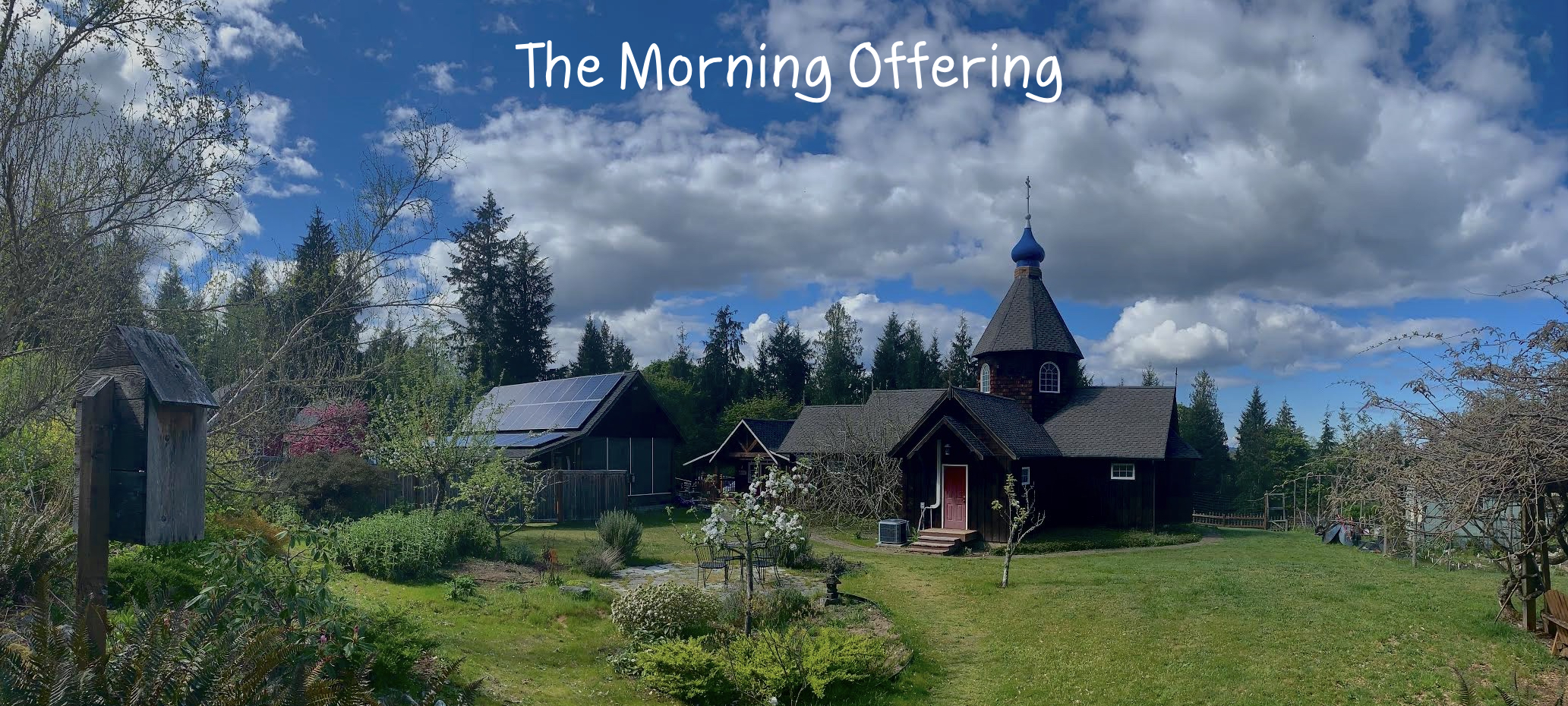
The Church, like a forest, needs oxygen

Growing up in Northern Idaho, I was surrounded by mountains and forests. I don’t remember a time when forests did not tug at my heart and fill my imagination with thoughts of adventure. As a small child my parents took my brother Dwayne, and me, on annual camping trips to a state park on the far northeast side of Lake Pend Oreille. There my dad would make us small toy canoes, complete with sails, out of birch bark. This state park is virtually unchanged since that time, and I try to visit the campground every summer, when I go bass fishing with my brother.
As a high school student I regularly went hiking in the mountains around Sandpoint, Idaho, together with my best friend (now a retired professor of the University of Edinburgh in Scotland). Jim and I would climb to the highest point of a given mountain, and pray together. We could understand the Prophet Moses meeting God on Mt. Sinai, for we too felt the presence of God on the mountain. To this day I feel closer to God when hiking in a forest, and the grandeur of the mountains that surround the Puget Sound inspire me, and lift up my soul.
When we first cleared the land to build the monastery, we cut down as few trees as possible, desiring as we did to have the buildings appear as though cupped like a kitten in the hands of God. We even named our forest after Saint Seraphim of Sarov, who himself sought solitude in a forest. Our forest not only provides that needed solitude, but like the forests throughout the whole world, provides good air to breath, and fills our lungs with the sweet odor that only a forest can provide.
Monks have always had a special place in their hearts for forests. Coptic and Ethiopian monks have been known to plant trees on desert mountains whereupon monasteries have been built, and calling these places, “holy forests”. Russian monks sought their solitude in the Northern Thebaid, forests that became their desert.
For me, forests and mountains have always been associated with prayer. My first chapel was at the end of a hidden trail, in a forest that was just a short walk down the beach from our home on Lake Pend Oreille. I’d constructed a small altar out of driftwood, and nailed a cross made out of tree branches on a tree behind the altar. When in college, my first encounter with an icon took place during the very summer I’d visited the Redwood Forest of Northern California for the first time.
Our temples are like forests in many ways. When we enter into an Orthodox temple we are encompassed in the living presence of God, and our spiritual lungs are filled. It is oxygen for the soul that we breath in, and the forest that surrounds us is none other than the cloud of witnesses, the saints, who join us in worship before the Throne of God. The oxygen we breath in is God’s Grace that flows out to all who would seek the safety and sanctuary that awaits us in God’s Holy Temple. It is the breath of life that comes in our relationship with Christ.
With love in Christ,
Abbot Tryphon
Tuesday March 20, 2018 / March 7, 2018
Fifth Week of the Great Lent. Tone eight.
Great Lent. By Monastic Charter: Food without Oil
The Holy Hieromartyrs of Cherson: Basil, Ephraim, Capito, Eugene, Aetherius, Elpidius, and Agathodorus (4th c.).
New Hieromartyr Nicholas priest (1930).
New Hieromartyr Nilus, Virgin-martyrs Matrona, Mary, Eudocia, Ecaterina, Antonina, Nadezhda, Xenia, and Anna (1938).
Venerable Paul the Simple of Egypt, disciple of St. Anthony the Great (4th c.).
St. Paul the Confessor, bishop of Prusias in Bithynia (850).
Venerable Emilian of Rome.
Icon of the Most Holy Theotokos “Surety of Sinners” in Korets (1622), Odrin (1843) and Moscow (1848).
Sts. Nestor and Arcadius, bishops of Tremithus (Greek).
Venerable Laurence, founder of the monastery of the Mother of God on Salamis (1707) (Greek).
St. Ephraim, Patriarch of Antioch (546).
St. Dandus and all Saints of Thrace.
St. Eosterwine, abbot of Wearmount.
The Scripture Readings
Luke 21:12-19
12 But before all these things, they will lay their hands on you and persecute you, delivering you up to the synagogues and prisons. You will be brought before kings and rulers for My name’s sake. 13 But it will turn out for you as an occasion for testimony.14 Therefore settle it in your hearts not to meditate beforehand on what you will answer; 15 for I will give you a mouth and wisdom which all your adversaries will not be able to contradict or resist. 16 You will be betrayed even by parents and brothers, relatives and friends; and they will put some of you to death. 17 And you will be hated by all for My name’s sake. 18 But not a hair of your head shall be lost. 19 By your patience possess your souls.
Genesis 15:1-15
God’s Covenant with Abram
15 After these things the word of the Lord came to Abram in a vision, saying, “Do not be afraid, Abram. I am your shield, your exceedingly great reward.”
2 But Abram said, “Lord God, what will You give me, seeing I go childless, and the heir of my house is Eliezer of Damascus?” 3 Then Abram said, “Look, You have given me no offspring; indeed one born in my house is my heir!”
4 And behold, the word of the Lord came to him, saying, “This one shall not be your heir, but one who will come from your own body shall be your heir.” 5 Then He brought him outside and said, “Look now toward heaven, and count the stars if you are able to number them.” And He said to him, “So shall your descendants be.”
6 And he believed in the Lord, and He accounted it to him for righteousness.
7 Then He said to him, “I am the Lord, who brought you out of Ur of the Chaldeans, to give you this land to inherit it.”
8 And he said, “Lord God, how shall I know that I will inherit it?”
9 So He said to him, “Bring Me a three-year-old heifer, a three-year-old female goat, a three-year-old ram, a turtledove, and a young pigeon.” 10 Then he brought all these to Him and cut them in two, down the middle, and placed each piece opposite the other; but he did not cut the birds in two. 11 And when the vultures came down on the carcasses, Abram drove them away.
12 Now when the sun was going down, a deep sleep fell upon Abram; and behold, horror and great darkness fell upon him. 13 Then He said to Abram: “Know certainly that your descendants will be strangers in a land that is not theirs, and will serve them, and they will afflict them four hundred years. 14 And also the nation whom they serve I will judge; afterward they shall come out with great possessions. 15 Now as for you, you shall go to your fathers in peace; you shall be buried at a good old age.
Proverbs 15:7-19
7 The lips of the wise disperse knowledge,
But the heart of the fool does not do so.
8 The sacrifice of the wicked is an abomination to the Lord,
But the prayer of the upright is His delight.
9 The way of the wicked is an abomination to the Lord,
But He loves him who follows righteousness.
10 Harsh discipline is for him who forsakes the way,
And he who hates correction will die.
11 Hell and Destruction are before the Lord;
So how much more the hearts of the sons of men.
12 A scoffer does not love one who corrects him,
Nor will he go to the wise.
13 A merry heart makes a cheerful countenance,
But by sorrow of the heart the spirit is broken.
14 The heart of him who has understanding seeks knowledge,
But the mouth of fools feeds on foolishness.
15 All the days of the afflicted are evil,
But he who is of a merry heart has a continual feast.
16 Better is a little with the fear of the Lord,
Than great treasure with trouble.
17 Better is a dinner of herbs where love is,
Than a fatted calf with hatred.
18 A wrathful man stirs up strife,
But he who is slow to anger allays contention.
19 The way of the lazy man is like a hedge of thorns,
But the way of the upright is a highway.
Beautifully written! I have often thought of the Lord as every sustaining breath I take. Thank you for your wonderful meditations!
Father Bless,
Growing up on Vashon-Maury, I, too, as a teenager, first sought the great Mysteries through solitude in Nature. Many days wandering the fields behind my home, many nights alone on KVI Beach. My approach was by no means as direct or “religious” as your own, as you describe it, but look where it led me, in time.
Evenings, now, I revisit KVI Beach, though it is harder to find time alone, there, than it used to be. And I have discovered, in my advanced age, a new appreciation for the relics of trees which lay deposited, there, just as I have–you may have noticed–for the great relics of forest giants which you allowed to remain on your monastery grounds.
I live in the Appalachian Mtns. I have a fossil, in slate, of a fern. The same ferns that still grow here. That’s a long time.
The first time I walked into a Carpatho-Rusyn church during Pentecost week, and saw white birch trees everywhere, I thought “Far Out.” It struck me as not just joyful, but even playful, in a way. Children in our Father’s house.
Part of my family is Lithuanian. The last European country to embrace Christianity, in the 14th century. Before that we worshipped forest spirits.
When I walk my neighbor’s dog, there’s a little “sacred spot” on the hill, where the dog always lies down, and I’ll pray the Trisagion prayers.