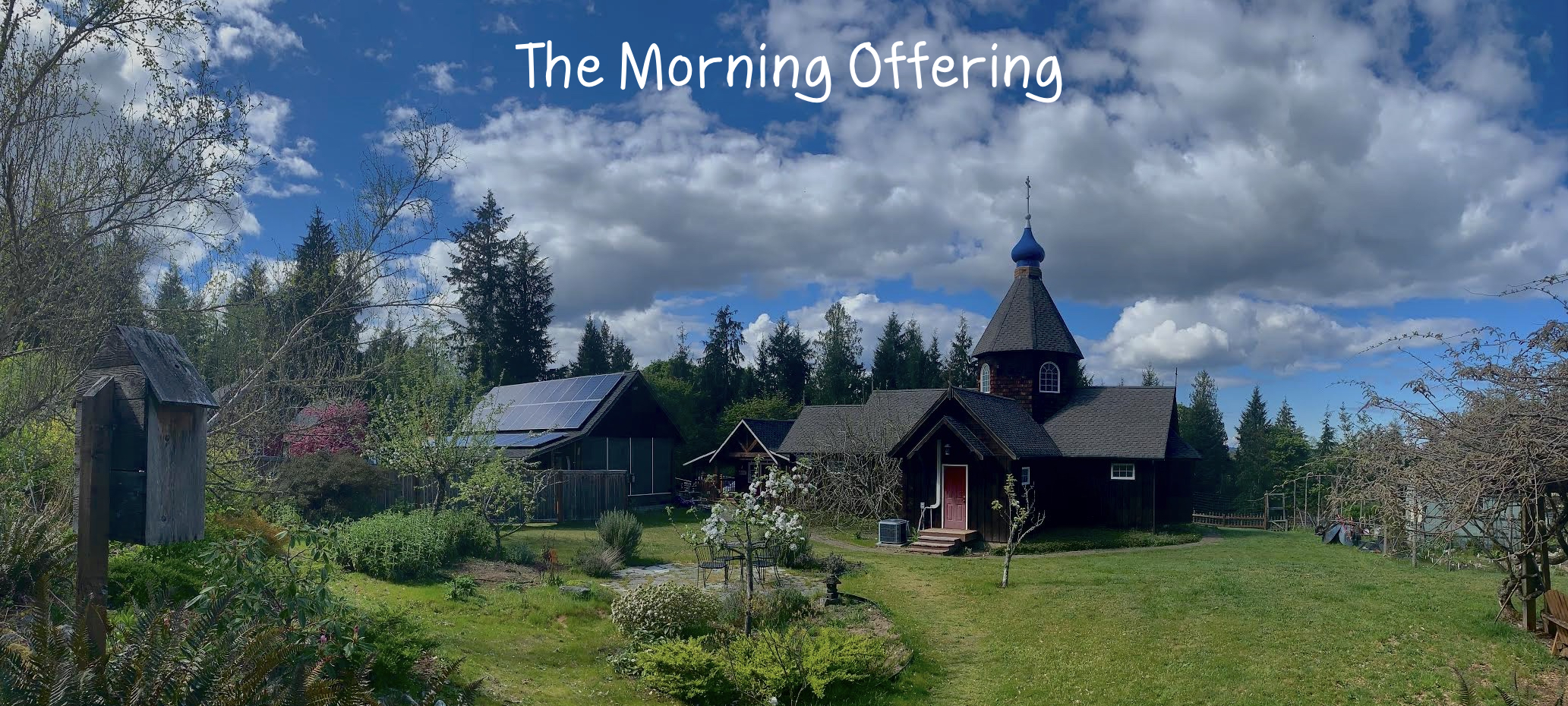
Entering into the Silence

All Orthodox Christians are aware of the importance of prayer, fasting, and almsgiving in our journey to God. These three practices are at the heart of the Great Lenten Fast. Prayer is our way of communicating with God on a daily basis, and fasting days (Wednesday and Friday) are called for throughout the Church Year. As Christians, we are also obligated to give alms to the poor, as demonstrated throughout the New Testament. Yet we often overlook the great spiritual practice of entering into the Silence as a way to discover ourselves, and deepen our experience with God’s presence.
Today’s technological advancements have introduced noise into our lives in ways unthinkable to the ancients. Not more than a hundred years ago, most families found silence as an everyday experience, for when the sun went down, families nestled into warm corners of their parlors, and their kitchens, often reading books, or simply watching a crackling fire. Along with this quieting down of the day, silence was part of every evening. Orthodox families were especially cognisant of the need to spend quiet time on the eve of the Sunday Liturgy, as well as great feasts of the Church, knowing that this silence served as a preparation time for receiving Christ’s Body and Blood, during the celebration of the upcoming Liturgy.
Keeping silence by turning off radios and television sets, muting iPods, and turning off computers, is a splendid way of allowing everyone in the family to experience the silence that allows us to listen for the voice of God, speaking in our hearts. Refraining from conversation, music, and all forms of entertainment for just an hour or two, helps open us to an experience of God that has become foreign to most modern Americans.
Silence is the means by which we may access and deepen our relationship with God, and develop self-knowledge. Silence allows us to live more harmoniously in our world, and actually listen for the voice of God speaking to our hearts. Saint Theophilus, Patriarch of Alexandria, placed the virtue of silence on par with the faith itself in a synodal letter from AD 400. “Monks—if they wish to be what they are called—will love silence and the catholic faith, for nothing at all is more important than these two things.” This invitation into the silence is not for monks only.
With love in Christ,
Abbot Tryphon
Sunday July 14, 2019 / July 1, 2019
4th Sunday after Pentecost. Tone three.
Venerables Tikhon, Basil and Nikon Sokolovsky (16th c.) (movable holiday on the 1st Sunday after June 29th).
St. Arsenius, bishop of Tver (movable holiday on the 1st Sunday after June 29th).
Synaxis of saints of Tver (movable holiday on the 1st Sunday after June 29th).
Hieromartirs Neophytus, Jonah, Neophytus, Jonah, and Parthenius of Lampsacus (movable holiday on the 1st Sunday after June 27th).
Synaxis of All Saints of Pskov-Pechers (movable holiday on the 4th Sunday of Pentecost).
Holy and Wonderworking Unmercenaries Cosmas and Damian, martyrs at Rome.
New Hieromartyr Arcadius priest (1918).
New Hieromartyr Alexis deacon (1942).
Martyr Potitus at Naples (2nd c.).
Venerable Peter the Patrician, monk, of Constantinople (854).
St. Angelina, despotina of Serbia (16th c.).
Venerable Nicodemus of Svyatogorsk (1809).
Translation of the relics of Venerable John of Rila (946) from Turnovo to Rila (1470) (Bulgaria).
Holy Julius and Aaron, protomartyrs of Wales (ca. 304) (Celtic & British).
St. Servanus, Apostle of Western Fife of East Scotland (6th c.) (Celtic & British).
St. Leontius, bishop of Radauti in Moldavia (15th c.) (Romania).
Venerable Gallus, bishop of Clermont (551) (Gaul).
25 Martyrs in Nicomedia (Greek).
Venerable Basil, founder of the Monastery of the Deep Stream in Cappadocia (10th c.) (Greek).
Martyr Constantine the Wonderworker and those with him, of Cyprus (Greek).
St. Leo the Hermit (Greek).
St. Serf, bishop of Kinross.
St. Eparchius the Recluse of Gaul (581)
Scripture Readings
Luke 24:1-12
He Is Risen
24 Now on the first day of the week, very early in the morning, they, and certain other women with them, came to the tomb bringing the spices which they had prepared. 2 But they found the stone rolled away from the tomb. 3 Then they went in and did not find the body of the Lord Jesus. 4 And it happened, as they were greatly perplexed about this, that behold, two men stood by them in shining garments. 5 Then, as they were afraid and bowed their faces to the earth, they said to them, “Why do you seek the living among the dead? 6 He is not here, but is risen! Remember how He spoke to you when He was still in Galilee, 7 saying, ‘The Son of Man must be delivered into the hands of sinful men, and be crucified, and the third day rise again.’ ”
8 And they remembered His words. 9 Then they returned from the tomb and told all these things to the eleven and to all the rest. 10 It was Mary Magdalene, Joanna, Mary the mother of James, and the other women with them, who told these things to the apostles. 11 And their words seemed to them like idle tales, and they did not believe them. 12 But Peter arose and ran to the tomb; and stooping down, he saw the linen cloths lying by themselves; and he departed, marveling to himself at what had happened.
Romans 6:18-23
18 And having been set free from sin, you became slaves of righteousness. 19 I speak in human terms because of the weakness of your flesh. For just as you presented your members as slaves of uncleanness, and of lawlessness leading to more lawlessness, so now present your members as slaves of righteousness for holiness.
20 For when you were slaves of sin, you were free in regard to righteousness. 21 What fruit did you have then in the things of which you are now ashamed? For the end of those things is death. 22 But now having been set free from sin, and having become slaves of God, you have your fruit to holiness, and the end, everlasting life. 23 For the wages of sin is death, but the gift of God is eternal life in Christ Jesus our Lord.
Matthew 8:5-13
Jesus Heals a Centurion’s Servant
5 Now when Jesus had entered Capernaum, a centurion came to Him, pleading with Him, 6 saying, “Lord, my servant is lying at home paralyzed, dreadfully tormented.”
7 And Jesus said to him, “I will come and heal him.”
8 The centurion answered and said, “Lord, I am not worthy that You should come under my roof. But only speak a word, and my servant will be healed. 9 For I also am a man under authority, having soldiers under me. And I say to this one, ‘Go,’ and he goes; and to another, ‘Come,’ and he comes; and to my servant, ‘Do this,’ and he does it.”
10 When Jesus heard it, He marveled, and said to those who followed, “Assuredly, I say to you, I have not found such great faith, not even in Israel! 11 And I say to you that many will come from east and west, and sit down with Abraham, Isaac, and Jacob in the kingdom of heaven. 12 But the sons of the kingdom will be cast out into outer darkness. There will be weeping and gnashing of teeth.” 13 Then Jesus said to the centurion, “Go your way; and as you have believed, so let it be done for you.” And his servant was healed that same hour.
A beautiful thought to even begin anew! Throw out all that suffocates the silence in our lives. This does not mean our little children who much play and make noise as God loves these little ones dearly. The idea of being constantly in touch with others or entertained by anything and everything has really gone over the top. This is also hard on our nervous systems. I went to a clinic recently and had some blood taken for a test. First off, I noticed the loud rock music in the lab and just outside a waiting room full of people. How could this loud crashing rock music be of any comfort to an ill person or child? I couldn’t wait to get out! Being that I do maintain a lot of silence and prayer at home, I just thought, “Oh well, I am not part of that I suppose.” Well, I am not and thank God for that! On my way to the clinic now, I notice I am already getting revved up inside because it will be a hyper situation. Best to lay our the groundwork for proper and spiritual silence in our lives. God bless and thankyou!
Thank you Fr Tryphon for showing us (and the world) our absolute need for silence and how it is an integral part of our tradition. It’s a common misconception that it is intended only for monks.
I have felt myself strongly drawn to it in the last few years. Nowadays therapists are recommending it to relieve anxiety!!
Dear Abbot Tryphon
I believe silence and repentance is the two most important, not catholic faith. We are of orthodox faith Thank you for your message and wisdom. God bless you for your service.
In Jesus Christ,
Victor