The Orthodox practice of standing for worship
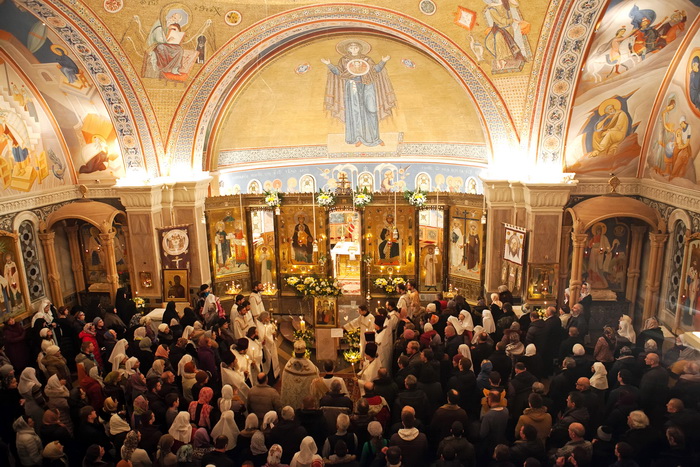
Standing before God has been the only acceptable posture for Orthodox Christians from the earliest of times. We recognize that a faithful servant would never sit before his master, for the faithful are all servants of the Lord, whom we worship as we stand in our temples. The Holy Apostle Paul tells us, “Watch ye, stand fast in the faith” (I Cor. 16:13); “Stand, therefore, having your loins girt about with truth (Ephesians 6:14).
As Christians we must always be on guard spiritually, ever more so then when attending the divine services. By standing we subject our bodies to the attention needed to properly and fully worship God with all our mind and soul. We subject ourselves before the Master as His humble servants, being attentive to our God. When we become fatigued during long services we symbolically become offerings to the very God we worship. Saint Paul says: “Present you bodies a living sacrifice, holy, acceptable unto God, which is your reasonable service” (Romans 12:1).
In addition to the ascetic practice of standing in worship, we Orthodox can also add the pious act of prostrations. Prostrations can be done when entering the nave from the narthex, before we venerate an icon in the temple, or when saying the Jesus Prayer in the privacy of our home. There are times to sit (cf. the Kathismata: the sections of the Psalter read each day: Kathisma means “seated”), and not to sit (the Akathistos: not seated!
Monks commonly perform prostrations while saying the Jesus Prayer, especially when fingering the beads that are spaced throughout one’s prayer rope. Prostrations, like standing, help aid in purifying the heart, for in doing so we bring the mind’s attention back from wandering, and worship God with body and soul united.
With love in Christ,
Abbot Tryphon
Thursday May 4, 2017 / April 21, 2017
Third Week of Pascha. Tone two.
Hieromartyr Januarius, bishop of Benevento, and his companions: Festus, Proclus, and Sosius, deacons; Desiderius, reader; and Eutychius and Acutius, laymen, at Pozzuoli (305).
Hieromartyr Theodore of Perge in Pamphylia, his mother Philippa, and Martyrs Dioscorus, Socrates, and Dionysius (2nd c.).
Uncovering of the relics (1999) of St. Theodore of Sanaxar (1791).
St. Alexis, priest of Bortsumany, Nizhni-Novgorod (1848).
New Hieromartyr John priest (1918).
St. Nicholas confessor, priest (1933).
New Hieromartyr Alexis priest (1938).
New Hieromartyr Protopresbyter Basil Martysz of Teratyn (Chelm and Podlasie, Poland) (1945).
Martyrs Isaacius, Apollo, and Codratus of Nicomedia (303).
St. Maximus (Maximian), patriarch of Constantinople (434).
The Mozdok Icon of the Mother of God.
Martyr Alexandra the Empress (303).
Venerable Jakov (James) of Stromynsk.
St. Niphon, bishop of Novgorod (Kiev Caves).
Venerable Beuno, abbot of Clynnog, England (ca. 640) (Celtic & British).
St. Maelruba of Apur Crossan (722) (Celtic & British).
St. Ethilwald, hermit of Farne. (Celtic & British).
St. Anastasius of Sinai (beg. of 8th c.).
The Scripture Readings
Acts 8:26-39
Christ Is Preached to an Ethiopian
26 Now an angel of the Lord spoke to Philip, saying, “Arise and go toward the south along the road which goes down from Jerusalem to Gaza.” This is desert. 27 So he arose and went. And behold, a man of Ethiopia, a eunuch of great authority under Candace the queen of the Ethiopians, who had charge of all her treasury, and had come to Jerusalem to worship, 28 was returning. And sitting in his chariot, he was reading Isaiah the prophet. 29 Then the Spirit said to Philip, “Go near and overtake this chariot.”
30 So Philip ran to him, and heard him reading the prophet Isaiah, and said, “Do you understand what you are reading?”
31 And he said, “How can I, unless someone guides me?” And he asked Philip to come up and sit with him. 32 The place in the Scripture which he read was this:
“He was led as a sheep to the slaughter;
And as a lamb before its shearer is silent,
So He opened not His mouth.
33 In His humiliation His justice was taken away,
And who will declare His generation?
For His life is taken from the earth.”
34 So the eunuch answered Philip and said, “I ask you, of whom does the prophet say this, of himself or of some other man?” 35 Then Philip opened his mouth, and beginning at this Scripture, preached Jesus to him. 36 Now as they went down the road, they came to some water. And the eunuch said, “See, here is water. What hinders me from being baptized?”
37 Then Philip said, “If you believe with all your heart, you may.”
And he answered and said, “I believe that Jesus Christ is the Son of God.”
38 So he commanded the chariot to stand still. And both Philip and the eunuch went down into the water, and he baptized him. 39 Now when they came up out of the water, the Spirit of the Lord caught Philip away, so that the eunuch saw him no more; and he went on his way rejoicing.
John 6:40-44
40 And this is the will of Him who sent Me, that everyone who sees the Son and believes in Him may have everlasting life; and I will raise him up at the last day.”
Rejected by His Own
41 The Jews then complained about Him, because He said, “I am the bread which came down from heaven.” 42 And they said, “Is not this Jesus, the son of Joseph, whose father and mother we know? How is it then that He says, ‘I have come down from heaven’?”
43 Jesus therefore answered and said to them, “Do not murmur among yourselves. 44 No one can come to Me unless the Father who sent Me draws him; and I will raise him up at the last day.
I so much wonder about the handicapped, so much. I cannot stand more than very short because of Post Polio, and this is a grief to me. If I stand and continue to stand I may not be able to stand at all anymore. How do the Othodox look upon a handicapped person I often wonder.
I myself, given my arthritis, can not stand for long periods of time. The practice of standing for services is much like the fasting requirements, it is expected for only those healthy enough to do so.
Thank you Father I have been wondering where they were – because I saw so few.
Dear Father,
Christ is Risen!
I ask for your prayers for our parish, that we might in unity come to realize that the pews we have are harmful to true worship.
Deacon Nicholas