Thoughts on the Oneness of Creation: What will We Experience in the Afterlife?

There is no formal doctrine in the Orthodox Church concerning the afterlife for animals, including our pets. Those Fathers of the Church who have expressed themselves on this matter were simply expressing theological opinions that have not become universally accepted, and remain known as “theologoumena” (personal opinion).
The Church has wisely refrained from pronouncing conclusively regarding the afterlife, for much remains unknown. We will not truly understand what awaits us after this life until we have entered into the afterlife. As Orthodox Christians, we simply accept the Nicaeo-Constantinopolitan Creed, reciting the words, “I look for….the life of the world to come.”
By God’s grace and our cooperation with this grace, we expect to inherit eternal life. We believe that all beings who have been a part of our lives will also be there. Some of us would even hope, along with C.S. Lewis, that it might be possible Paradise will also include our beloved pets, and even the animals that have contributed in a myriad of ways to our own well being. Would it be possible that the cow that provided milk for our children, and cheese for our table, might one day join us in a Paradise where there is no death and no pain?
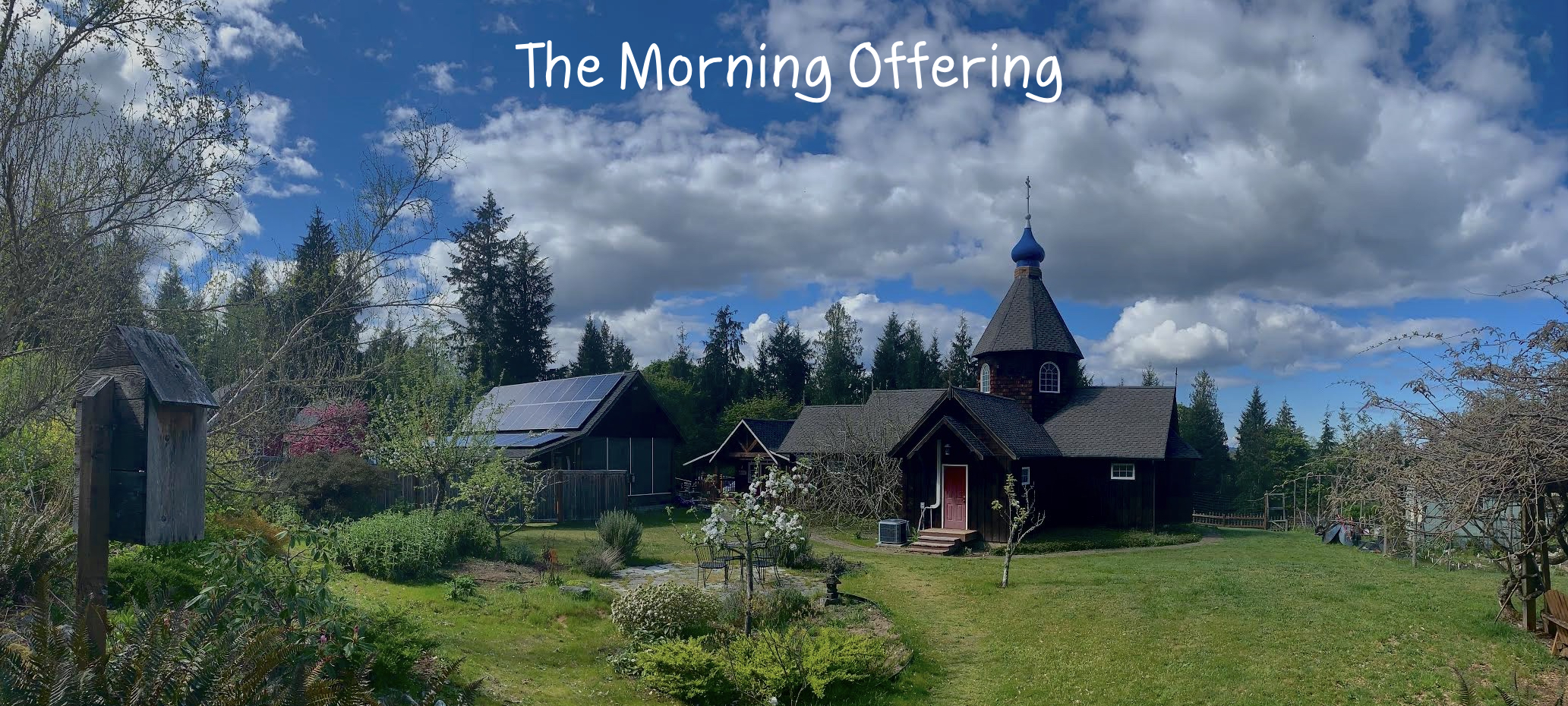
C.S. Lewis describes something like this in his book “The Great Divorce” in which a sanctified lady in paradise is accompanied by a myriad of animals as she walks in glory through the fields of Paradise. As I have enjoyed the affection and loyalty of our monastery’s wonderful Norwegian Forest Cat, Hammi, it would seem to me a Paradise without this loving little creature, would be wanting. Even the eternal loss of our hens, who’ve provided us with so many wonderful, fresh eggs, and given me so much delight, as I’ve watched them enjoying their free range lives, would seem sad to me.
This is simply my opinion, and I look forward to the possibility of meeting with the many beloved dogs and cats whose lives I have shared, over my seventy years. The saints saw animals as creatures of God, created as gifts of God’s love, and therefore resisted negligence or indifference when these animals were under their charge.
Saint Paul of Obnora was known to converse with birds, and Saint Seraphim of Sarov made friends with a bear. Saint Anthony the Great had a friendship with a lion. Saint Modestos viewed animals as sublime and mysterious gifts from God, and would often bless the livestock of the faithful – praying for their health and survival and glorifying in the vastness and beauty of all that God made. I myself, for some sixteen years, have blessed our cat Hammi, as I’ve let him out of the library after his night of sleep.
The traditional lands of Britain, Scotland, Wales and Ireland, all lands of the Celtic peoples, which, until the 11th century were part of the unified Orthodox Catholic Church and whose saints and spiritual life have much to offer the contemporary world, saw all of reality as a single unity. These saints knew, as all of the holy saints of the Church have known, that the wholeness of creation had been torn apart by the sin of Adam, and was restored by the saving act of Christ. In their lives they embodied the restoration of wholeness in creation, whether by communication with angels and spirits, or by kinship with all of the natural world.
Saint Athanasius said, “(God) provided the work of creation also as a means by which the Maker might be known … Three ways thus lay open to them, by which they might obtain the knowledge of God. (First), they could look up to the immensity of heaven, and by pondering the harmony of creation come to know its Ruler, the Word of the Father.” Thus, the natural world, seen in the light of Christ, remains a way to know God, that is, a way of salvation.
The oneness of our relationship with Creation is brought to life with the story of Saint Kevin of Glendalough. While standing at prayer in a traditional Celtic monastic position with his arms outstretched in the form of a cross, a blackbird built a nest on his arm and laid her eggs. Saint Kevin, not wanting to disturb her nest, stayed in the position until the eggs were hatched. The saint is said to have stated, “It is no great thing for me to bear this pain of holding my hand under the blackbird for the sake of heaven’s king.”
In the beginning of the restoration of the unity in the entire fallen cosmos, Christ went out into the desert and “He was with the wild beasts, and the angels served Him” (Mark 1:13). These heavenly and earthly creatures who were destined to become the new creation in the God-Man Jesus Christ were assembled around Him. There is a pointed reference to this restoration in the life of St Isaac of Syria, when he wrote:
The humble man approaches wild animals, and the moment they catch sight of him their ferocity is tamed. They come up and cling to him as their Master, wagging their tails and licking his hands and feet. They scent as coming from him the same fragrance that came from Adam before the transgression, the time when they were gathered together before him and he gave them names in Paradise. This scent was taken away from us, but Christ has renewed it and given it back to us at his coming. It is this which has sweetened the fragrance of humanity.
In other words, the state of likeness to God in Christ to which he had risen enabled him to be with the wild beasts just as Adam was in his naming of them. And, I suspect the reason pets are so important to we humans is that they aid in our journey into the restoration of kinship between two different parts of creation. Our pets become like all the animals were in the beginning, when Adam was charged with naming them.
When the human can lie down with the cat, or the dog, or the chicken, (to paraphrase Isaiah) we aid the advancement of the Kingdom just a little, work to recreate Paradise just a little, and so give new meaning to such menial tasks as cleaning out the chicken coop, or the litter box.
Finally, as one of my favorite bishops said, “Animals were with Adam and Eve in Paradise, so why on earth wouldn’t they also be in Heaven (Metropolitan Kallistos Ware)?”
With love in Christ,
Abbot Tryphon

Friday April 22, 2016 / April 9, 2016
Sixth Week of the Great Lent. Tone five.
Great Lent. By Monastic Charter: Strict Fast (Bread, Vegetables, Fruits)
Martyr Eupsychius of Caesarea in Cappadocia (362).
New Martyr Gabriel (1942).
Martyrs Desan bishop, Mariabus presbyter, Abdiesus, and 270 other martyrs in Persia (362).
Hieromartyr Bademus (Vadim), archimandrite of Persia (379).
Venerable Woutruide, foundress of a monastery (688) (Neth.).
Newly revealed Martyrs Raphael, Nicholas, and Irene of Lesbos (1463) (Greek).
Martyrs Fortunatus, Donatus, twelve virgins and six laymen at Sirmium (304).
St. Acacius, bishop of Amida in Mesopotamia (5th c.).
Scripture Readings
Isaiah 66:10-24
10 “Rejoice with Jerusalem,
And be glad with her, all you who love her;
Rejoice for joy with her, all you who mourn for her;
11 That you may feed and be satisfied
With the consolation of her bosom,
That you may drink deeply and be delighted
With the abundance of her glory.”
12 For thus says the Lord:
“Behold, I will extend peace to her like a river,
And the glory of the Gentiles like a flowing stream.
Then you shall feed;
On her sides shall you be carried,
And be dandled on her knees.
13 As one whom his mother comforts,
So I will comfort you;
And you shall be comforted in Jerusalem.”
The Reign and Indignation of God
14 When you see this, your heart shall rejoice,
And your bones shall flourish like grass;
The hand of the Lord shall be known to His servants,
And His indignation to His enemies.
15 For behold, the Lord will come with fire
And with His chariots, like a whirlwind,
To render His anger with fury,
And His rebuke with flames of fire.
16 For by fire and by His sword
The Lord will judge all flesh;
And the slain of the Lord shall be many.
17 “Those who sanctify themselves and purify themselves,
To go to the gardens
After an idol in the midst,
Eating swine’s flesh and the abomination and the mouse,
Shall be consumed together,” says the Lord.
18 “For I know their works and their thoughts. It shall be that I will gather all nations and tongues; and they shall come and see My glory. 19 I will set a sign among them; and those among them who escape I will send to the nations: to Tarshish and Pul[a] and Lud, who draw the bow, and Tubal and Javan, to the coastlands afar off who have not heard My fame nor seen My glory. And they shall declare My glory among the Gentiles. 20 Then they shall bring all your brethren for an offering to the Lord out of all nations, on horses and in chariots and in litters, on mules and on camels, to My holy mountain Jerusalem,” says the Lord, “as the children of Israel bring an offering in a clean vessel into the house of the Lord. 21 And I will also take some of them for priests and Levites,” says the Lord.
22 “For as the new heavens and the new earth
Which I will make shall remain before Me,” says the Lord,
“So shall your descendants and your name remain.
23 And it shall come to pass
That from one New Moon to another,
And from one Sabbath to another,
All flesh shall come to worship before Me,” says the Lord.
24 “And they shall go forth and look
Upon the corpses of the men
Who have transgressed against Me.
For their worm does not die,
And their fire is not quenched.
They shall be an abhorrence to all flesh.”
Genesis 49:33-50:26
33 And when Jacob had finished commanding his sons, he drew his feet up into the bed and breathed his last, and was gathered to his people.
50 Then Joseph fell on his father’s face, and wept over him, and kissed him. 2 And Joseph commanded his servants the physicians to embalm his father. So the physicians embalmed Israel. 3 Forty days were required for him, for such are the days required for those who are embalmed; and the Egyptians mourned for him seventy days.
4 Now when the days of his mourning were past, Joseph spoke to the household of Pharaoh, saying, “If now I have found favor in your eyes, please speak in the hearing of Pharaoh, saying, 5 ‘My father made me swear, saying, “Behold, I am dying; in my grave which I dug for myself in the land of Canaan, there you shall bury me.” Now therefore, please let me go up and bury my father, and I will come back.’”
6 And Pharaoh said, “Go up and bury your father, as he made you swear.”
7 So Joseph went up to bury his father; and with him went up all the servants of Pharaoh, the elders of his house, and all the elders of the land of Egypt, 8 as well as all the house of Joseph, his brothers, and his father’s house. Only their little ones, their flocks, and their herds they left in the land of Goshen. 9 And there went up with him both chariots and horsemen, and it was a very great gathering.
10 Then they came to the threshing floor of Atad, which is beyond the Jordan, and they mourned there with a great and very solemn lamentation. He observed seven days of mourning for his father. 11 And when the inhabitants of the land, the Canaanites, saw the mourning at the threshing floor of Atad, they said, “This is a deep mourning of the Egyptians.” Therefore its name was called Abel Mizraim,[a] which is beyond the Jordan.
12 So his sons did for him just as he had commanded them. 13 For his sons carried him to the land of Canaan, and buried him in the cave of the field of Machpelah, before Mamre, which Abraham bought with the field from Ephron the Hittite as property for a burial place. 14 And after he had buried his father, Joseph returned to Egypt, he and his brothers and all who went up with him to bury his father.
Joseph Reassures His Brothers
15 When Joseph’s brothers saw that their father was dead, they said, “Perhaps Joseph will hate us, and may actually repay us for all the evil which we did to him.” 16 So they sent messengers to Joseph, saying, “Before your father died he commanded, saying, 17 ‘Thus you shall say to Joseph: “I beg you, please forgive the trespass of your brothers and their sin; for they did evil to you.”’ Now, please, forgive the trespass of the servants of the God of your father.” And Joseph wept when they spoke to him.
18 Then his brothers also went and fell down before his face, and they said, “Behold, we are your servants.”
19 Joseph said to them, “Do not be afraid, for am I in the place of God? 20 But as for you, you meant evil against me; but God meant it for good, in order to bring it about as it is this day, to save many people alive. 21 Now therefore, do not be afraid; I will provide for you and your little ones.” And he comforted them and spoke kindly to them.
Death of Joseph
22 So Joseph dwelt in Egypt, he and his father’s household. And Joseph lived one hundred and ten years. 23 Joseph saw Ephraim’s children to the third generation. The children of Machir, the son of Manasseh, were also brought up on Joseph’s knees.
24 And Joseph said to his brethren, “I am dying; but God will surely visit you, and bring you out of this land to the land of which He swore to Abraham, to Isaac, and to Jacob.” 25 Then Joseph took an oath from the children of Israel, saying, “God will surely visit you, and you shall carry up my bones from here.” 26 So Joseph died, being one hundred and ten years old; and they embalmed him, and he was put in a coffin in Egypt.
Proverbs 31:8-31
8 Open your mouth for the speechless,
In the cause of all who are appointed to die.
9 Open your mouth, judge righteously,
And plead the cause of the poor and needy.
The Virtuous Wife
10 Who[b] can find a virtuous[c] wife?
For her worth is far above rubies.
11 The heart of her husband safely trusts her;
So he will have no lack of gain.
12 She does him good and not evil
All the days of her life.
13 She seeks wool and flax,
And willingly works with her hands.
14 She is like the merchant ships,
She brings her food from afar.
15 She also rises while it is yet night,
And provides food for her household,
And a portion for her maidservants.
16 She considers a field and buys it;
From her profits she plants a vineyard.
17 She girds herself with strength,
And strengthens her arms.
18 She perceives that her merchandise is good,
And her lamp does not go out by night.
19 She stretches out her hands to the distaff,
And her hand holds the spindle.
20 She extends her hand to the poor,
Yes, she reaches out her hands to the needy.
21 She is not afraid of snow for her household,
For all her household is clothed with scarlet.
22 She makes tapestry for herself;
Her clothing is fine linen and purple.
23 Her husband is known in the gates,
When he sits among the elders of the land.
24 She makes linen garments and sells them,
And supplies sashes for the merchants.
25 Strength and honor are her clothing;
She shall rejoice in time to come.
26 She opens her mouth with wisdom,
And on her tongue is the law of kindness.
27 She watches over the ways of her household,
And does not eat the bread of idleness.
28 Her children rise up and call her blessed;
Her husband also, and he praises her:
29 “Many daughters have done well,
But you excel them all.”
30 Charm is deceitful and beauty is passing,
But a woman who fears the Lord, she shall be praised.
31 Give her of the fruit of her hands,
And let her own works praise her in the gates.
The idea that salvation EXCLUDES the restoration of the ENTIRE cosmos, which includes chickens, cats, dogs, and whales is a “self-absorbed” view. It is a view that is very prideful.
Of course Hammi will be there. How dare us to presume otherwise!
in today’s daily offering you have addressed so many issues that I have pondered in my life as an Orthodox Christian….