Cremation versus the Orthodox practice of burial

The first time I ever attended a funeral service where cremation of the body of the deceased had taken place was in Portland, Oregon, many years ago. An Episcopal priest friend had died and had requested his body be cremated. Walking into the church and seeing a small box sitting before the altar was a shock for me. Cremation was always something only non-believers practiced, Christians having always viewed cremation as something of pagan roots. I clearly remember feeling cheated out of that last goodby, unable as I was to view my friend for one last time.
In ancient times pagans always either burned the bodies of their dead, or left them for birds to consume, whereas Jews and Christians placed their dead in tombs, or in the earth, awaiting the bodily resurrection. For Christians the belief that the body was the temple of the Holy Spirit and therefore sacred, made the burning of the body unacceptable. Bodies of our dead were always to be treated with great reverence. From the earliest of times the bodies of the martyrs and saints were buried in the catacombs, their tombs used as altars for the celebration of the Eucharistic offering, catacombs often being the only safe place for believers to worship without threat of arrest.
One of my earliest memories was going to a family plot in Spokane, WA. with my maternal grandmother. She would lay flowers on the graves of her loved ones, family members who were long dead before I was even born. Even though many had been gone from this life for a few generations, to my grandmother they were still alive. She would sit on a tombstone, flowers in hand, and tell me about her sisters, her parents, and other family members. Her shared memories were made all the more real seeing the names of these loved ones chiseled in stone. The ritual of visiting graves was common back in those days, with families keeping alive the memories, while showing their love and respect for their dead relatives by tending to the graves, and leaving flowers. It was even quite common, especially in Western Europe, for friends and families to take picnics to graveyards.
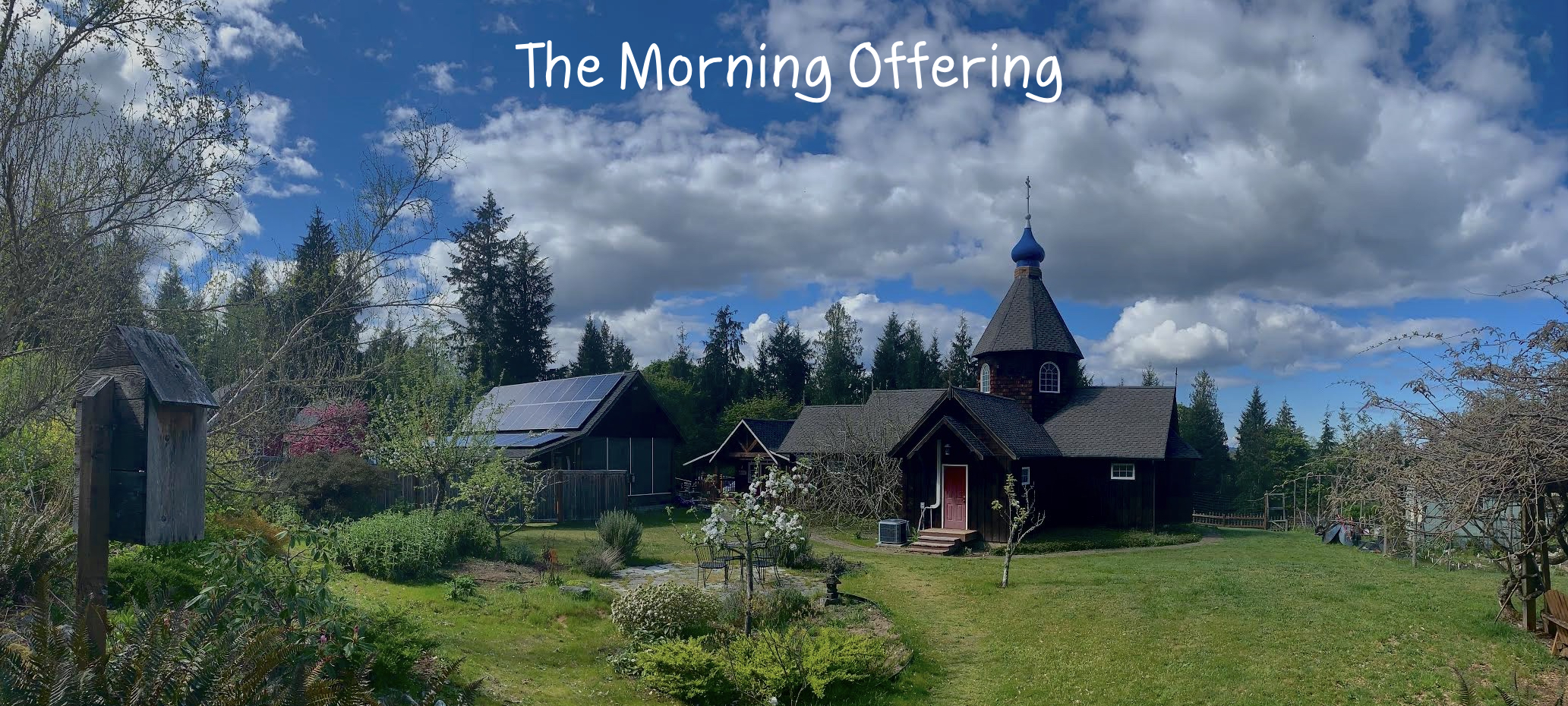
There is also the role cemeteries can play in our own spiritual lives, for they are clear reminders of our own mortality. I have already picked the plot where my own remains will be placed on the grounds of our monastery. Seeing where one will eventually be laid to rest is a good way to remember one’s own eventual death, reminding ourselves of our own mortality, and to use our remaining days wisely.
The Orthodox Church forbids the cremated remains of anyone to be brought into the temple for services, or for any other reason, and funeral services over cremated remains is strictly forbidden. The practice is seen as a denial of the bodily resurrection, not because God can’t raise the dead from ashes, but because the practice does not reflect the Church’s teaching that the body of a believer housed the Holy Spirit. It is also ignoring the fact that believers receive, in their lifetime, the very Body and Blood of Christ, and the body is therefore made holy in preparation for that day when we shall be united in both body and soul, to live forever with God.
My parents converted to Orthodoxy in their mid seventies and are buried in the church yard next to Saint John the Baptist Church in Post Falls, Idaho. Having them in an Orthodox cemetery, side by side, means a lot to me, and I visit their graves whenever I am in Northern Idaho on visits to my family. Having a plot to visit continues that connection and allows me a chance to show my love for them by placing flowers on their graves as I offering prayers for their souls. It saddens me that so many people have deprived themselves of such moments, having spread their loved one’s ashes over golf courses or on beaches. The loss of family cemeteries has contributed, I am convinced, to the breakdown of the all important extended families that were at one time so important to the cohesiveness of family values.
For those who would say that cremation is more ecologically sound, I would point out that the particles dispersed in the atmosphere are by no means good for the environment. A new way of burial, known as green burial, is gaining popularity throughout the country and is far more ecologically sound than cremation. Green burials require a simple pine coffin with no metal, nails or glue, using only wooden pegs and natural materials. The body is not embalmed (in keeping with Orthodox tradition), so nothing goes into the earth that is not natural. This is one of the most inexpensive ways of internment and is in keeping with the canons of the Orthodox Church. This is the way my own body will be laid to rest.
With love in Christ,
Abbot Tryphon


Saturday October 22, 2016 / October 9, 2016
18th Week after Pentecost. Tone eight.
Holy Apostle James, son of Alphaeus (1st c.).
Venerable Andronicus and his wife Venerable Athanasia of Egypt (500).
New Hieromartyrs Constantine and Peter priests (1918).
New Hieromartyr Constantine priest (1937).
Righteous Forefather Abraham (2000 B.C.) and his nephew Righteous Lot.
Martyrs Juventius and Maximus at Antioch (4th c.).
St. Publia the Confessor of Antioch (360).
Venerable Peter of Galatia (9th c.).
Icons of the Most Holy Theotokos “Korsun” (Cherson) and “Assuage My Sorrow”.
St. Stephen the New of Serbia (1427) (Serbia).
St. Demetrius, patriarch of Alexandria (231).
Hieromartyr Dionysius (Denis, Denys) of Paris, bishop (258) (Celtic & British).
Venerable Stephen the Blind, king of Serbia (1468).
Scripture Readings
John 21:15-25
Jesus Restores Peter
15 So when they had eaten breakfast, Jesus said to Simon Peter, “Simon, son of Jonah, do you love Me more than these?”
He said to Him, “Yes, Lord; You know that I love You.”
He said to him, “Feed My lambs.”
16 He said to him again a second time, “Simon, son of Jonah, do you love Me?”
He said to Him, “Yes, Lord; You know that I love You.”
He said to him, “Tend My sheep.”
17 He said to him the third time, “Simon, son of Jonah,[c] do you love Me?” Peter was grieved because He said to him the third time, “Do you love Me?”
And he said to Him, “Lord, You know all things; You know that I love You.”
Jesus said to him, “Feed My sheep. 18 Most assuredly, I say to you, when you were younger, you girded yourself and walked where you wished; but when you are old, you will stretch out your hands, and another will gird you and carry you where you do not wish.”19 This He spoke, signifying by what death he would glorify God. And when He had spoken this, He said to him, “Follow Me.”
The Beloved Disciple and His Book
20 Then Peter, turning around, saw the disciple whom Jesus loved following, who also had leaned on His breast at the supper, and said, “Lord, who is the one who betrays You?” 21 Peter, seeing him, said to Jesus, “But Lord, what about this man?”
22 Jesus said to him, “If I will that he remain till I come, what is that to you? You follow Me.”
23 Then this saying went out among the brethren that this disciple would not die. Yet Jesus did not say to him that he would not die, but, “If I will that he remain till I come, what is that to you?”
24 This is the disciple who testifies of these things, and wrote these things; and we know that his testimony is true.
25 And there are also many other things that Jesus did, which if they were written one by one, I suppose that even the world itself could not contain the books that would be written. Amen.
1 Corinthians 15:39-45
39 All flesh is not the same flesh, but there is one kind of flesh of men, another flesh of animals, another of fish, and another of birds.
40 There are also celestial bodies and terrestrial bodies; but the glory of the celestial is one, and the glory of the terrestrial is another. 41 There is one glory of the sun, another glory of the moon, and another glory of the stars; for one star differs from another star in glory.
42 So also is the resurrection of the dead. The body is sown in corruption, it is raised in incorruption. 43 It is sown in dishonor, it is raised in glory. It is sown in weakness, it is raised in power. 44 It is sown a natural body, it is raised a spiritual body. There is a natural body, and there is a spiritual body. 45 And so it is written, “The first man Adam became a living being.” The last Adam became a life-giving spirit.
Luke 5:27-32
Matthew the Tax Collector
27 After these things He went out and saw a tax collector named Levi, sitting at the tax office. And He said to him, “Follow Me.” 28 So he left all, rose up, and followed Him.
29 Then Levi gave Him a great feast in his own house. And there were a great number of tax collectors and others who sat down with them. 30 And their scribes and the Pharisees complained against His disciples, saying, “Why do You eat and drink with tax collectors and sinners?”
31 Jesus answered and said to them, “Those who are well have no need of a physician, but those who are sick. 32 I have not come to call the righteous, but sinners, to repentance.”
Thank you for these comments on cremation. I have in the past always had a difficult time responding to those who favor cremation and want to know why the Orthodox Church does not condone nor accept it.
Abbot Tryphon
Glory To Jesus Christ
I ( “po nashemu;” according to us) am of the same loving tradition and belief as what you describe in your “burial of our dead” article. I am 73 yrs young (much as you), raised in a Byzantine Greek Ukrainian church in Ct. We indeed also visited our cemetery after liturgy every Sunday. Of course I am perhaps ancestorially and genetically created with the rich Slavonic tones and melodies of my environment and youth. The experience of funeral and church: the smell of incense and candles, fresh flowers, and the bitter/sweet sounds of “eternal memory” with other humans and spirits ignites ” truth in my inward being” allowing me to experience the fullness of “God’s Heaven on Earth.” I also journeyed on God’s plan as a monastic in an Orthodox Monastery here in Ct/NY for 12 years. And even now having been married for 43 years after that still feel like that “monk: prophet/priest/king who continues to live the (True Believer) Orthodox Faith. I and my wife Roz are active member’s in Holy Trinity Orthodox Church in Danbury, Ct. With Father Luke Mihaly. Everyday I strive to be that suffering servant dying to myself manifesting Paul’s words that “love is patient, love is kind…..:”Please do not think me more than I am” but as in my weakness as that is my strength.
You speak lovingly of the Orthodox Tradition much as I do and believe that the mystery and meaning of salvation history are far simpler than a scholastic intellectual meaning (as in my past education). I am aware that my mind can be a cause of much chaos for me if I let it. My mind, body and spirit connection coupled with God’s grace and my free will do find meaning with prayer and fasting.
Going back to the burying of our dead: please respectfully consider some challenge thoughts to your article. The $ 15,000.00 cost of my father-in-law’s Church funeral this past February certainly give me pause. Average costs are about 10 thousand plus plots and all other expenses including legal. What you describe is beautiful and rich and meaningful. Please understand. I am of similar belief; It’s beautiful. At what cost? The lawyers, the florists, the funeral homes etc. People have limited funds and means. At a very difficult time shame and pressure making decisions are often instruments oppressing to many. Cremation is about $1200.00 now. Give the rest to the poor, Church, kids the needy. I believe in the resurrection of the body. I do not disrespect the body. Many of us has been incinerated and burned through church and human history.
I am not meaning to be trivializing nor disrespectful. I love and will defend the Orthodox Faith and live humbly as a believer. My example of living is my prayer; my prayer is patience and kindness. I am more successful sometimes more than others as now discussing differing views. Our externals and traditions are “body” as sights, sounds, tastes, touch, smells, non are insignificant. Our beliefs are true and must be faithful to Christ and the Church. Our faith as a way of life is both simple and profound “sold” by attraction rather than promotion (using 12 Step words). We have much beauty with tradition but also must live realistically in a world where some cannot understand or afford “wooden pegs for nails” in caskets, nor green funerals.” Please have patience for my words. I love your thoughts ideas and presentation. I read it daily and often share thoughts with Father Luke Mihaly (Danbury, Ct) who introduced me to your site. You remind me of the my years as a young monk in the 60’s when we as a group (12 of us with our Staretz) (Life Magazine Jan 1970) were going back to basics in NY. as a simple farming monastic community. I identified with Andrew Greeley as “New Breed” and Arlo Gutherie in the “movement” in Alice’s Restaurant. You are good for the Orthodox Church, you are good for tradition and explaining the true faith with words understandable to gutsy people. You have a great sense of humor as a great presentation speaker using modern communications skills. God is using you much as he used us then and me now “speaking Orthodox.” I did a spirituality group for 14 years in a max security prison in Garner CI. Newtown Ct. called Gutsy Spirituality. The inmates didn’t know it but I used Orthodox Spirituality.
But enough on that…. Just some thoughts………….some hopes…………….thank you for your inspiration..
Glory Now and Forever
Luke Mihaylo MSW LCSW LADC
82 Wewaka Brook Road
Bridgewater Ct. 06752
e4luke@msn.com
Abbot Tryphon
I had to respond……. with love
luke mihaylo
Thank you Father.
Two excellent resources on this subject:
book
https://www.amazon.com/Dust-Ashes-Christian-Examination-Cremation/dp/1928653219
:
Marcus Daly, Vashon Island
http://mariancaskets.com/
Marcus Daly is a good man, and worthy of your business.
just a small note – I understand that in Japan, Orthodox Christians are cremated with full church interactions. Why is that? Thank you for your reply and for your good work.
Because Japan does not have the room, and therefore does not allow burial.
Thank you for explaining the necessity of Orthodox Burial rather than cremation. We are seeing increasing numbers of our people demanding cremation, then complaining bitterly when the Funeral cannot be conducted in the Parish Church according to their wishes. (What ensues is always undignified and unbefitting a Disciple of Christ!) It is indeed, a matter of Humility and Obedience to the Divine Will of our Loving, Benevolent Lord and our own egocentric, stubborn and wilful ignorance. Furthermore the Priests who Shepherd us do not always explain clearly and concisely to the people that our body belongs to God, being a Sanctified Temple – constantly being Sanctified by means of the Holy Mysteries of which we so joyfully and freely partake. It is so sad to see lonely crosses placed along the road where people have died – not where they have been lovingly laid to rest and will continue to receive the Love of Church, family and friends so that their memory is unforgotten, and their soul prayed for! With Love in Christ.
From your article I understand the Orthodox view can be summarized as:
1. Burial shows respect for the body as the house of the Holy Spirit
2. Visiting gravesites shows respect for the dead
3. This is a reminder of our own mortality and brevity of life.
I would agree with all three yet believe cremation can incorportate those as well. For example, my wife’s aunt was cremated and her ashes placed in an urn that was located in the local cemetery. Those who wish can visit and pay their respect.
I have wrestled with this for quite some time and have concluded that burial is based more on church practice than church doctrine. I would prefer a simple cremation and have the remaining money used for the living. I believe God will raise all the dead from time past (including those whose burial has now left no visible trace of their remains). I respect your view but humbly offer cremation for the believer as a viable option.
The wonderful thing about being Orthodox, is that we don’t have to come to conclusions about what is right and proper, for the Church, guided by the Holy Spirit, has always pointed the way. My article was not based on my ideas, God forbid, but on the Mind of the Church.