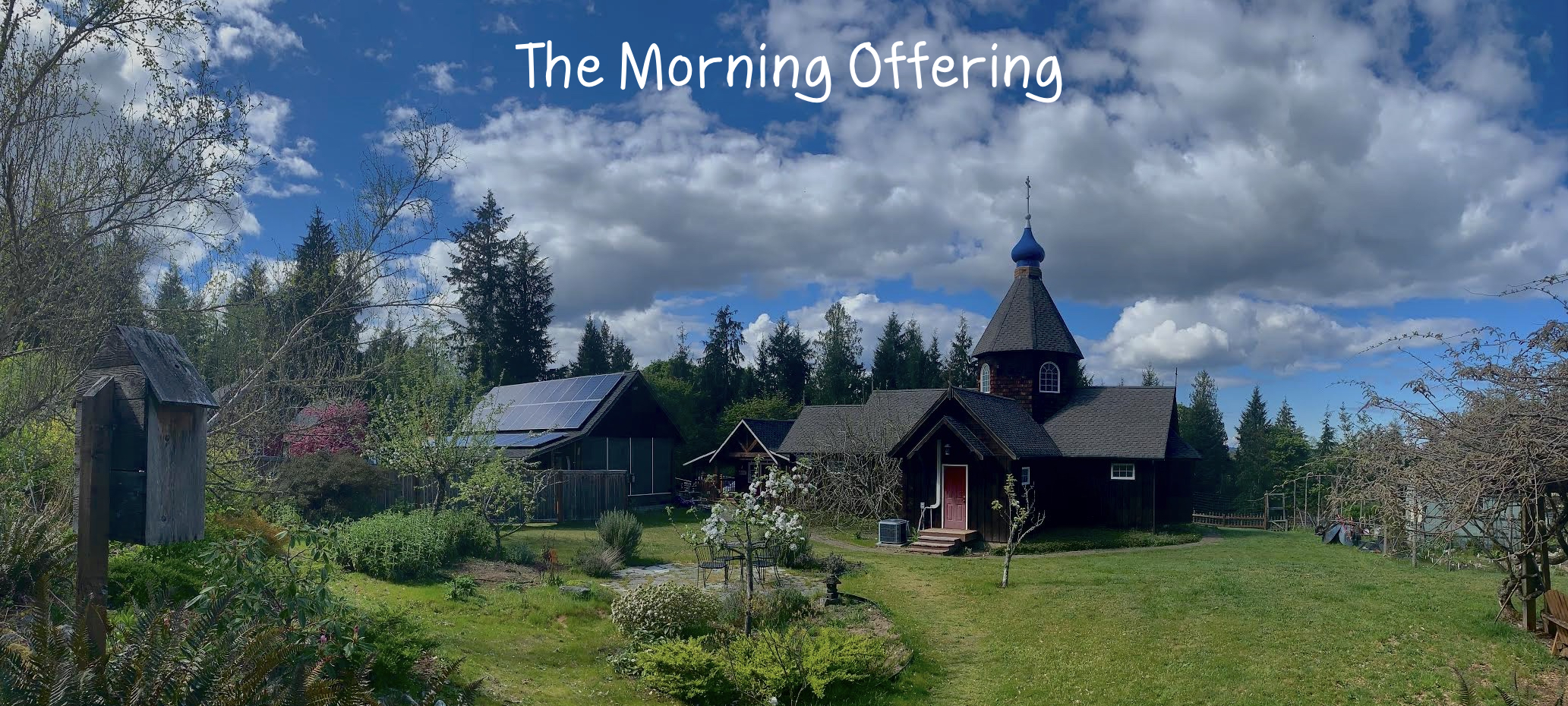
The incubator for a life of righteousness
Prior to electricity and central heating, most families gathered in parlors, spending evenings with reading, sewing, and family conversations. The notion that everyone would retreat to bedrooms, kitchens, or dens, separating themselves from other family members, was unthinkable. The communal nature of the family was natural. I can remember, as a child (this really dates me), sitting together with my brother and my parents, listening to radio dramas. Before the coming of television, families would gather for evenings in the living room, where children would play with Lincoln Logs, or play board games with their parents.
Evenings spent together as family is important, for these moments not only build a bond between parents and their children, but serve as important times in which to share family values. The old saying that “a family that prayers together, stays together” was a truism that is often forgotten. I remember, as a boy of six, a Catholic family living next to us who had a small family chapel, complete with altar, statues, and candles. Every evening they would all gather in that little chapel to pray the rosary. As a protestant boy, I remember wishing we had a chapel as well.
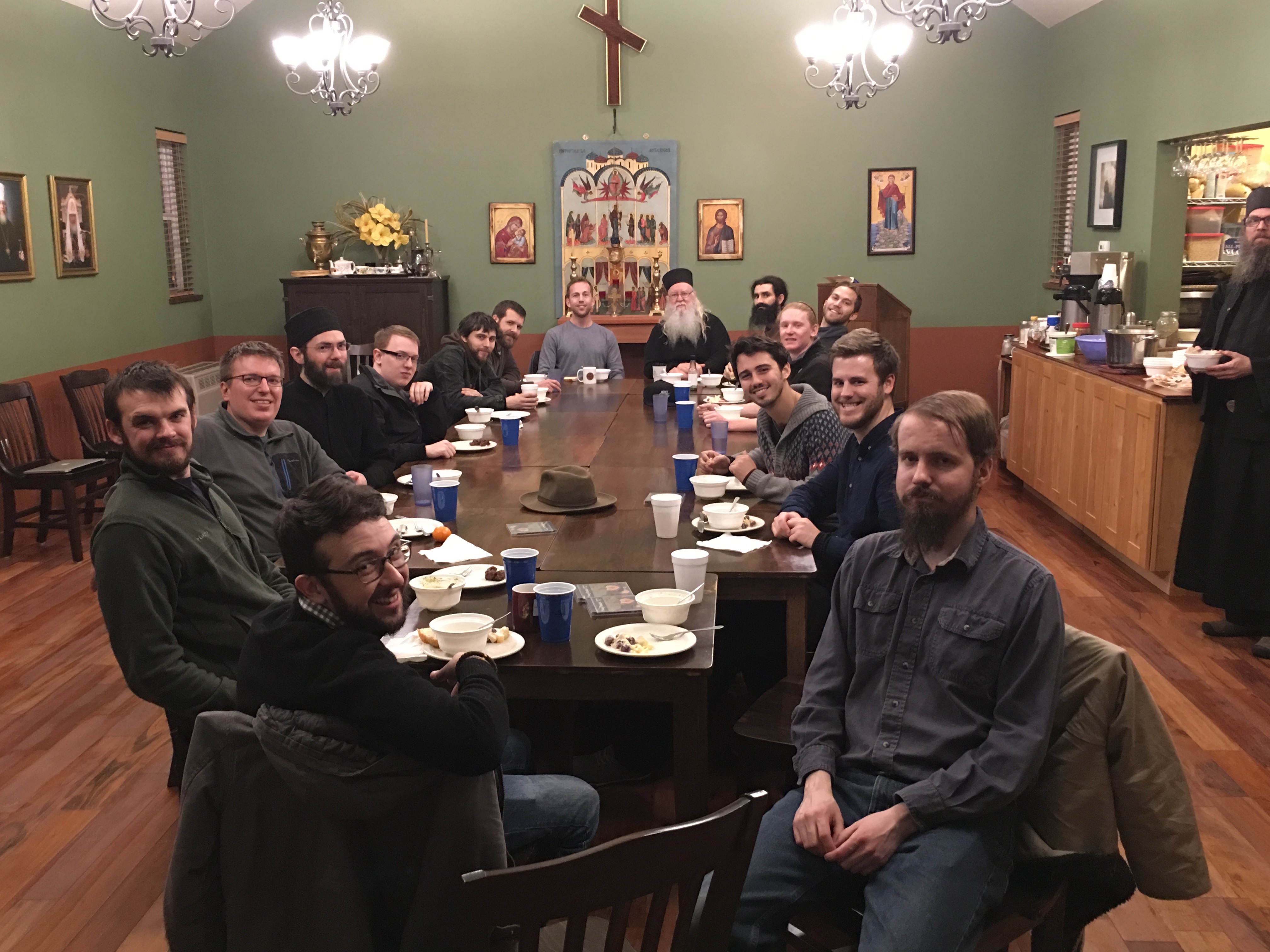
Family meals are also important times for building strong moral and spiritual foundations in children. Sitting around the dinner table is a great time for parents to develop strong bonds of trust with their children. Dinner is a perfect time for talking to your children about their friends, or school activities, or recounting the homily from the Sunday Liturgy. Family members dispersing throughout the house for the evening, can end up functioning as autonomous entities, and family bonds are unlikely to develop in a healthy manner.
The domestic church, which is such an important element of the Orthodox Christian tradition, can not be developed in a family where meals, prayers, and social life are all in separate parts of the house. Parents, in their capacity as shepherds and nurturers, have the God given responsibility to make sure the home is an incubator for a life of righteousness, and where the Orthodox faith can take root. It is in such households that these children, in turn, learn how to be good parents to their own future children.
Hebrews 10:24-25: “… and let us consider how to stimulate one another to love and good deeds, not forsaking our own assembling together, as is the habit of some, but encouraging one another …”
With love in Christ,
Abbot Tryphon
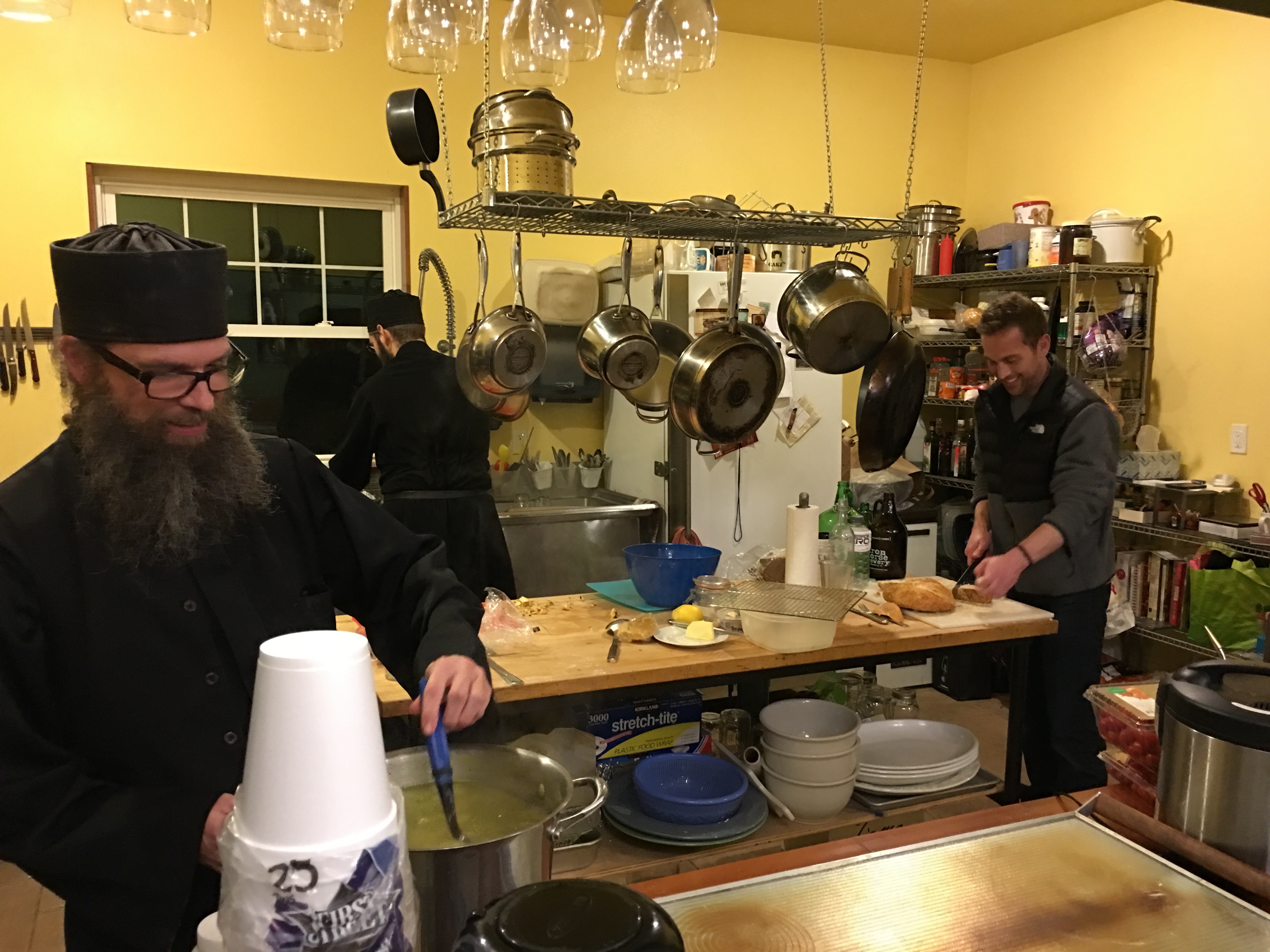
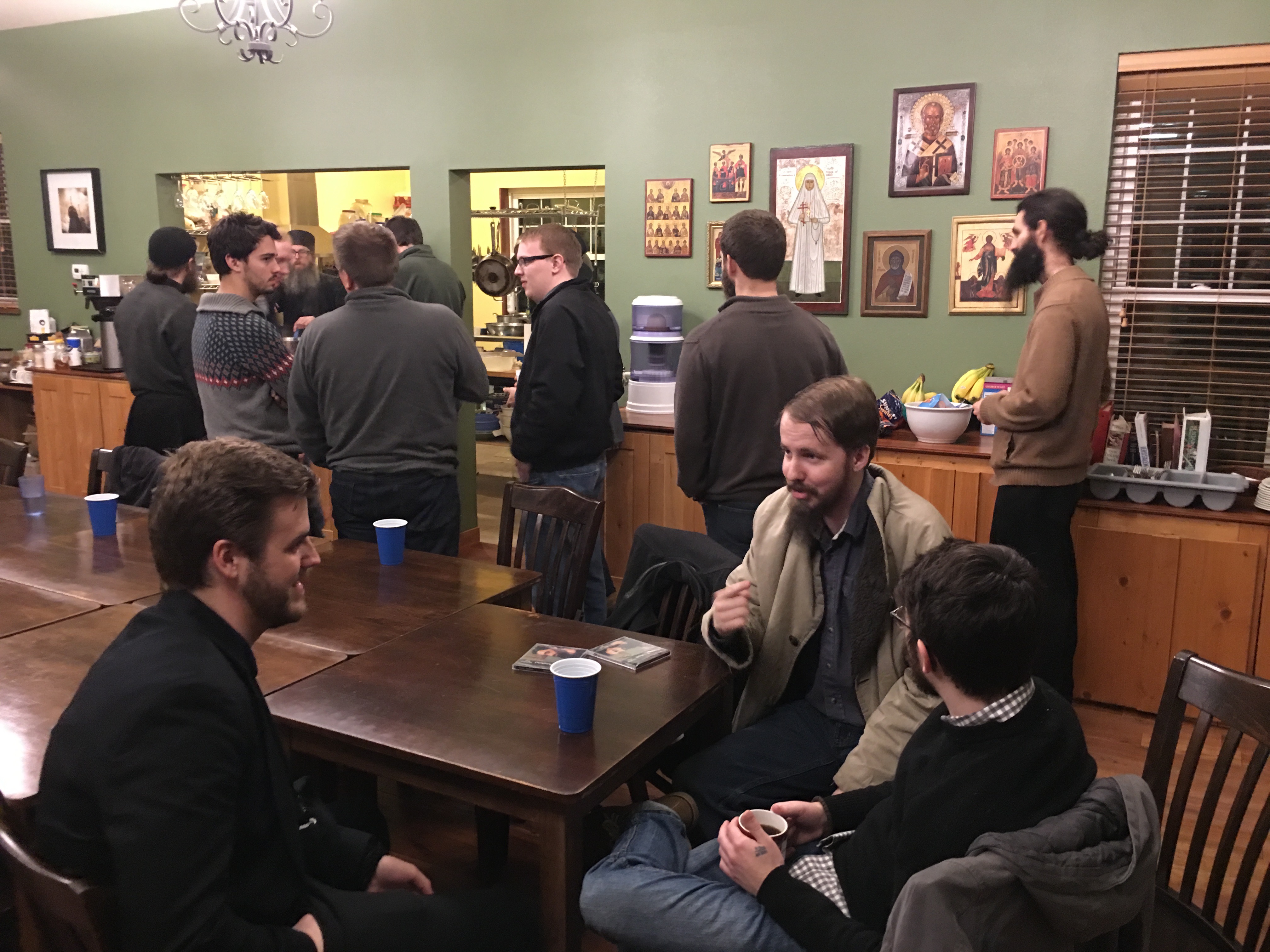
Photos: Orthodox Lay Brotherhood of Saint John the Wonderworker retreat at the monastery.
Sunday February 7, 2016 / January 25, 2016
36th Sunday after Pentecost. Tone three.
Holy New Martyrs and Confessors of Russia(movable holiday on the Sunday, after January 25th, Russian Orthodox Church – the Moscow Patriarchate).
St. Gregory the Theologian, archbishop of Constantinople (389).
Venerable Anatole I (Zertsalov, the “Elder”) of Optina (1894).
New Hieromartyr Vladimir, metropolitan of Kiev, proto-martyr of the communist yoke in Russia (1918).
New Martyr Abbess Margaret (Gunaronulo) of Menzelino (1918).
New Hieromartyr Peter archbishop of Voronezh (1929).
New Hieromartyr Basil bishop of Priluksk. 1930).
New Martyr Abbess Athanasia (Lepeshkin) of Zosima Hermitage (1931).
St. Stephen priest, martyr Boris (1938).
St. Moses, archbishop of Novgorod (1362).
Martyrs Felicitas of Rome and seven sons: Januarius, Felix, Philip, Silvanus, Alexander, Vitalis, and Martial (164).
Venerable Publius, ascetic of Syria (380).
Venerable Mares the Singer of Syria (430).
Icons of the Most Holy Theotokos “Assuage My Sorrow”and “Unexpected Joy.”.
New Martyr Auxentius of Constantinople (1720) (Greek).
Martyr Medula and her companions (Greek).
St. Castinus, bishop of Byzantium (240) (Greek).
Venerable Demetrius Skevophylax (“Keeper of the Sacred Vessels”) of Constantinople (8th c.) (Greek).
Venerable Apollo of the Thebaid, monk (4th c.) (Greek).
St. Bretanion (Vetranion), bishop of Tomis (380) (Romania).
St. Gregory of Golutvin (15th c.).
St. Dwyn, virin of Llandwyn.
Scripture Readings
1 Timothy 1:15-17
15 This is a faithful saying and worthy of all acceptance, that Christ Jesus came into the world to save sinners, of whom I am chief. 16 However, for this reason I obtained mercy, that in me first Jesus Christ might show all longsuffering, as a pattern to those who are going to believe on Him for everlasting life. 17 Now to the King eternal, immortal, invisible, to God who alone is wise, be honor and glory forever and ever. Amen.
Luke 18:35-43
A Blind Man Receives His Sight
35 Then it happened, as He was coming near Jericho, that a certain blind man sat by the road begging. 36 And hearing a multitude passing by, he asked what it meant. 37 So they told him that Jesus of Nazareth was passing by. 38 And he cried out, saying, “Jesus, Son of David, have mercy on me!”
39 Then those who went before warned him that he should be quiet; but he cried out all the more, “Son of David, have mercy on me!”
40 So Jesus stood still and commanded him to be brought to Him. And when he had come near, He asked him, 41 saying, “What do you want Me to do for you?”
He said, “Lord, that I may receive my sight.”
42 Then Jesus said to him, “Receive your sight; your faith has made you well.” 43 And immediately he received his sight, and followed Him, glorifying God. And all the people, when they saw it, gave praise to God.
Thank you Father!
It appears that Saturday’s scripture reads and notes where mistakenly attached to today’s reading, please double check my assumption.
I truly enjoy reading your writings. Reading the morning offering has become my spiritual cup of coffee to get me up and going in to right direction each morning. Thank you so much for all your hard work and devotion. God Bless
Thank you, Matthew, for calling attention to my oversight. Corrections have been made!
Thank you Father!
As always, thank you, father, for your wisdom. I look forward to reading The Morning Offering daily. You are always in my prayers. Again, thank you exceedingly for sharing your wisdom and truths. You are an immense blessing!
As a part time history teacher, I have had the opportunity to realize throughout human history there have been eras in which things kind of “reset” themselves. Humanity launches off on a “immoral rant” only to have nature and historical events, intended or unintended, serve to do the “reseting.” These seem like mini-apocalypses. Take for, example, the Babylonian exile and the fall of the Roman Empire.
I wonder if we are in the midst of such a “reset” or on the verge of one in light of humanity’s current multifaceted and global “immoral rant.” Perhaps the days of the domestic church and Lincoln logs on the living room floor are not over forever. God does have a way of regularly “reseting” us through the use of history — natural and human.
How may I get to see the list of Saints for Feb. 7th? I always copy them, day by day, and would very much like to have the full list.
Thank you very much for your kind attention.
I apologize for having posted the wrong saints for the day. I’ve been so exhausted, what with the young men’s retreat, and a host of other duties, I didn’t notice I’d made a mistake. Thanks for letting me know, Kenneth! The correction has been made.
Many thanks, and may you be able to get rested up.
It looks like the lay brotherhood is composed of decent men and I hope it continues to grow, and always with members who have promise & integrity.