The Church must incarnate people, not ideas or beliefs
According to the Metropolitan of Thessaloniki, John Zizioulas, if the Church is truly the Church, she must incarnate Christ and manifest the Kingdom in a particular place, and as a local event. The Church, thus, “must incarnate people, not ideas or beliefs”.
Since God the Father has freely willed His communion with the Son, Whom He has begotten, and has brought forth the Spirit, He is person. It is because of this truth that we must address ourselves as persons, as this theological concept, found only in Christianity, calls us into a loving and personal relationship with our Creator, as co-creators. This personal relationship into which we’ve been invited by our loving and merciful God, Who walks among us, by extension, works mercy and love through us.
Because Christianity is the only religion that teaches God has come to dwell among us, we are called by His Holy Incarnation, to be agents of His incarnation. We are called to heal the sick, visit the imprisoned, defend the poor and homeless, preach the Gospel to all nations, and serve as peacemakers. We are called to be merciful, and to be quick to forgive. We are called to lay down our lives for others, and incarnate the mercy and love of our God, in every action, and in every place.
Because forgiveness and compassion have everything to do with the incarnation, the truth of just who God is, calls for us to reveal the love and mercy of our Co-Suffering Saviour, Jesus Christ Himself, who incarnated in our midst. Being saved by beliefs and ideas of the mind does not save us, and is not what expresses our Christian faith. It is about the soul and being of the Person with whom we are encountering. How do we become whole and healed? By our encounter with the loving Lord Who has come into our midst, and “walks among us”.
With love in Christ,
Abbot Tryphon
Thursday December 10, 2015 / November 27, 2015
28th Week after Pentecost. Tone two.
Nativity (St. Philip’s Fast). Fish Allowed
Icon of the Most Holy Theotokos named “Znamenie”.
Commemoration of the miracle of the Weeping Icon of the Most Holy Theotokos “Of the Sign” at Novgorod in 1170.
Great-martyr James the Persian (421).
Venerable Palladius of Thessalonica (6th-7th c.).
St. James, bishop and wonderworker of Rostov (1392).
Uncovering of the relics (1192) of St. Vsevolod (Gabriel), prince and wonderworker of Pskov (1138).
Blessed Andrew of Symbirsk (1841).
New Hieromartyrs Nicholas archbishop of Vladimir, Basil, Boris, Theodore, Nicholas, Alexis, John, Sergius, John, Sergius, Nicholas priests, New Hieromartyrs Ioasaf, Cronides, Nicholas, Xenophon, Alexis, Appolos, Seraphim, Nicholas and Martyr John (1937).
17 Monk-martyrs in India (4th c.).
Venerable Romanus the Wonderworker of Cilicia (5th c.).
Znamenie-Sign Icons of the Mother of God: “Kursk-Root” (1295), “Abalatsk” (1637), “Tsarskotsel’sk” and “Seraphimo-Ponetaevsk” (1879), Verkhnetagilsk (1753) and named “Korchemnaia” (18 c.).
Venerable Pinuphrius of Egypt (4th c.).
Venerable Nathaniel of Nitria (6th c.).
Venerable Diodorus of George Hill (Solovki) (1633).
St. Maximus of Riez (460).
Venerable Theodosius of Trnovo (1363).
St. Virgil, bishop of Salzburg (748).
St. Congar, bishop of Somerset.
St. Fergus, bishop of Glamis.
Scripture Readings
Titus 1:5-2:1
Qualified Elders
5 For this reason I left you in Crete, that you should set in order the things that are lacking, and appoint elders in every city as I commanded you— 6 if a man is blameless, the husband of one wife, having faithful children not accused of dissipation or insubordination. 7 For a bishop must be blameless, as a steward of God, not self-willed, not quick-tempered, not given to wine, not violent, not greedy for money, 8 but hospitable, a lover of what is good, sober-minded, just, holy, self-controlled, 9 holding fast the faithful word as he has been taught, that he may be able, by sound doctrine, both to exhort and convict those who contradict.
The Elders’ Task
10 For there are many insubordinate, both idle talkers and deceivers, especially those of the circumcision, 11 whose mouths must be stopped, who subvert whole households, teaching things which they ought not, for the sake of dishonest gain. 12 One of them, a prophet of their own, said, “Cretans are always liars, evil beasts, lazy gluttons.” 13 This testimony is true. Therefore rebuke them sharply, that they may be sound in the faith, 14 not giving heed to Jewish fables and commandments of men who turn from the truth. 15 To the pure all things are pure, but to those who are defiled and unbelieving nothing is pure; but even their mind and conscience are defiled. 16 They profess to know God, but in works they deny Him, being abominable, disobedient, and disqualified for every good work.
Qualities of a Sound Church
2 But as for you, speak the things which are proper for sound doctrine:
Luke 18:31-34
Jesus a Third Time Predicts His Death and Resurrection
31 Then He took the twelve aside and said to them, “Behold, we are going up to Jerusalem, and all things that are written by the prophets concerning the Son of Man will be accomplished. 32 For He will be delivered to the Gentiles and will be mocked and insulted and spit upon. 33 They will scourge Him and kill Him. And the third day He will rise again.”
34 But they understood none of these things; this saying was hidden from them, and they did not know the things which were spoken.
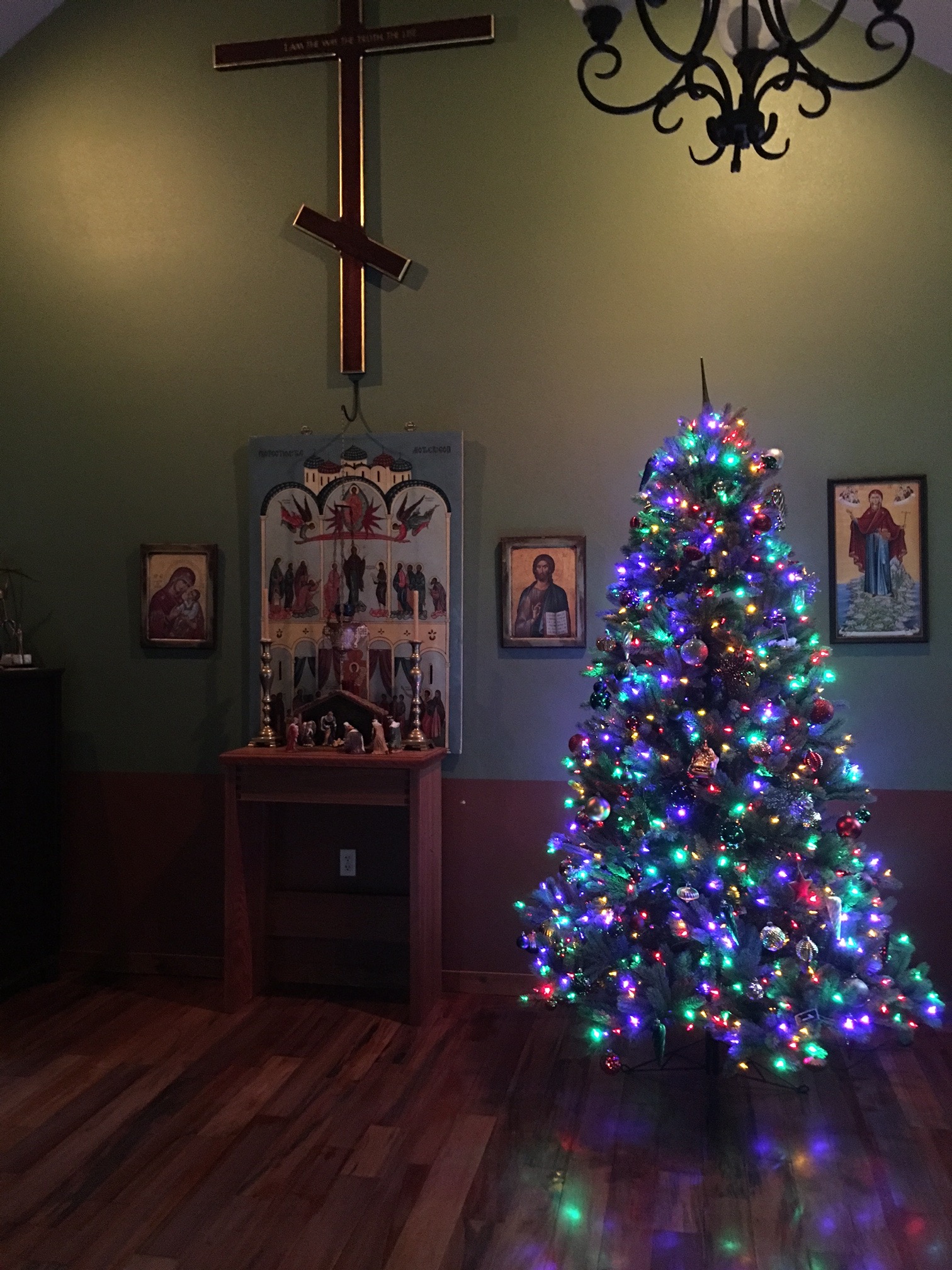
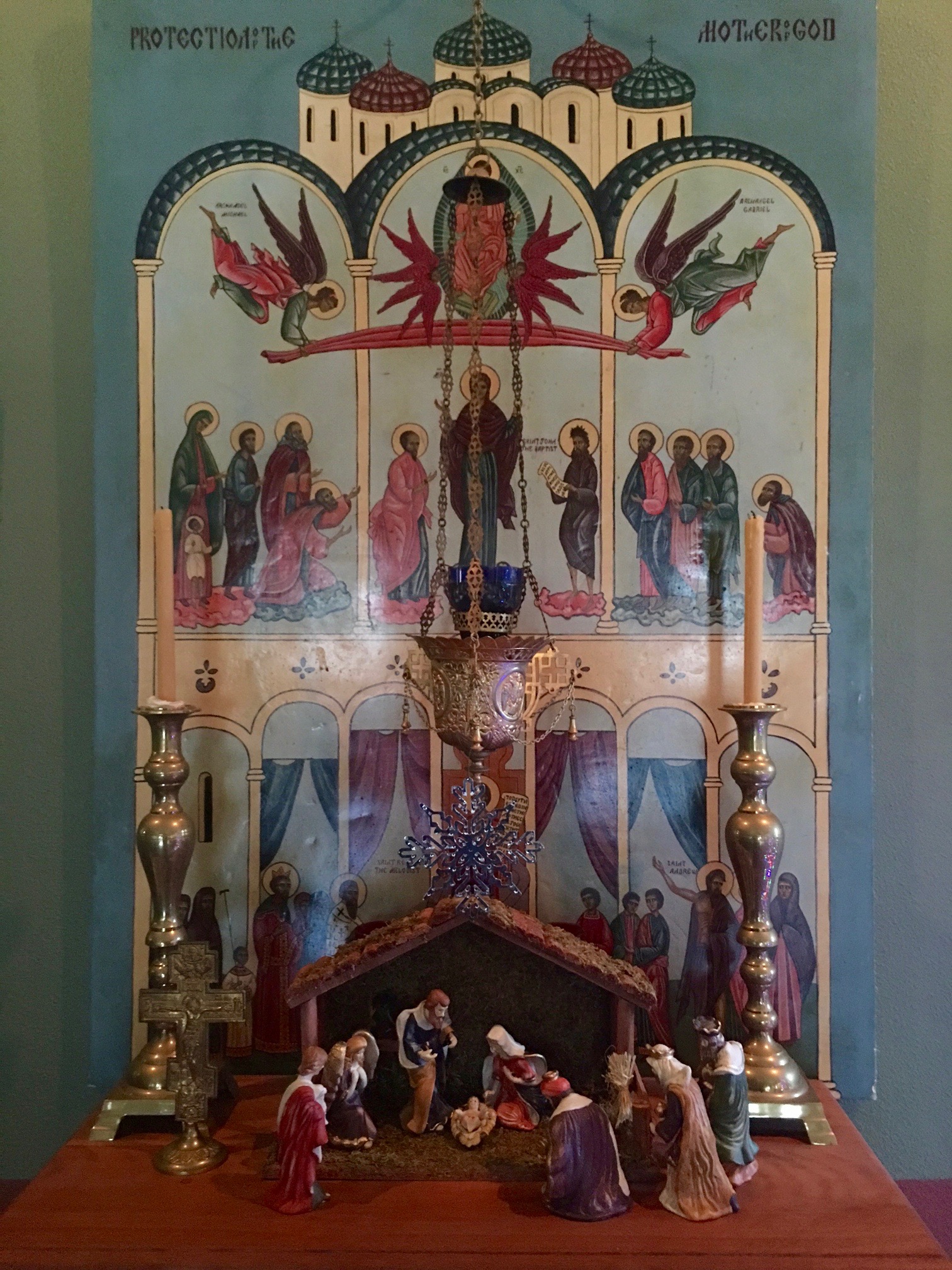
I understand the use of the Christmas tree as an icon of Christ who was the tree of life but can you explain why you have statues? I am generally curious, as I see some Orthodox use them and some don’t. Statues never developed in the East as to not be confused with pagan statue deities and using statues goes against the seventh council. Why do people use them anyway? I’m also confused why a monastery would use them as monks are suppose to be the light and living example for us in the world.
Thanks
Well, dear “Anonymous”, you’ll notice these statues are NOT in our monastery’s temple. They are in our trapeza, where we gather together for our meals, and where we share food and drink with our pilgrims. Since Christ is the Light of the World, and we are all called to shine forth this very light in how we live our lives, sharing a Nativity Scene, as well as a Christmas Tree (of German Protestant origin) in our dining room, is not the same as placing “statues” in our church, for veneration.
Oh that is right, I’ve heard about that (part about the temple l Thanks for the clarification and reminder. It is very fainating to see all the different small t traditions. Speaking of which, forgive me for my last comment about the Coptics, I’ve learned that conical Orthodox in Africa use instruments, its all just tradition.