Not only do those in heaven pray with us, they also pray for us

Most Protestant churches strongly reject all saintly intercession, citing passages such as 1 Timothy 2:1-5, which says that Jesus is the sole mediator between God and man, as well as Deuteronomy 18:10-11 which seems to forbid invoking departed souls. They also point to the fact that there are no examples in the Bible of living humans praying to dead humans — Jesus Christ being the lone exception, because He is alive and resurrected, and because He is both human and Divine.
Yet the Bible indeed directs us to invoke those in heaven and ask them to pray with us. In Psalms 103, we pray, “Bless the Lord, O you his angels, you mighty ones who do his word, hearkening to the voice of his word! Bless the Lord, all his hosts, his ministers that do his will!” (Psalms 103:20-21). And in Psalms 148 we pray, “Praise the Lord! Praise the Lord from the heavens, praise him in the heights! Praise him, all his angels, praise him, all his host!” (Psalms 148:1-2).
Not only do those in heaven pray with us, they also pray for us. In the book of Revelation, we read: “[An] angel came and stood at the altar [in heaven] with a golden censer; and he was given much incense to mingle with the prayers of all the saints upon the golden altar before the throne; and the smoke of the incense rose with the prayers of the saints from the hand of the angel before God” (Rev. 8:3-4). And those in heaven who offer to God our prayers aren’t just angels, but humans as well. John sees that “the twenty-four elders [the leaders of the people of God in heaven] fell down before the Lamb, each holding a harp, and with golden bowls full of incense, which are the prayers of the saints” (Rev. 5:8). The simple fact is, as this passage shows: The saints in heaven offer to God the prayers of the saints on earth.
Yes, we have Christ as the only intercessor before the Throne, but that never stopped any of our Protestant brethren from asked fellow believers from praying for them. We ask the friends of God to pray for us all the time, when we ask for the prayers of our friends and fellow believers. Asking those who’ve gone on before us is possible because they are alive in Christ, and offer their prayers to Christ just as do we. We all, both those in heaven and those still upon this earth, pray before the same “sole mediator between God and man”, Jesus Christ. It is Christ through whom we approach the Throne of the Father.
Finally, why would we not want to ask for the prayers of those who have already won their place in Paradise, and are already standing before the Throne of God, worshiping the Holy Trinity?
Love in Christ,
Abbot Tryphon
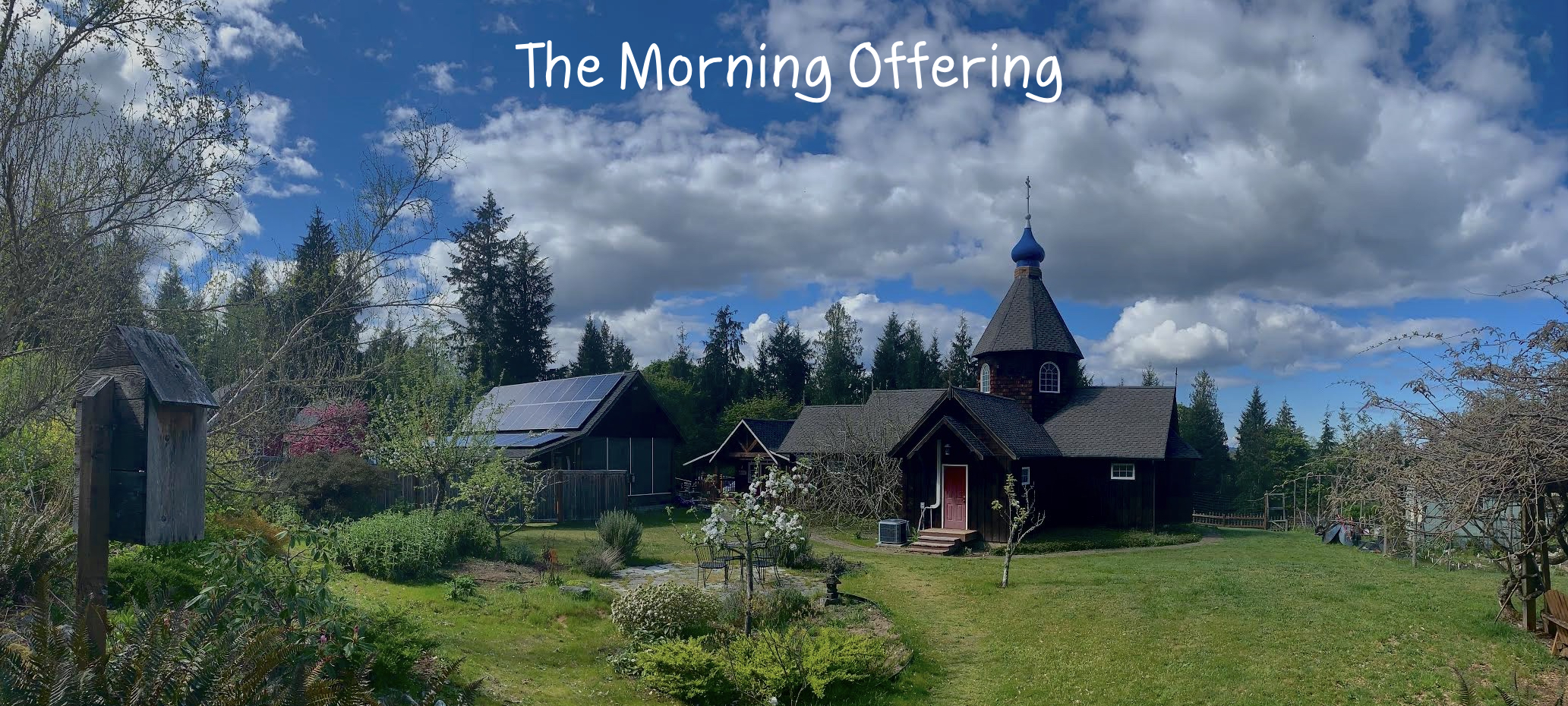
Photos: Holy Resurrection Orthodox Church in Clinton, Mississippii, where I will be presenting a PanOrthodox Women’s Retreat this weekend.

Friday October 25, 2019 / October 12, 2019
19th Week after Pentecost. Tone one.
Fast. By Monastic Charter: Strict Fast (Bread, Vegetables, Fruits)
Martyrs Probus, Tarachus, and Andronicus at Tarsus in Cilicia (304).
Venerable Cosmas the Hymnographer, bishop of Maiuma (787).
St. Euphrosyne (Mezenova) the Faster, schema-abbess of Siberia (1918).
New Hieromartyr John (1930).
New Hieromartyr John (Pommer) bishop of Riga (1934).
Venerable Laurence (1937).
New Hieromartyr Nicholas confessor mitropoliten of Alma-Ata (1955).
New Hieromartyr Alexander priest (1940).
Venerables Amphilochius (1452), Macarius, and Tarasius, abbots, and Theodosius, monk, of Glushitsa Monastery (Vologda).
Martyr Domnina of Anazarbus (286).
St. Martin the Merciful, bishop of Tours (397).
Translation from Malta to Gatchina of a part of the Life-Creating Cross of the Lord, together with the Philermia Icon of the Mother of God, and the right hand of Saint John the Baptist (1799).
“Jerusalem” (48), “Yaroslav-Smolensk” (1642), “Rudensk” (1687) and “Kaluga” (1748) Icons of the Mother of God.
St. Mobhi of Glasnevin (544) (Celtic & British).
St. Edwin, king and martyr (633) (Celtic & British).
St. Wilfrid, archbishop of York (709) (Celtic & British).
Venerable Anastasia of Rome (250) (Greek).
St. Theodotus, bishop of Ephesus (Greek).
St. Jason, bishop of Damascus (Greek).
Venerable Symeon the New Theologian (1021) (Greek).
Venerable Theosebius the God-bearer of Arsinoe in Cyprus (Greek).
Martyrs Malfethos and Anthea (Greek).
Hieromartyr Maximilian, bishop of Noricum (284).
The Scripture Readings
Philippians 1:27-2:4
Striving and Suffering for Christ
27 Only let your conduct be worthy of the gospel of Christ, so that whether I come and see you or am absent, I may hear of your affairs, that you stand fast in one spirit, with one mind striving together for the faith of the gospel, 28 and not in any way terrified by your adversaries, which is to them a proof of perdition, but to you of salvation, and that from God. 29 For to you it has been granted on behalf of Christ, not only to believe in Him, but also to suffer for His sake, 30 having the same conflict which you saw in me and now hear is in me.
Unity Through Humility
2 Therefore if there is any consolation in Christ, if any comfort of love, if any fellowship of the Spirit, if any affection and mercy, 2 fulfill my joy by being like-minded, having the same love, being of one accord, of one mind. 3 Let nothing be done through selfish ambition or conceit, but in lowliness of mind let each esteem others better than himself. 4 Let each of you look out not only for his own interests, but also for the interests of others.
Luke 9:12-18
12 When the day began to wear away, the twelve came and said to Him, “Send the multitude away, that they may go into the surrounding towns and country, and lodge and get provisions; for we are in a deserted place here.”
13 But He said to them, “You give them something to eat.”
And they said, “We have no more than five loaves and two fish, unless we go and buy food for all these people.” 14 For there were about five thousand men.
Then He said to His disciples, “Make them sit down in groups of fifty.” 15 And they did so, and made them all sit down.
16 Then He took the five loaves and the two fish, and looking up to heaven, He blessed and broke them, and gave them to the disciples to set before the multitude. 17 So they all ate and were filled, and twelve baskets of the leftover fragments were taken up by them.
Peter Confesses Jesus as the Christ
18 And it happened, as He was alone praying, that His disciples joined Him, and He asked them, saying, “Who do the crowds say that I am?”
I am happy to have Saints in my prayer life and Patron Saints for specific causes are most helpful…..
God bless!
What a confirmation!(To invoke some old Protestant lingo). Was just discussing this with my priest yesterday. A stinking point for many converting to Orthodoxy (particularly from Protestantism). Though Hebrews 12:1 is often invoked – “Therefore we also, since we are surrounded by so great a cloud of witnesses, let us lay aside every weight, and the sin which so easily ensnares us, and let us run with endurance the race that is set before us” – and is seen metaphorically outside of Orthodoxy ( and Catholicism, in which I was raised) , what I’ve heard from those trying to grasp this is “if so, HOW do the departed hear us , as they’re not omnipresent , nor omniscient”. Haven’t really found a good apologetic for it yet.
Have a blessed day, Father.
John, just to say that I always believed Saints could hear us, but with God’s permission and the same when we receive answers/blessings to our prayers. God ordains all of this and in a way and time that is good for us. The Saints intercede but I don’t think have the power or control – God does.
If I am off-track, I’m sure I will hear…..
God bless!
Thanks for the reply Maria(sorry I’m late with it!).
There are countless angels, right? They aren’t limited by distance and time. I’d say we have better network coverage than Verizon.
A good thought ,Kevin. And made me smile.
As a former protestant I can most certainly appreciate this. I am so grateful to God for having brought me to the Orthodox Church and to have discovered all the great richness and church heritage that was denied to me as a protestant. I love the saints and am thankful for their example, prayers and guidance.
Excellent blog Fr. Tryphon! I often try to show the Evangelicals that it’s not a sin to pray for those who have gone before us and that they too can pray for us. Wherever there is hope there is the Heart of Christ.
Pax et Bonum,
Your brother in Christ,
Bro. Mark
Hermits of the Holy Cross
I am happy to have a special devotion to Saint Simeon the Pillar Ascetic. While the Stylite askesis is long extinct, too radical for our weak souls today (and Simeon was the first) it never ceases to inspire. St Simeon had an absolutely bottomless submission to God’s Will. Saint Simeon IS long-suffering and mastery over logismoi. He was miraculously wise by his asceticism and helped countless people, and corrected opinions on the controversial Christology of Chalcedon, in which he is fully Orthodox. Read in his life that many visitors (whom he accepted; Stylites cannot ‘hide’ as other hermits did) wondered if he actually had a ‘bodiless nature’, so incredible was his victory over creaturely comfort and security. Yet his theosis was fully humanizing: he wept for hours when his deceased mother Saint Martha was lifted up to his Pillar, helping her soul through the toll houses.
May they all pray for us!
How could those who came this way before us not yet be there ahead of us on the path? Did the path fall away and disappear, along with our predecessors?