
And the response of authentic Christian charity
The Church, if she be authentic in her Christian witness, must grapple with the challenges of society starting from its most marginalized sector. If the Church does not teach with a loud voice that her ministry must include service to the poor and downtrodden, and that her role does not stop with her liturgical services, but begins there, she fails to be the Church. Saint John Chrysostom taught that fasting without accompanying good deeds is like a ship going from port to port without cargo. The Elder Sophrony of Essex, wrote, “A man is not saved by having once shown mercy to someone, although, if he scorns someone but once, he merits eternal fire. For ‘hungered’ and ‘thirsty’ is said not of one occasion, not of one day, but of the whole life. In the same way ‘ye gave me meat’, ‘ye gave me drink’, ‘ye clothed me’, and so on, does not indicate one incident, but a constant attitude to everyone. Our Lord Jesus Christ said that He Himself accepts such mercy from His slaves (in the person of the needy.”
Saint John Chrysostom, perhaps the greatest preacher of all time, told us, “Do you wish to honor the Body of the Savior? Do not despise it when it is naked. Do not honor it in church with silk vestments while outside it is naked and numb with cold. He who said, “This is my body,” and made it so by his word, is the same who said, ‘You saw me hungry and you gave me no food. As you did it not to the least of these, you did it not to me.’ Honor him then by sharing your property with the poor. For what God needs is not golden chalices but golden souls.”
Every community has local food banks that are in desperate need of donated food, with the numbers of the poor and homeless growing at an astounding rate. Never before has there been a time when the Church and her people have been faced with a need that offers us the chance to commit to reflection on the cultural and spiritual issues related to charity. In the face of a “contemporary culture that promotes the marginalization of those who are weak, it is increasingly necessary to restore the centrality in the lives of Christians, of the encounter with the poor and their questions, especially in the context of uncertainty produced by the complexity and uncertainty of the globalized world (Moscow Patriarchate)”.
“Our church walls sparkle with gold, which also glitters upon our ceilings-while the capitals of our pillars are lavishly decorated. The holy vessels are beaten out of costly elements and precious stones. Yet Christ is dying at our doors in the person of His poor, naked and hungry (St Jerome).”
“At the Last Judgement I will not be asked whether I satisfactorily practiced asceticism, nor how many bows I have made before the divine altar. I will be asked whether I fed the hungry, clothed the naked, visited the sick, and the prisoner in his jail. That is all I will be asked (Saint Maria of Paris).”
With love in Christ,
Abbot Tryphon
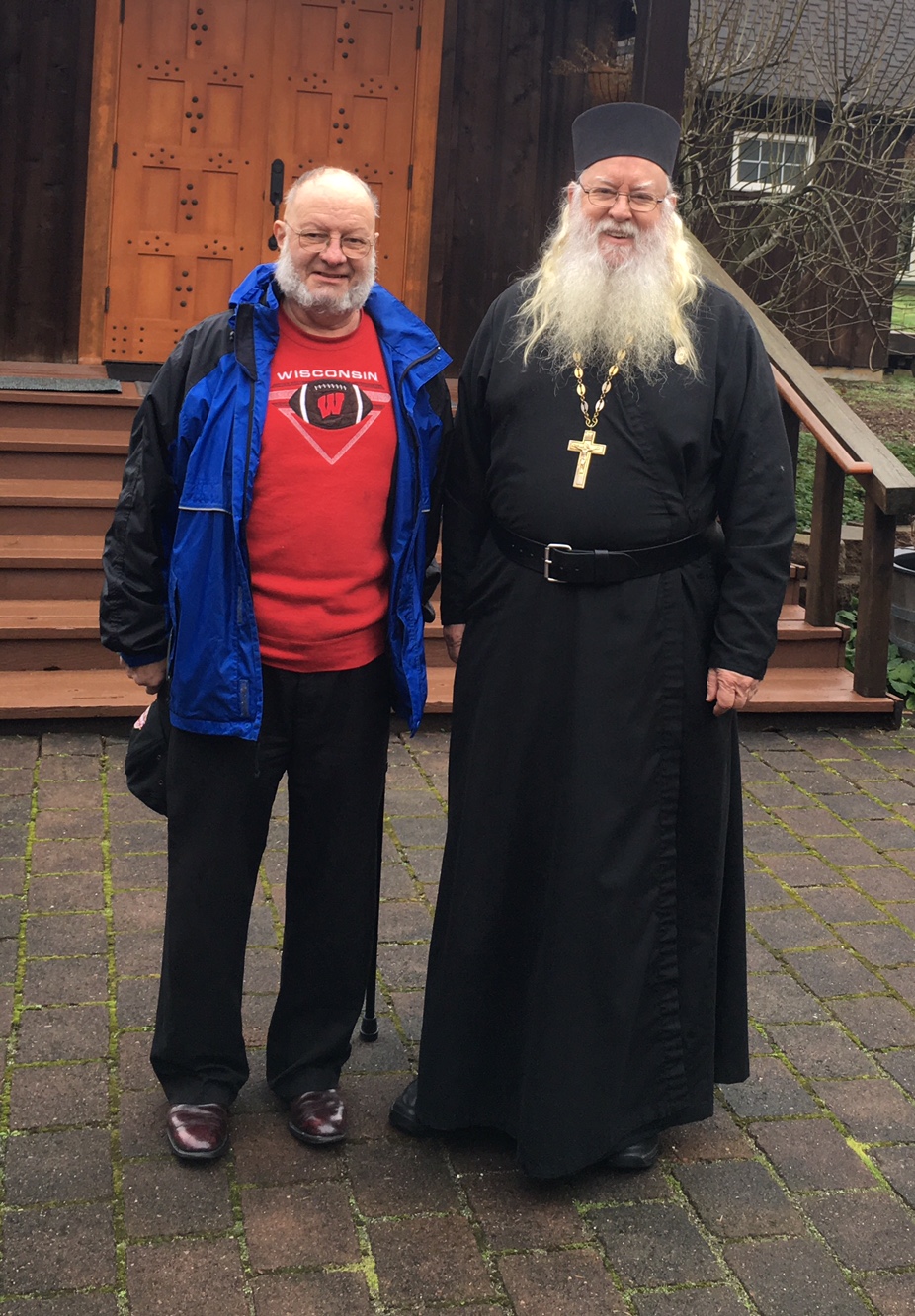
Photo: Rev. Paul Ivaska, former minister of Vashon Island’s Bethel Evangelical Free Church, visited with Abbot Tryphon on Saturday. Pastor Ivaska is one of the most humble, kind, and Christ loving clergy I’ve known, and I am grateful for his continued friendship.
Monday December 28, 2015 / December 15, 2015
31st Week after Pentecost. Tone five.
Nativity (St. Philip’s Fast). Fish Allowed
Hieromartyr Eleutherius, bishop of Illyria, and his mother, Martyr Anthia and Martyr Corivus the Eparch (126).
Venerable Paul of Mt. Latros (956).
St. Stephen the Confessor, archbishop of Surozh in the Crimea (790).
Synaxis of All Saints of Crimea.
New Russian Hieromartyrs Joseph, metropolitan of Petrograd (1938), Hilarion (Troitsky), bishop of Verey (1929); Virgin-martyr Victorina (Diobronravova).
New Hieromartyrs Alexander, Basil, Victorinus priests (1937).
Venerable Tryphon, of Pechenga or Kola (1583), and his martyred disciple Venerable Jonah.
Synaxis of All Saints of Kolsk.
Martyr Eleutherius at Constantinople (4th c.).
Venerable Pardus, hermit of Palestine (6th c.).
Monk-martyr Bacchus of Mar Saba (8th c.).
Martyr Susanna the Deaconess of Palestine (4th c.).
Venerable Nektarius of Bitel’sk (1500).
St. Aubertus, bishop (668) (Neth.).
Scripture Readings
Hebrews 11:17-23
The Faith of the Patriarchs
17 By faith Abraham, when he was tested, offered up Isaac, and he who had received the promises offered up his only begotten son, 18 of whom it was said, “In Isaac your seed shall be called,”19 concluding that God was able to raise him up, even from the dead, from which he also received him in a figurative sense.
20 By faith Isaac blessed Jacob and Esau concerning things to come.
21 By faith Jacob, when he was dying, blessed each of the sons of Joseph, and worshiped, leaningon the top of his staff.
22 By faith Joseph, when he was dying, made mention of the departure of the children of Israel, and gave instructions concerning his bones.
The Faith of Moses
23 By faith Moses, when he was born, was hidden three months by his parents, because they saw he was a beautiful child; and they were not afraid of the king’s command.
Hebrews 11:27-31
27 By faith he forsook Egypt, not fearing the wrath of the king; for he endured as seeing Him who is invisible. 28 By faith he kept the Passover and the sprinkling of blood, lest he who destroyed the firstborn should touch them.
29 By faith they passed through the Red Sea as by dry land, whereas the Egyptians, attempting to do so, were drowned.
By Faith They Overcame
30 By faith the walls of Jericho fell down after they were encircled for seven days. 31 By faith the harlot Rahab did not perish with those who did not believe, when she had received the spies with peace.
Mark 8:11-21
The Pharisees Seek a Sign
11 Then the Pharisees came out and began to dispute with Him, seeking from Him a sign from heaven, testing Him. 12 But He sighed deeply in His spirit, and said, “Why does this generation seek a sign? Assuredly, I say to you, no sign shall be given to this generation.”
Beware of the Leaven of the Pharisees and Herod
13 And He left them, and getting into the boat again, departed to the other side. 14 Now the disciples[a] had forgotten to take bread, and they did not have more than one loaf with them in the boat. 15 Then He charged them, saying, “Take heed, beware of the leaven of the Pharisees and the leaven of Herod.”
16 And they reasoned among themselves, saying, “It is because we have no bread.”
17 But Jesus, being aware of it, said to them, “Why do you reason because you have no bread? Do you not yet perceive nor understand? Is your heart still[b] hardened? 18 Having eyes, do you not see? And having ears, do you not hear? And do you not remember? 19 When I broke the five loaves for the five thousand, how many baskets full of fragments did you take up?”
They said to Him, “Twelve.”
20 “Also, when I broke the seven for the four thousand, how many large baskets full of fragments did you take up?”
And they said, “Seven.”
21 So He said to them, “How is it you do not understand?
Thank you
I am so glad I found this site
I so look forward to reading from it at the beginning of my day
Thank you again
Thank you for the comments on “Poor and Hungry.” I have been active in a prison ministry at a high security prison for several years, and have been blessed beyond my wildest dreams. One of my fellow volunteers once said, “I go to church on Sunday morning to worship God, and I come to prison Sunday night to meet Jesus face to face.”
As a volunteer Orthodox prison chaplain for eight years (fourteen years ago), I know of what you speak!