Darkness does not exist in its own right

Our Orthodox Christian theology views evil not as a primeval essence that is co-eternal and equal to God, but rather a falling away from good. Evil does not exist in and of itself, and was not created by God. Our Orthodox Church rejects the Gnostic teaching that the entirety of being is made up of two realms which have forever existed together: the kingdom of light, and the kingdom of darkness.
This darkness does not exist in its own right, but is simply the absence or lack of light. Evil, according to Saint Basil the Great, ‘is not a living and animated substance, but a condition of the soul which is opposed to virtue and which springs up in the slothful because of their falling away from Good. Do not, therefore, contemplate evil from without; and do not imagine some original nature of wickedness, but let each one recognize himself as the first author of the vice that is in him’.
Nothing is greater than God, including evil, and evil results when the free will of God’s creation is directed against God and thereby engendering evil. This is precisely what happened when the light-bearing morning star (Lucifer), fell away from the Source of goodness, and became the evil one, Satan. Lucifer, by imposing his own will, found himself in darkness. Since his power is based in falsehood, he can only influence us by convincing people that he is as powerful as God. Yet his power is finite, and good will eventually triumph on the Last Day.
That God would allow evil to exist in the first place, is a mystery, for the scriptures do not explain this. Yet we do know through the scriptures that true love must express itself in action, and in the face of evil and suffering, a Christian is called to action by loving God and his neighbor. Evil then becomes but a simple practical problem, one that the Christian finds ways to alleviate. As Christians we are charged with bringing God’s love and goodness into the world by our actions.
Saint Anthony of Egypt, said, “The devil is afraid of us when we pray and make sacrifices. He is also afraid when we are humble and good. He is especially afraid when we love Jesus very much. He runs away when we make the Sign of the Cross.”
With love in Christ,
Abbot Tryphon
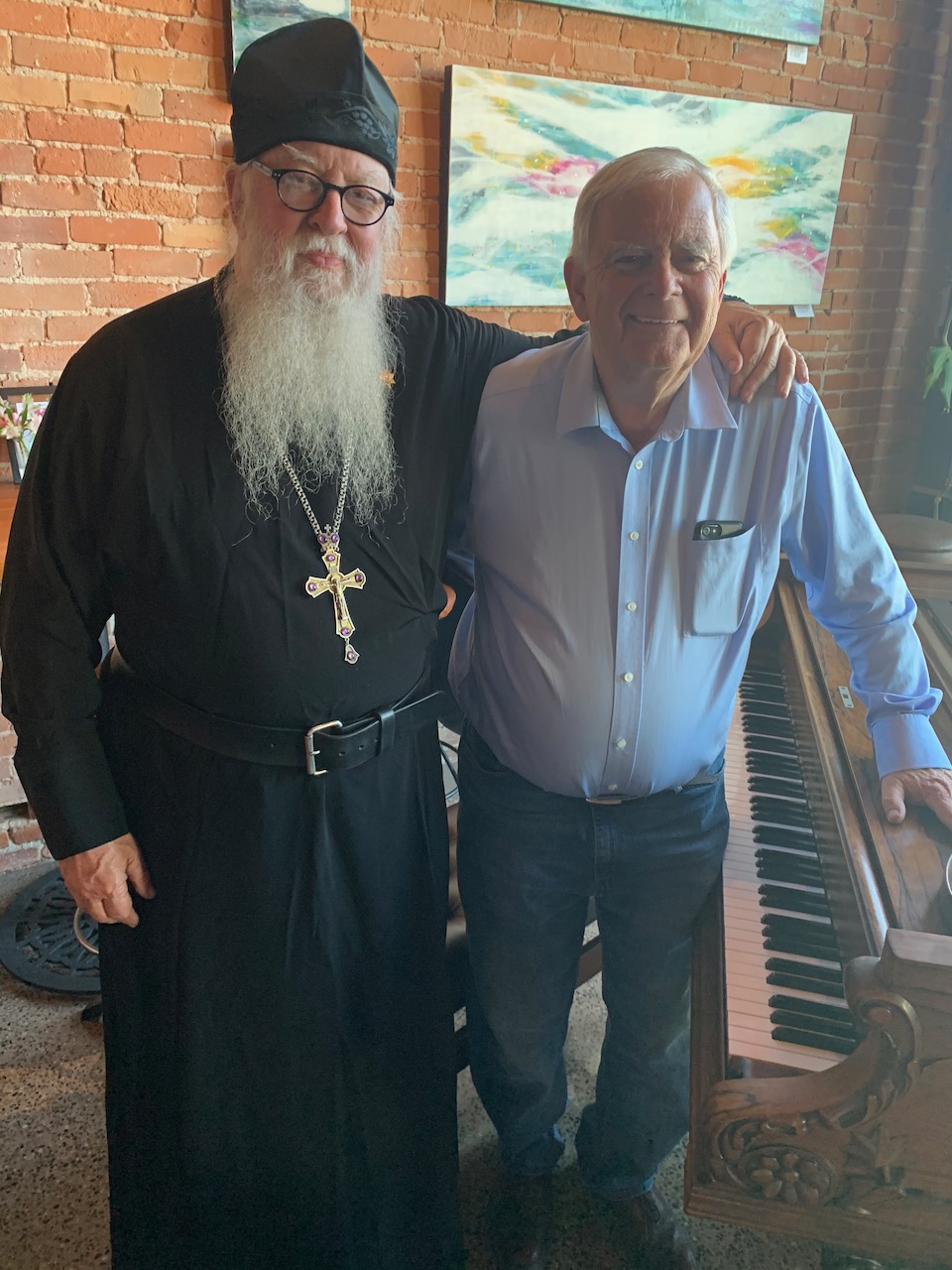
Photos: View of Lake Pend d’Oreille in Northern Idaho, where I was raised. Spent a few days with my younger brother, Dwayne Parsons and his wife Claudia, and attended a piano concert performed by Dwayne.
Thanks are in order to the generous individuals who funded our new air conditioner. We can now serve without feeling like we are in an oven. Thanks so very much!


Tuesday August 25, 2020 / August 12, 202012th Week after Pentecost. Tone two.
Dormition (Theotokos) Fast. By Monastic Charter: Food without Oil
Martyrs Anicetus and Photius (Photinus) of Nicomedia (305).
New Hieromartyrs Barlaam abbot of Belogor St. Nicholas monastery and brotherhood: hieromonks Sergius, Ilia, Viacheslav, Iosaph, John, Anoty, hierodeacons Mikhey, Bessarion, Mathew, Euphemia, monks Barnabas, Demetrius, Sabbas, Hermogenus, Arcadius, Euphemia, btothers John, Jacob, Peter, another Jacob, Alexander, Theodore, another Peter, Sergius, Alexis (1918).
New Hieromartyr Basil priest (1918).
New Hieromartyrs Leonidas, John and Nicholas priests (1937).
Hieromartyr Alexander, bishop of Comana (3rd c.).
Martyrs Pamphilus and Capito.
Venerable Pallamon of Egypt, instructor of St. Pachomius the Great.
St. Muredach (Murtagh), first bishop of Killala and founder of Innismurray (Ireland) (6th c.) (Celtic & British).
St. Molaise of Devenish (563) (Celtic & British).
St. Seigine, abbot of Iona (652) (Celtic & British).
Sts. Sergius and Stephen, monks (Greek).
Soldier-martyrs of Crete (Greek).
Monk-martyrs Gerontius, Serapion, Germanus, Bessarion, Michael, and Simeon of Garesja, slain by the Lekians (1851) (Georgia).
Translation of relics of St. Edwold, hermit of Cerne.
St. Jambert, archbishop of Canterbury (Celtic & British).
The Scripture Readings
2 Corinthians 5:15-21
15 and He died for all, that those who live should live no longer for themselves, but for Him who died for them and rose again.
16 Therefore, from now on, we regard no one according to the flesh. Even though we have known Christ according to the flesh, yet now we know Him thus no longer. 17 Therefore, if anyone is in Christ, he is a new creation; old things have passed away; behold, all things have become new. 18 Now all things are of God, who has reconciled us to Himself through Jesus Christ, and has given us the ministry of reconciliation, 19 that is, that God was in Christ reconciling the world to Himself, not imputing their trespasses to them, and has committed to us the word of reconciliation.
20 Now then, we are ambassadors for Christ, as though God were pleading through us: we implore you on Christ’s behalf, be reconciled to God. 21 For He made Him who knew no sin to be sin for us, that we might become the righteousness of God in Him.
Mark 1:16-22
Four Fishermen Called as Disciples
16 And as He walked by the Sea of Galilee, He saw Simon and Andrew his brother casting a net into the sea; for they were fishermen. 17 Then Jesus said to them, “Follow Me, and I will make you become fishers of men.” 18 They immediately left their nets and followed Him.
19 When He had gone a little farther from there, He saw James the son of Zebedee, and John his brother, who also were in the boat mending their nets. 20 And immediately He called them, and they left their father Zebedee in the boat with the hired servants, and went after Him.
Jesus Casts Out an Unclean Spirit
21 Then they went into Capernaum, and immediately on the Sabbath He entered the synagogue and taught. 22 And they were astonished at His teaching, for He taught them as one having authority, and not as the scribes.
What a calming ,idyllic scene by the lake. You were truly blest to grow up in such a region.
Blest day Father
I believe it is explained why God allows evil. It’s rather simple: free will. God’s love is also the kind that chastens, since he leaves us to our own sinful devices at times, according to our fallen wills, in order to guide us toward repentance having experienced sin and its poisonous fruits. The parable of the prodigal son explains this implicitly.
Excellent break down of God’s loving nature and provision of free will. He doesn’t send anyone to hell, but many will choose that destination. The allowance of evil to begin with is perhaps what trips many of us up, but that is indeed a mystery. As the scripture says, “Who can know the mind of God?” I wish every Calvinist could read this!
Yes, evil is the turning away from God who is always the same unchanging – it is WE who change and leave the presence of God.
Lord have mercy upon us all!
Thank you Father! You have been such a blessing to me.