Prayer is not about asking for things, but about our relationship with God

Over the years, as strange as it may seem, we’ve had a number of people ask us if we’d pray they win the lottery, promising that if they did they’d donate a large portion to the brotherhood. The logic seemed to suggest that if the monks were going to get some of the take, the Lord would be more than happy to tweak the State Lottery numbers so they’d win big. Upon hearing this, I’ve often thought the poor person would more than likely lose their soul, should they win, with temptation likely to make them forget their promise to God. When large sums of money are in one’s hands, it takes a person with a very strong will to be philanthropic with their fortune. Most of us are better off without a lot of money, as news items in recent years have given us ample examples of people who’s greed has been their ruin.
I once prayed I’d get a certain job, thinking all my problems would be solved if only I had that job. If I had that job, I told myself, I could get a better apartment, a new car, pay off my bills, and be set. When the job didn’t materialize, I ended up going off to graduate school, a decision that was ultimately the very best thing I could have done for myself. That job could well have derailed God’s plans for me, which is often the case when we push for our own will, while praying, rather than humbly seeking out God’s will.
The Scriptures instruct us as to how we should pray. In Acts 17:27-28, we read: “so that they should seek the Lord, in the hope that they might grope for Him and find Him, though He is not far from each one of us; for in Him we live and move and have our being, as also some of your own poets have said, ‘For we are also His offspring’.”
Prayer is not about asking for things, but about relationship. Prayer is the vehicle that takes us into the heart of God, where we find ‘a peace that passes all understanding’ (Philippians 4:7). Prayer is our opportunity to come before God with reverence and humility, seeking the transformation of the heart that is our true inheritance. Prayer is that opportunity for us to show our love for God because of His great love for us. Prayer is not about asking for things, but rather seeking to deepen our relationship with the God Who has invited us into communion with Him.
An infant in the care of loving parents need not worry about food, clothing, security, safety, for his parents know what he needs, and freely give it in abundance. The Lord is like that with us. We may think we know what we need, but like the small child who thinks he doesn’t need to go to school, and who’s parents make sure he does, God gives us that which is needed for our salvation.
If we trust the love that God has for us, we trust that we need not ask for anything, but only offer worship and love, and give ourselves over to our Heavenly Father. Like any child loved by his parents, we are assured of the love of the Father. Nothing else matters.
With love in Christ,
Abbot Tryphon
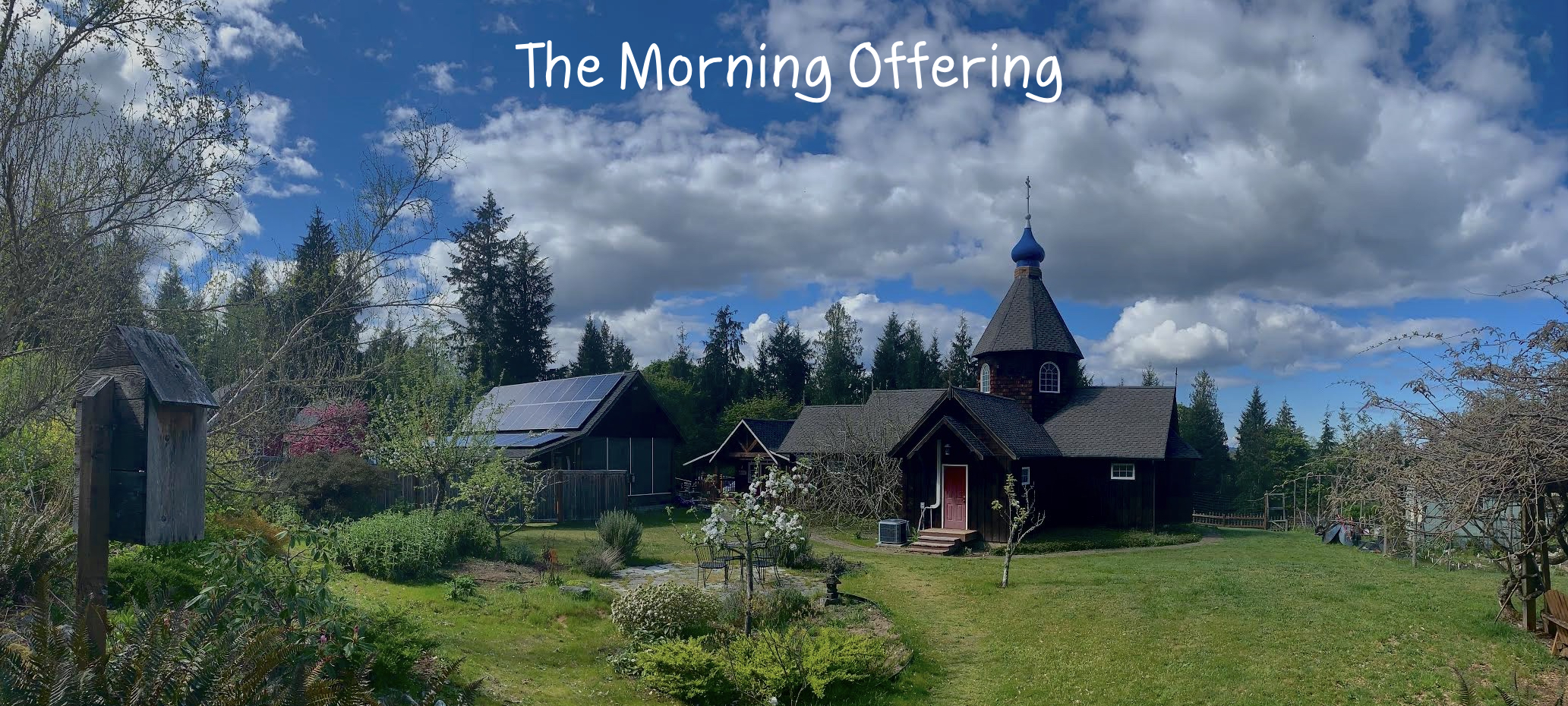
Photo: We were blessed to have had Hieromonk Andrew, a Romanian priestmonk temporarily serving at a parish in Seattle, visit the monastery on Saturday.

Monday June 25, 2018 / June 12, 2018
5th Week after Pentecost. Tone three.
Apostles’ (Peter & Paul) Fast. By Monastic Charter: Strict Fast (Bread, Vegetables, Fruits)
Venerable Onuphrius the Great (400).
Venerable Peter of Mt. Athos (734).
Opening of the relics (1650) of St. Anna of Kashin (1338).
Venerable Arsenius, abbot of Konevits (1447).
Venerable Onuphrius, abbot of Malsk (Pskov) (1492).
Venerables Bassian and Jonah, monks, of Petroma (Solovki) (1561).
Venerables Onuphrius and Auxentius, monks, of Vologda (1521).
Venerable Stephen of Komel, abbot of Ozersk Monastery, Vologda (1542).
Venerables John, Andrew, Heraclemon, and Theophilus, hermits of Egypt (4th c.).
St. John the Soldier of Egypt (6th-7th c.).
Venerable Onuphrius, abbot of Katrom Monastery (Vologda) (16th c.).
St. Julian of Dagouta at Constantinople (Greek).
New Martyrs Onuphrius, bishop (1938), and with him: Anthony, Barsanuphius and Joseph (1937), and bishop Alexander Kharkovsky.
St. Olympius, bishop and confessor who suffered in Thrace (4th c.).
St. Timothy the Hermit of Egypt (4th c.).
St. Cunera, virgin-martyr of Rhenen (451) (Neth.).
Venerable John (Tornike) of Mt. Athos (998) (Georgia).
Finding of the relics (1672) of St. John of Moscow, fool-for-Christ (1589).
Synaxis of All Saints of St. Onuphrius Monastery at Jablechna (Poland).
Miracle-working icons of the Theotokos (14th c.) and St. Onuphrius (14th c.) at St. Onuphrius Monastery (Poland).

The raising of the Byzantine flag, in imitation of the Holy Mountain of Athos.
The Scripture Readings
Romans 12:4-5
4 For as we have many members in one body, but all the members do not have the same function, 5 so we, being many, are one body in Christ, and individually members of one another.
Romans 12:15-21
15 Rejoice with those who rejoice, and weep with those who weep. 16 Be of the same mind toward one another. Do not set your mind on high things, but associate with the humble. Do not be wise in your own opinion.
17 Repay no one evil for evil. Have regard for good things in the sight of all men. 18 If it is possible, as much as depends on you, live peaceably with all men. 19 Beloved, do not avenge yourselves, but rather give place to wrath; for it is written, “Vengeance is Mine, I will repay,” says the Lord. 20 Therefore
“If your enemy is hungry, feed him;
If he is thirsty, give him a drink;
For in so doing you will heap coals of fire on his head.”
21 Do not be overcome by evil, but overcome evil with good.
Matthew 12:9-13
Healing on the Sabbath
9 Now when He had departed from there, He went into their synagogue. 10 And behold, there was a man who had a withered hand. And they asked Him, saying, “Is it lawful to heal on the Sabbath?”—that they might accuse Him.
11 Then He said to them, “What man is there among you who has one sheep, and if it falls into a pit on the Sabbath, will not lay hold of it and lift it out? 12 Of how much more value then is a man than a sheep? Therefore it is lawful to do good on the Sabbath.” 13 Then He said to the man, “Stretch out your hand.” And he stretched it out, and it was restored as whole as the other.
I agree that prayer is about communion with God and not about asking for things but what is your take on james 4 “you have not because you ask not” and Philippians 4 ” Be anxious for nothing, but in everything by prayer and supplication, with thanksgiving, let your requests be made known to God; and the peace of God, which surpasses all understanding, will guard your hearts and minds through Christ Jesus.”
Also, in the gospels jesus sleeps while the deciples struggle in the storm. It isnt until they ask that they find relief.
Any insight would be greatly appreciated. Thank you Father.
Father, bless. Thank you for the post and the analogy of a parent and his or her child. As parents, and like our own loving parents, my wife and I gladly gave to our children anything they needed – and when they were young my wife and I knew better than they what they needed (or did not need). We expected nothing in return but held a hope that we would form a joyful loving relationship with our children and – Glory to God! – it has been realized. Using your analogy I have a different perspective about prayer – and time will tell – will develop a better relationship with Our Lord.